Scope 3 emissions explained: the 15 categories, supplier data and what Malaysian SMEs should prepare
Scope 3 emissions are all the indirect greenhouse gas emissions in a company's value chain, outside its own operations and purchased energy, grouped by the GHG Protocol into 15 categories. Malaysian listed companies get temporary relief from reporting them under the NSRF, so many are now asking their suppliers for emissions data in preparation.

Scope 1, 2 and 3 in plain terms
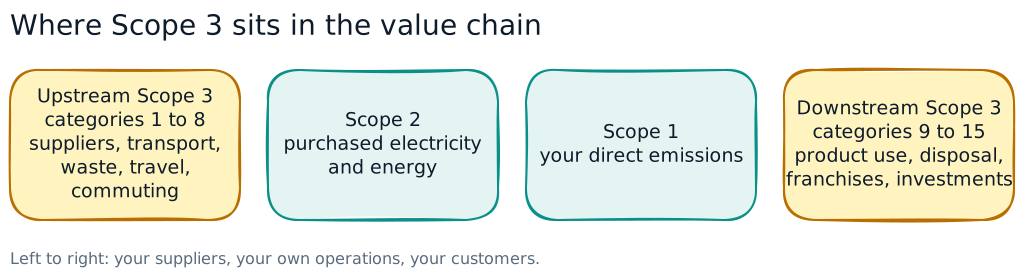
The GHG Protocol, the most widely used greenhouse gas accounting standard and the basis for IFRS S2, sorts a company's emissions into three scopes:
- Scope 1: direct emissions from sources the company owns or controls, such as boilers, company vehicles, generators and process emissions.
- Scope 2: indirect emissions from the electricity, steam, heat or cooling the company buys.
- Scope 3: all other indirect emissions in the value chain, upstream from suppliers and downstream from customers using and disposing of the products.
For many companies Scope 3 is the largest share, especially for manufacturers, retailers, banks and property developers, because most of their footprint sits in what they buy and sell. It is also the hardest to measure, because the data belongs to other companies. That is why reporting rules give extra time for it and why supplier data requests are growing.
The Climate & GHG Emissions lesson walks through the three scopes in a 3D carbon management centre.
The 15 Scope 3 categories
The GHG Protocol Corporate Value Chain (Scope 3) Standard groups Scope 3 into 15 categories. Not every category applies to every company; a screening step decides which are relevant.
| # | Category | Example |
|---|---|---|
| Upstream | ||
| 1 | Purchased goods and services | Raw materials, packaging, IT and cleaning services |
| 2 | Capital goods | Machinery, vehicles, buildings bought in the year |
| 3 | Fuel- and energy-related activities | Extraction and transmission losses for fuel and power you use |
| 4 | Upstream transportation and distribution | Third-party logistics bringing goods to you |
| 5 | Waste generated in operations | Landfill, incineration, wastewater treatment |
| 6 | Business travel | Flights, hotels, rental cars |
| 7 | Employee commuting | Staff driving or riding to work |
| 8 | Upstream leased assets | Leased offices or warehouses not in Scope 1 and 2 |
| Downstream | ||
| 9 | Downstream transportation and distribution | Delivery to customers you do not pay for |
| 10 | Processing of sold products | A customer processing your intermediate product |
| 11 | Use of sold products | Fuel burned by vehicles or appliances you sell |
| 12 | End-of-life treatment of sold products | Disposal and recycling of your products |
| 13 | Downstream leased assets | Space you own and lease to tenants |
| 14 | Franchises | Outlets run by franchisees |
| 15 | Investments | Emissions of companies financed or invested in |
Category 15 is the big one for banks and insurers, category 11 for carmakers and appliance makers, and category 1 for most manufacturers and retailers.
Spend-based vs activity data: how Scope 3 is calculated
Every Scope 3 figure is some activity multiplied by an emission factor. The question is how good the activity data is. The GHG Protocol's calculation guidance describes several methods, from roughest to best:
- Spend-based: ringgit spent on a category multiplied by an average emission factor per ringgit for that industry. Fast, because finance already holds the data, but it rises when prices rise and falls when you negotiate a discount, so it cannot show real reductions.
- Average-data: physical quantities (tonnes of steel, kilometres trucked, kWh) multiplied by industry-average factors. Better, and you need quantities from purchasing or logistics.
- Supplier-specific: the supplier's own product-level or company-level emissions data. Most accurate, and the only method that rewards a supplier that has cut its emissions.
- Hybrid: supplier data where you have it, filled in with average or spend data for the rest.
Most companies start spend-based to find their hotspots, then move the largest categories and suppliers to activity and supplier data. Whichever method you use, record the data source, the emission factor and its year, and any assumptions, so the figure can be checked and restated if needed.
Scope 3 under Malaysia's NSRF
The National Sustainability Reporting Framework (NSRF) adopts IFRS S1 and S2, and IFRS S2 requires Scope 3 emissions. Bursa Malaysia's amended Listing Requirements, aligned with the NSRF, give transitional relief:
- Main Market issuers: for two full financial years from their start date (financial years ending on or after 31 December 2025 for Group 1, and 31 December 2026 for Group 2), the sustainability statement is not required to disclose Scope 3, except for categories required by regulators.
- ACE Market issuers: the same carve-out for three full financial years from financial years ending on or after 31 December 2027.
Main Market issuers were already asked under Bursa's earlier sustainability rules to report at least business travel and employee commuting (categories 6 and 7), so those stay in.
The relief is time to prepare, not an exemption. When it ends, reporting companies need a credible Scope 3 figure for their relevant categories, and the biggest category for many of them is goods and services bought from suppliers. The Sustainability Reporting lesson covers boundaries, data quality and restatements.
Supplier data requests: what customers ask for
Because your customer's category 1 is built partly from your Scope 1 and 2, expect questionnaires from listed companies, multinationals and banks. Typical requests:
- Electricity use (kWh) and fuel use (litres of diesel, petrol, LPG, natural gas) for the year.
- Your Scope 1 and 2 emissions, the method and emission factors used, and whether they were verified.
- Emissions per unit of product, or a share of your total allocated to that customer.
- Reduction targets and actions, such as solar, efficiency projects or fleet changes.
- Wider ESG questions: labour practices, safety, anti-bribery and environmental permits.
Answer consistently across customers, keep the workings, and say plainly what is estimated. A confident number you cannot back up is worse than an honest estimate with its method. The Supplier ESG lesson shows the buyer's side: how suppliers are screened, audited and developed.
What SMEs supplying listed companies should prepare
- Collect a year of energy data: electricity bills by site, fuel receipts and fleet records. This is your Scope 1 and 2 base.
- Calculate Scope 1 and 2 using recognised emission factors, and write down which ones and from which year.
- Name an owner who answers customer questionnaires and keeps the evidence file.
- Use a common format. Capital Markets Malaysia's Simplified ESG Disclosure Guide (SEDG) for SMEs in supply chains, first released in October 2023 with 35 disclosures at Basic, Intermediate and Advanced levels, gives one set of answers that can serve several customers. Version 2 adds three disclosures and aligns with the ASEAN Simplified ESG Disclosure Guide launched in April 2025, and CMM offers a free SEDG GHG emissions calculator.
- Screen your own Scope 3 roughly, starting with purchased goods, transport and waste, so you know where your footprint sits.
- Plan reductions you can show over time: efficiency, solar, fuel switching, less waste.
- Train the people who handle the data: purchasing, finance, operations and whoever signs off ESG answers.
Common mistakes with Scope 3
- Treating spend-based figures as precise. They are a screening tool. Do not set targets or claim reductions on them alone.
- Double counting inside the inventory, for example counting fuel in Scope 1 and again in category 3 without the right split, or counting the same transport twice in categories 1 and 4.
- Ignoring downstream categories such as use of sold products, which can be the largest share for some products.
- Netting off carbon credits. Credits are reported separately, not deducted. See our guide to carbon credits in Malaysia.
- Overclaiming to customers. Calling a product low-carbon without the data invites challenge; the Greenwashing & Honest Claims lesson covers how to keep claims specific and evidenced.
The ESG topic on WorkQuest2U puts emissions, supplier ESG, reporting and honest claims into short 3D scenes with a quiz and a completion certificate, so staff in purchasing and operations understand why the data matters before the first questionnaire arrives.
Practise it in WorkQuest2U
Short 3D lessons where staff walk the scene, spot the issues and make the calls. Free to try, with certificates and progress records for companies.
 ESG & SustainabilityClimate & GHG EmissionsA carbon management centre: greenhouse gases, Scope 1, 2 and 3, intensity versus absolute, measuring and verifying, and the levers that cut emissions.
 ESG & SustainabilitySupplier ESGA supplier's fabrication yard: screen, audit and develop suppliers on labour, human rights, environment and Scope 3.
 ESG & SustainabilitySustainability ReportingThe sustainability data room: NSRF and IFRS S1/S2, Bursa rules, materiality, boundaries, data quality, restatements and assurance.
 ESG & SustainabilityGreenwashing & Honest ClaimsA communications studio, packaging wall and claims review room: make environmental claims specific, evidenced and approved.
 ESG & SustainabilityESG BasicsA sustainability gallery in a KL tower: what E, S and G really cover, materiality, why the world is watching, NZCE 2050 and your part in it.
Frequently asked questions
What are Scope 3 emissions?
How many Scope 3 categories are there?
Is Scope 3 reporting mandatory in Malaysia?
What is the difference between spend-based and activity-based Scope 3?
Do SMEs have to report Scope 3?
Sources
- GHG Protocol: Corporate Value Chain (Scope 3) Standard
- GHG Protocol: Technical Guidance for Calculating Scope 3 Emissions
- Securities Commission Malaysia: National Sustainability Reporting Framework (NSRF)
- Skrine: Bursa Malaysia amends sustainability reporting requirements (January 2025, law-firm summary)
- Skrine: Bursa Malaysia amends Listing Requirements to enhance sustainability reporting framework (September 2022, law-firm summary)
- Capital Markets Malaysia: Simplified ESG Disclosure Guide (SEDG) for SMEs
- Capital Markets Malaysia: SEDG GHG emission calculator for SMEs (July 2025 release)
This guide is general information for workplaces in Malaysia, checked against the sources above on 30 October 2026. It is not legal advice; laws and guidelines change, so confirm the current text before you act.