Carbon credits Malaysia: how the market works, what a good credit looks like, and where the carbon tax stands
A carbon credit represents one tonne of carbon dioxide equivalent that a project has avoided or removed, verified under a standard and recorded in a registry. In Malaysia, credits are traded on the voluntary market, including on Bursa Carbon Exchange, and the National Carbon Market Policy (2026) sets the framework for both voluntary and compliance use.

What a carbon credit is
A carbon credit is a tradeable certificate representing one tonne of carbon dioxide equivalent (tCO2e) that a project has kept out of the atmosphere or taken out of it. The project might capture methane from palm oil mill effluent, replace diesel generators with solar, protect a forest that would otherwise be cleared, or plant new trees.
Before credits exist, the project is assessed against a standard, such as Verra's Verified Carbon Standard or Gold Standard. An independent body validates the design and later verifies the reductions. The standard then issues credits into a registry, where each one has a serial number, a project and a vintage (the year the reduction happened). When a buyer uses a credit to compensate for its own emissions, the credit is retired in the registry so nobody can use it again.
There are two broad kinds:
- Avoidance or reduction credits: emissions that would have happened but did not, such as from renewable energy or avoided deforestation.
- Removal credits: carbon actually taken out of the atmosphere and stored, such as through reforestation or engineered capture and storage.
The difference matters. Many net-zero frameworks expect any remaining emissions to be balanced with removals, not avoidance, and buyers increasingly ask which kind they are paying for.
Compliance vs voluntary carbon markets
A compliance market exists because a law creates it. A government sets a price on emissions through a carbon tax, or caps emissions and lets covered companies trade allowances (an emissions trading scheme). Some schemes let companies use a limited number of approved credits to meet part of their obligation.
A voluntary market exists because companies choose to buy. They use credits to meet their own targets, such as a carbon neutral product or a net-zero pledge. Nobody is legally required to buy, so quality depends on the standard, the project and the buyer's own checks.
| Compliance market | Voluntary market | |
|---|---|---|
| Why people buy | A legal obligation | Corporate pledges and customer expectations |
| Who sets the rules | Government and regulators | Independent standards and registries |
| Status in Malaysia | Framework being built; carbon tax deferred | Operating, including trading on Bursa Carbon Exchange |
Malaysia is moving towards both. The Cabinet approved the National Carbon Market Policy (Dasar Pasaran Karbon Kebangsaan, DPKK) on 1 April 2026, and the Ministry of Natural Resources and Environmental Sustainability (NRES) launched it on 21 April 2026 as part of the National Climate Change Policy 2.0. It sets a framework for voluntary and compliance markets for credits from Malaysian projects, including use towards Malaysia's commitments under the Paris Agreement. NRES has said the government will first make sure credits are reliable, then bring in legislation and a national carbon registry. A Climate Change Act is planned to give that legal basis.
Bursa Carbon Exchange (BCX)
Bursa Carbon Exchange is the carbon trading platform operated by Bursa Malaysia. It launched on 9 December 2022 as a voluntary carbon market exchange and is described as the world's first Shariah-compliant carbon exchange.
- The first auction, on 16 March 2023, sold 150,000 Verra-registered credits to 15 buyers from a range of industries.
- Continuous trading started in 2023 with two standardised contracts: the Global Technology-Based Carbon Contract (GTC) for technology projects and the Global Nature-Based Plus Carbon Contract (GNC+) for nature-based projects in agriculture, forestry and other land use with added co-benefits. Standardised contracts group credits that meet set criteria, so buyers trade a product rather than picking single projects.
- In 2024 BCX added renewable energy certificates (RECs) for hydropower, solar and bioenergy in Malaysia. A REC is evidence that one megawatt-hour of renewable electricity was generated; it supports Scope 2 claims and is not a carbon credit.
An exchange gives price discovery, settlement and a record of the trade. It does not decide for you whether a credit suits your claim. That judgement stays with the buyer.
The carbon tax: announced, then deferred
In the Budget 2025 speech in October 2024, the government announced a carbon tax to start in 2026, focused first on the iron and steel and energy sectors. Budget 2026, tabled in October 2025, restated the plan.
The timeline has since moved:
- In April 2026 the NRES Minister said the tax was on hold because of tensions in the Middle East and volatile energy prices, to avoid adding costs for industry and households. The Finance Ministry decides on the tax itself.
- In June 2026 the Deputy Finance Minister told the Dewan Rakyat the policy was in its final stage, would apply to large emitting sectors rather than small companies, and that the rate would be set in phases.
- On 5 October 2026 the NRES Minister said the government had decided to defer the tax and it would not be implemented this year. No new start date or rate was given.
For planning, assume a carbon price is coming but its timing, rate and whether credits can be used against it are not yet known. Exporters of steel and other covered goods to the EU also face the EU's carbon border adjustment mechanism, which is one reason the domestic tax has been discussed.
Credit quality: what makes a credit credible
Not all credits are equal. A cheap credit from a project that would have happened anyway does nothing for the climate, and a buyer that relies on it carries the reputational risk. The Integrity Council for the Voluntary Carbon Market (ICVCM) sets out ten Core Carbon Principles. The emissions-impact ones are the most useful questions for a buyer:
- Additionality. Would the reduction have happened without the credit revenue? A project that was already profitable or legally required is a weak case.
- Permanence. Will the carbon stay out of the atmosphere? Forests can burn or be cleared; look for buffer pools and monitoring.
- Robust quantification. Is the baseline (what would have happened otherwise) realistic and conservative?
- No double counting. Is the credit issued once, retired once and not also claimed by the host country or another buyer?
The other principles cover governance, tracking in a registry, transparency, independent validation and verification, social and environmental safeguards, and contribution to the net-zero transition. In practice, also check the vintage, the registry record and project documents, and any reports of community or land-rights issues. The Carbon Markets & Credits lesson lets you sort credible from weak credits in a 3D project showroom.
Offsetting vs reducing emissions
Credits are a supplement, not a substitute. Under the GHG Protocol, purchased credits are not subtracted from a company's Scope 1, 2 or 3 inventory; they are reported separately. IFRS S2, the climate standard behind Malaysia's NSRF, asks companies with a net emissions target to explain how far they plan to rely on carbon credits to meet it.
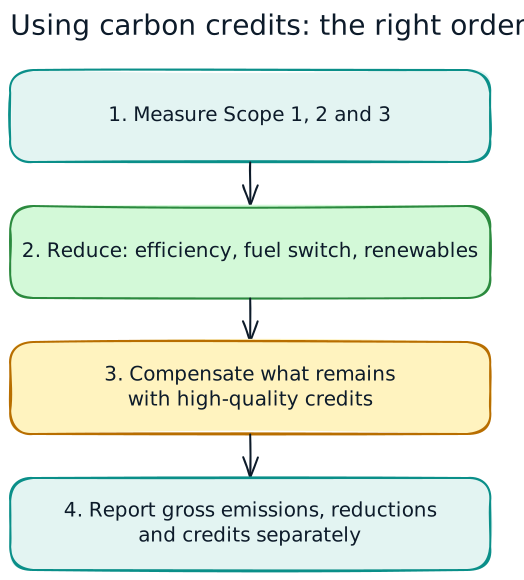
A sensible order of work:
- Measure Scope 1, 2 and, where you can, Scope 3 emissions. See our guide to Scope 3 emissions.
- Reduce: energy efficiency, fuel switching, renewable electricity, process changes and supplier engagement.
- Compensate for what remains with high-quality credits, preferring removals for long-term neutralisation.
- Report gross emissions, reductions and credits as separate numbers.
The Climate & GHG Emissions lesson covers measuring and cutting emissions before you reach for credits.
Greenwashing risk with carbon claims
Carbon claims are among the most challenged environmental claims worldwide. The common problems:
- Calling a product or company carbon neutral or net zero when the claim rests mostly on cheap avoidance credits and emissions are not falling.
- Not saying what the claim covers: one product, one site, Scope 1 and 2 only, or the whole value chain.
- Using credits that are not retired in the buyer's name, or that the seller also counts.
- Marketing that runs ahead of the evidence held by the sustainability team.
Keep claims specific ("we compensated our 2025 Scope 1 and 2 emissions with retired removal credits, listed here"), keep the evidence, and route claims through review before they go public. Our guide to greenwashing and the Greenwashing & Honest Claims lesson go further.
What managers and sustainability teams should do now
- Know your emissions and which reductions are realistic before buying anything.
- Write a credit policy: when credits may be used, which types and standards, minimum quality checks, and who approves purchases.
- Do due diligence on every purchase against the quality questions above, and keep the registry retirement records.
- Watch the policy timeline: the National Carbon Market Policy, the planned Climate Change Act and registry, and the deferred carbon tax.
- Align claims and reporting so marketing, investor reports and sustainability reporting tell the same story.
- Train the people involved: buyers, marketing, finance and sustainability staff. The ESG topic on WorkQuest2U covers carbon markets, emissions, reporting and honest claims in short 3D lessons with a completion certificate.
Practise it in WorkQuest2U
Short 3D lessons where staff walk the scene, spot the issues and make the calls. Free to try, with certificates and progress records for companies.
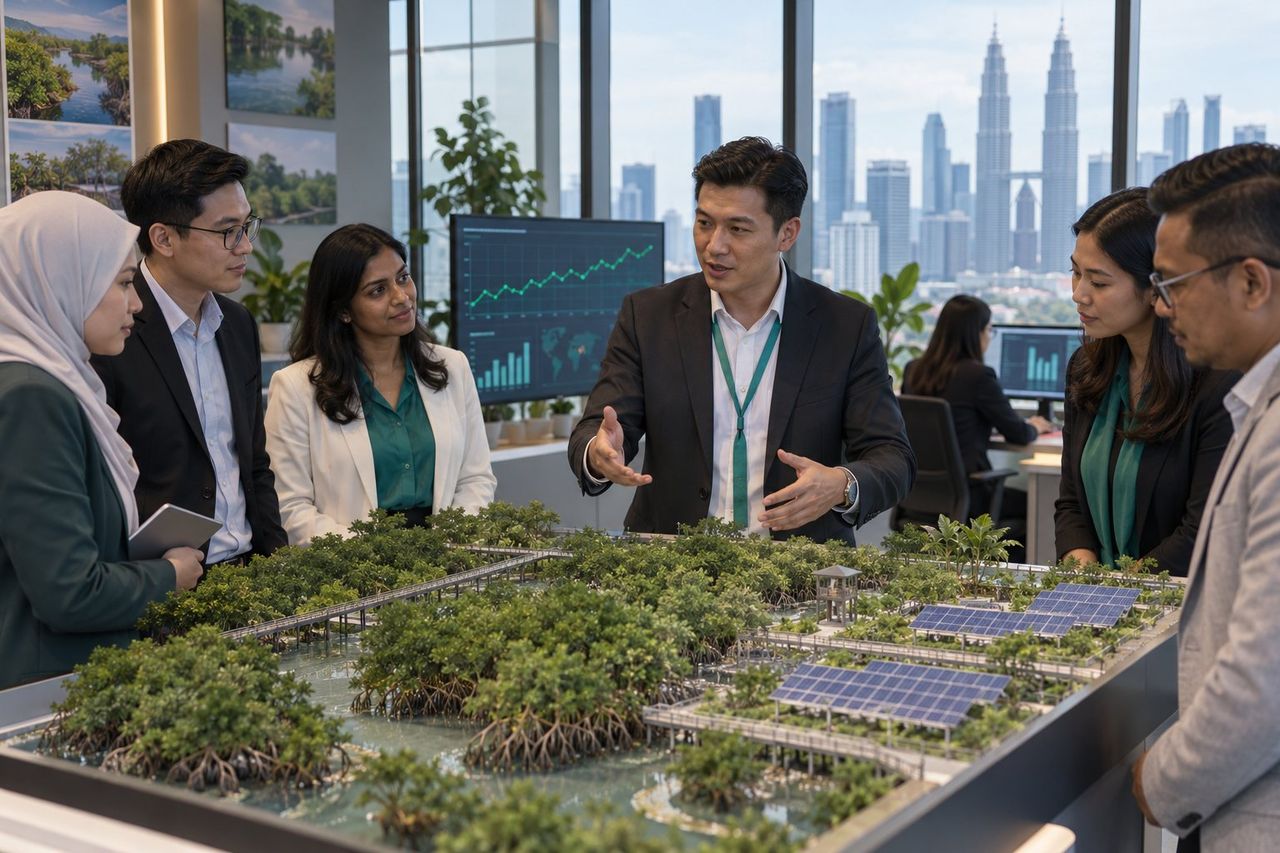 ESG & SustainabilityCarbon Markets & CreditsA carbon desk and project showroom: carbon taxes and trading schemes, voluntary credits, avoidance versus removal, what makes a credit credible, and Bursa Carbon Exchange.
 ESG & SustainabilityClimate & GHG EmissionsA carbon management centre: greenhouse gases, Scope 1, 2 and 3, intensity versus absolute, measuring and verifying, and the levers that cut emissions.
 ESG & SustainabilityGreenwashing & Honest ClaimsA communications studio, packaging wall and claims review room: make environmental claims specific, evidenced and approved.
 ESG & SustainabilitySustainability ReportingThe sustainability data room: NSRF and IFRS S1/S2, Bursa rules, materiality, boundaries, data quality, restatements and assurance.
 ESG & SustainabilitySustainable FinanceAn investor relations pavilion: green bonds and sukuk, sustainability-linked loans, taxonomies and ESG ratings.
Frequently asked questions
What is a carbon credit?
Can companies in Malaysia buy carbon credits?
Does Malaysia have a carbon tax?
What is the difference between compliance and voluntary carbon markets?
Do carbon credits reduce a company's reported emissions?
How do I know if a carbon credit is good quality?
Sources
- The Star: Carbon tax plan put on hold amid Middle East tensions, says Kurup (21 April 2026), including the National Carbon Market Policy launch
- The Star: National carbon tax policy in final phase, says MoF (24 June 2026)
- The Star: Govt defers carbon tax amid global uncertainties (5 October 2026)
- S&P Global: Malaysia sets 2026 carbon tax in Budget 2025
- NRES: National Carbon Market Policy (DPKK), 2026
- Grant Thornton Malaysia: National Carbon Market Policy summary (firm commentary)
- Allen & Gledhill: Bursa Malaysia launches Voluntary Carbon Market Exchange (law-firm summary)
- ICVCM: Core Carbon Principles
This guide is general information for workplaces in Malaysia, checked against the sources above on 30 October 2026. It is not legal advice; laws and guidelines change, so confirm the current text before you act.