NSRF Malaysia: who must report under IFRS S1 and S2, by when, and what it means for suppliers
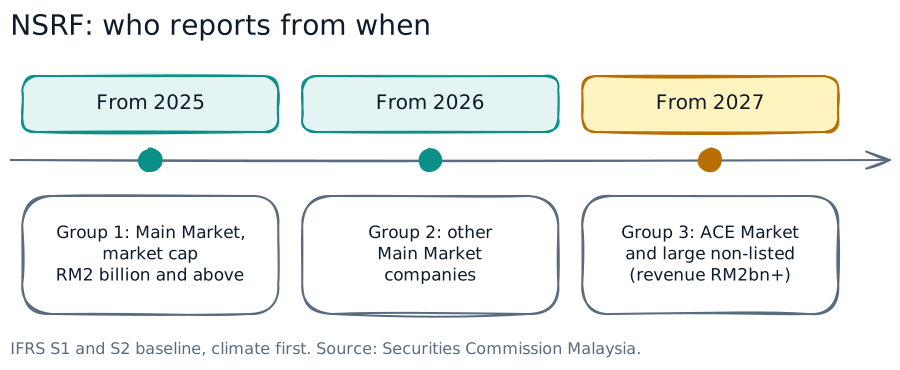
The National Sustainability Reporting Framework (NSRF) makes the ISSB Standards, IFRS S1 and IFRS S2, the baseline for sustainability reporting in Malaysia. It is phased in: large Main Market companies from 2025, other Main Market companies from 2026, and ACE Market companies and large non-listed companies from 2027, with climate-first reliefs in the early years.

What the NSRF is
The National Sustainability Reporting Framework (NSRF) sets out how companies in Malaysia report on sustainability. The Securities Commission Malaysia (SC) launched it on 24 September 2024. It was developed by the Advisory Committee on Sustainability Reporting (ACSR), an inter-agency committee chaired by the SC, with the endorsement of the Ministry of Finance. ACSR members are the SC, the Audit Oversight Board, Bank Negara Malaysia, the Companies Commission of Malaysia (SSM), Bursa Malaysia and the Financial Reporting Foundation.
The framework does three things:
- It adopts the IFRS Sustainability Disclosure Standards issued by the International Sustainability Standards Board (ISSB) as the baseline.
- It sets a phased timeline so that larger, better-prepared companies go first.
- It plans for assurance of sustainability information, so that reported figures can be relied on like financial figures.
The aim is sustainability information that investors and lenders can compare across companies and with other markets. In June 2025 the IFRS Foundation published a jurisdictional profile for Malaysia recognising its adoption of the ISSB Standards.
IFRS S1 and S2 in plain terms
IFRS S1 sets the general requirements: disclose sustainability-related risks and opportunities that could reasonably be expected to affect the company's cash flows, access to finance or cost of capital. IFRS S2 applies that to climate.
Both are organised around four pillars that listed companies will recognise from the earlier TCFD-based climate reporting:
| Pillar | What the company discloses |
|---|---|
| Governance | Who on the board and in management oversees sustainability risks, and how |
| Strategy | The risks and opportunities, their effect on the business model, plans and finances, and (for climate) how resilient the strategy is |
| Risk management | How these risks are identified, assessed and managed, and how that fits the wider risk process |
| Metrics and targets | The numbers used to track performance, including Scope 1, 2 and 3 greenhouse gas emissions, and progress against targets |
The practical shift is that sustainability reporting moves closer to financial reporting: it is about financial effects on the company, it has to be consistent with the financial statements, and it is expected to be assured.
The phased timeline by company group
| Group | Who | Starts |
|---|---|---|
| Group 1 | Main Market listed issuers with market capitalisation of RM2 billion and above | 2025 (Bursa: financial years ending on or after 31 December 2025) |
| Group 2 | Other Main Market listed issuers | 2026 (financial years ending on or after 31 December 2026) |
| Group 3 | ACE Market listed issuers, and large non-listed companies with annual revenue of RM2 billion and above | 2027 (ACE Market: financial years ending on or after 31 December 2027) |
For large non-listed companies, check the SC's NSRF FAQs for how the revenue threshold is measured and how a subsidiary may rely on its holding company's ISSB-aligned report. Do not assume a group structure takes you in or out of scope.
In December 2025 the ACSR also set out its approach to non-compliance: reviews will be developmental at first, with general shortcomings handled through engagement and corrective action, but enforcement can follow where deficiencies are not fixed, and serious breaches such as misleading disclosures will face enforcement.
Transitional reliefs and Scope 3
The NSRF is climate-first. Under the reliefs in Bursa Malaysia's Listing Requirements:
- Main Market issuers (Groups 1 and 2) get reliefs for two full financial years from their start date. In that period they may report only on climate-related risks and opportunities under IFRS S2, applying IFRS S1 only as it relates to those climate disclosures, and may focus on their principal business segments.
- ACE Market issuers get the same reliefs for three full financial years.
- Scope 3 emissions (the indirect emissions in the value chain, such as purchased goods, transport and use of sold products) are not required during the transitional period, except for categories a regulator already requires. Main Market issuers, for example, were already asked by Bursa's 2022 rules to report at least business travel and employee commuting.
The reliefs buy time; they do not remove the work. Companies that wait until the relief ends to start collecting Scope 3 data or building broader sustainability disclosures will find the first full-scope year hard. The sensible use of the relief period is to set up data owners, methods and controls.
How it fits Bursa Malaysia's listing requirements
For listed companies, the NSRF is applied through Bursa Malaysia's Listing Requirements. On 23 December 2024 Bursa amended its Main Market and ACE Market Listing Requirements so that the Sustainability Statement in the annual report is prepared in line with the IFRS Sustainability Disclosure Standards, on the timeline above.
Points from the amended requirements that affect how a company organises itself:
- The Sustainability Statement sits in the annual report, so the data has to be ready on the annual report timetable, not months later.
- Metrics and targets are shown for the last three financial years, built up year by year for new metrics, with a summary in a prescribed format.
- The statement must say whether it was subject to internal review by the internal auditor or independent assurance, the scope of that work, and any assurance conclusions.
- Before their start date, Group 2 and ACE Market companies still have to meet Bursa's existing sustainability disclosure requirements for those years.
Assurance: what is coming
When it launched the NSRF, the ACSR said it aims to mandate reasonable assurance of sustainability information starting in 2027, subject to further consultation. A Sustainability Assurance Working Group under the ACSR is preparing the Sustainability Assurance Framework, which will settle what must be assured, to what level and by whom. As of October 2026, check the SC's NSRF page for the current position before planning budgets.
Whatever the final timing, assurance changes what "good data" means. An assurer will ask for the source of every figure, the calculation method and emission factors, who checked it and what controls stop errors. Spreadsheets emailed between departments with no version history rarely survive that test.
What non-listed companies and suppliers should expect
Most Malaysian companies are not in the NSRF groups. They will still feel it, for three reasons:
- Customer data requests. A reporting company's Scope 3 figure is built from its suppliers' emissions. Expect questionnaires asking for your electricity and fuel use, your Scope 1 and 2 emissions, and policies on labour, safety and ethics. Capital Markets Malaysia's voluntary Simplified ESG Disclosure Guide (SEDG) for SMEs in supply chains gives a common set of disclosures at basic, intermediate and advanced levels, so one set of answers can serve several customers.
- Finance. Banks and investors are using the same frameworks to assess borrowers, so loan and financing reviews increasingly include climate questions.
- Possible new law. In April 2026 SSM consulted on amendments to the Companies Act 2016 that would require sustainability disclosure from non-listed companies with annual revenue above RM15 million, phased in from 2028 and starting with Scope 1 and 2 emissions. Companies below RM15 million revenue or with fewer than 100 employees would be exempt but could opt in. As of October 2026 this is a proposal; SSM has said it expects to table the amendments in Parliament by early 2027.
A practical start for a supplier: read your electricity bills and fuel records for the last 12 months, name one person who owns the data, and keep the evidence.
Getting your people ready
NSRF reporting is a team effort. The sustainability team writes the statement, but the numbers come from facilities, procurement, HR, finance and operations, and the claims are only as honest as the people making them. Common gaps are staff who do not know why a data request matters, inconsistent units and boundaries between sites, and marketing claims that run ahead of the evidence.
Our Sustainability Reporting lesson walks staff through evidence, boundaries and honest disclosure in a 3D scene, and Climate & GHG Emissions covers Scope 1, 2 and 3 with practical examples. ESG Governance is for managers and board support staff, and Supplier ESG is for procurement teams sending or answering data requests. For a wider programme, see our guide to ESG training for employees.
Practise it in WorkQuest2U
Short 3D lessons where staff walk the scene, spot the issues and make the calls. Free to try, with certificates and progress records for companies.
 ESG & SustainabilitySustainability ReportingThe sustainability data room: NSRF and IFRS S1/S2, Bursa rules, materiality, boundaries, data quality, restatements and assurance.
 ESG & SustainabilityClimate & GHG EmissionsA carbon management centre: greenhouse gases, Scope 1, 2 and 3, intensity versus absolute, measuring and verifying, and the levers that cut emissions.
 ESG & SustainabilityESG GovernanceThe boardroom floor: who oversees ESG, risk registers, targets, incentives, investment decisions and accountability.
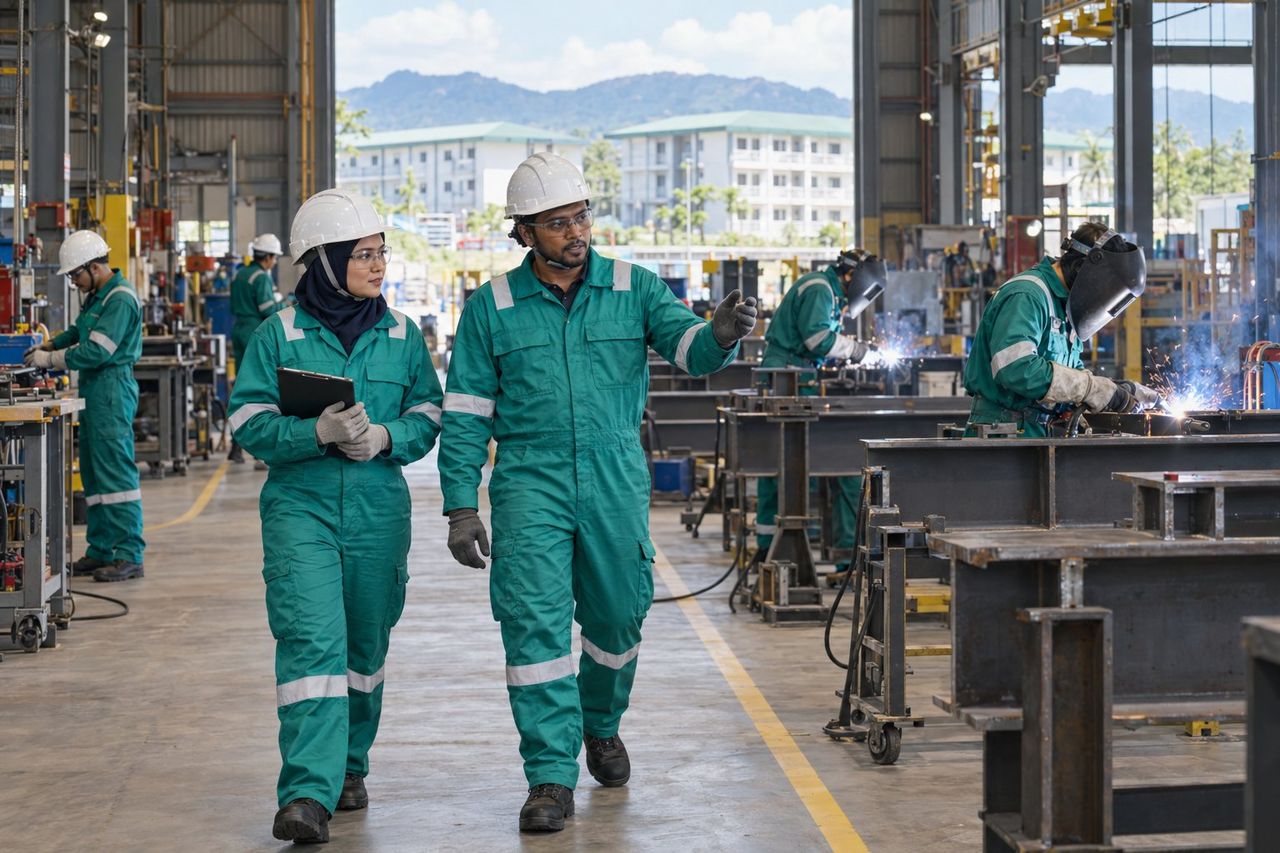 ESG & SustainabilitySupplier ESGA supplier's fabrication yard: screen, audit and develop suppliers on labour, human rights, environment and Scope 3.
Frequently asked questions
What is the NSRF in Malaysia?
Which companies must comply with the NSRF?
Is Scope 3 reporting required under the NSRF?
Does the NSRF apply to SMEs?
Is assurance of sustainability reports mandatory in Malaysia?
Sources
- Securities Commission Malaysia: National Sustainability Reporting Framework (NSRF)
- SC media release, 24 September 2024: National Sustainability Reporting Framework to enhance sustainability disclosures
- SC media release: Malaysia's sustainability reporting aligns with global ISSB Standards in IFRS jurisdictional profile
- Skrine: Bursa Malaysia amends sustainability reporting requirements (January 2025)
- The Star: ACSR sets out approach for non-compliance with sustainability reporting requirements (December 2025)
- The Star: SSM eyes early 2027 for Companies Act amendments on sustainability reporting (July 2026)
- Capital Markets Malaysia: Simplified ESG Disclosure Guide (SEDG) for SMEs
This guide is general information for workplaces in Malaysia, checked against the sources above on 30 October 2026. It is not legal advice; laws and guidelines change, so confirm the current text before you act.