Greenwashing examples: misleading green claims and how to avoid them in Malaysia
Greenwashing is making a product, service or company look more environmentally friendly than the evidence supports, through vague words, selective facts, unearned labels or targets presented as results. In Malaysia there is no single greenwashing law, but misleading claims to consumers can breach the Consumer Protection Act 1999, and listed companies’ sustainability disclosures fall under Bursa Malaysia and Securities Commission rules.

What greenwashing is
Greenwashing is any claim, picture or omission that leaves people with a better impression of an organisation’s environmental performance than the facts support. It can be deliberate, but much of it is careless: a marketing line nobody checked, an old figure left on a website, a logo that suggests a certification the product never had.
The cost is real. Customers and investors lose trust, regulators and campaign groups increasingly look for it, and staff who know the claim is weak stop believing the rest of the sustainability programme. It also hides genuine progress, because honest claims get lost among exaggerated ones.
Greenwashing is not limited to adverts. It shows up in packaging, product names, sustainability reports, investor presentations, tender documents, social media posts, job adverts and what sales staff say to customers.
Greenwashing examples: seven common types
The examples below are made up to show each pattern. They are not drawn from any real company.
| Type | Example | Why it misleads |
|---|---|---|
| Vague or absolute claims | “Eco-friendly cleaning range”, “100% green packaging” | No defined meaning, so readers assume the best. Absolute words like “zero impact” are almost never true. |
| Hidden trade-off | A bottle promoted as “made with 30% recycled plastic” while the product inside is the main impact | Highlights one small attribute and stays silent on bigger ones. |
| No proof | “Our factory runs on clean energy” with no data on how much, or for how long | A claim nobody can check, often based on a single project or a partial year. |
| Irrelevant claim | “Free from a chemical” that is already banned or never used in that product type | True but meaningless, and implies an advantage over competitors that does not exist. |
| Fake or borrowed labels | A leaf logo and the word “certified” designed in-house, or a supplier’s certificate shown as if it covers the whole product | Suggests independent approval that was never given. |
| Offset-only claims | “Carbon neutral delivery” achieved entirely by buying low-quality credits, with no cut in actual emissions | Readers assume emissions were reduced. The quality and permanence of the credits may be doubtful. |
| Targets sold as results | A banner reading “Net zero company” when the company has only set a 2050 target with no interim plan | Turns an ambition into an achievement, and hides how far there is still to go. |
Two more to watch: green imagery (forests, leaves and green colours on a product with no environmental benefit) and selective reporting (publishing the indicators that improved and dropping the ones that got worse). The Greenwashing & Honest Claims lesson puts learners in a 3D communications studio and claims review room to spot these patterns on packaging and posts and rewrite them.
Malaysian rules that apply to green claims
Malaysia does not have a law written specifically for greenwashing. Several existing rules reach it, depending on who the claim is aimed at.
Claims to consumers: Consumer Protection Act 1999
The Consumer Protection Act 1999 [Act 599] applies to goods and services offered or supplied to consumers, including online. Two provisions in Part II matter most:
- Section 9, misleading conduct. No person shall engage in conduct that is misleading or deceptive, or likely to mislead or deceive, the public as to the nature, manufacturing process, characteristics or suitability for a purpose of goods, or the nature, characteristics or suitability of services.
- Section 10, false or misleading representation. No person shall make a false or misleading representation that goods are of a particular kind, standard, quality or composition, or that goods or services have any sponsorship, approval, endorsement, performance characteristics, uses or benefits, among other things.
“Recyclable”, “biodegradable”, “made with renewable energy” or a home-made certification mark are all representations about composition, process, approval or benefits. Under section 25, breaching Part II is an offence. A company faces a fine of up to RM250,000 for a first offence and up to RM500,000 after that. An individual faces up to RM100,000, up to 3 years’ jail, or both, rising to RM250,000 and 6 years for a repeat offence, with a daily fine of up to RM1,000 for a continuing offence. The Act is enforced by the Ministry of Domestic Trade and Cost of Living (KPDN).
Claims to investors: Bursa Malaysia and the Securities Commission
The Consumer Protection Act does not apply to securities. Claims aimed at investors fall under capital markets rules instead. Companies listed on Bursa Malaysia have sustainability reporting duties under the Listing Requirements, which Bursa strengthened in amendments announced on 26 September 2022, and the National Sustainability Reporting Framework phases in IFRS S1 and S2 based disclosures, including climate data. See NSRF Malaysia. For funds, the Securities Commission’s Guidelines on Sustainable and Responsible Investment Funds (last revised 17 February 2023) require an SRI fund to disclose the risks and limits of its sustainability strategy and how it is measured and monitored, and to report on it in annual and interim reports. An inflated sustainability report or fund label is therefore a disclosure problem, not just a marketing one.
Advertising standards
The advertising industry’s self-regulatory Malaysian Code of Advertising Practice also prohibits misleading claims and expects claims in adverts to be substantiated.
How to substantiate a green claim
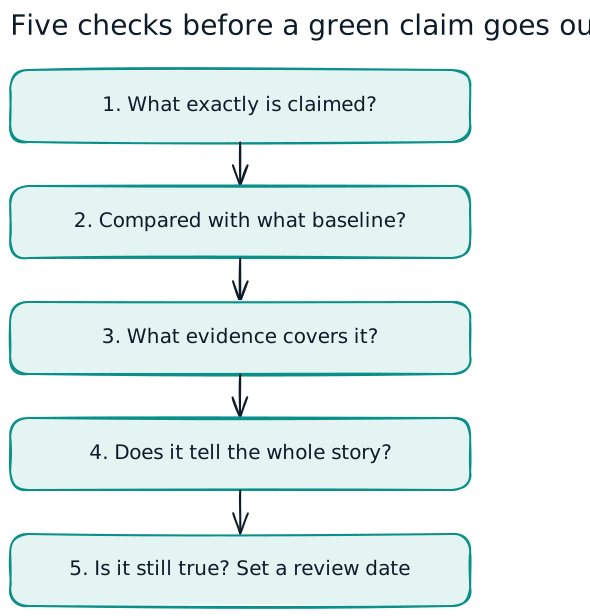
Before any environmental claim is published, the owner should be able to answer five questions with evidence on file:
- What exactly is claimed? Name the product, site or activity, the attribute (for example recycled content, energy use, emissions) and the size of the benefit. “30% recycled PET in the bottle, excluding cap and label” beats “greener bottle”.
- Compared with what? State the baseline: last year, the previous design, an industry average. Comparisons need like-for-like boundaries and dates.
- What is the evidence? Test reports, supplier declarations with chain-of-custody records, metered energy data, emissions calculations, or a certificate that actually covers this product and is still valid.
- Does it tell the whole story? Check that the claim is not undone by a bigger impact elsewhere in the life cycle, and say so if a benefit only applies in some conditions (for example “recyclable where collection facilities exist”).
- Is it still true? Set a review date. Suppliers, recipes and energy contracts change, and an accurate claim can become misleading a year later.
For carbon claims, show the reductions first and the credits second, name the credit standard and project type, and avoid “carbon neutral” or “net zero” as a description of a whole company unless the scope and method are stated. Carbon credits Malaysia explains what makes a credit credible, and the Climate & GHG Emissions and Carbon Markets & Credits lessons cover the measurement behind these claims. ISO 14021, the international standard on self-declared environmental claims, is a useful reference for wording.
Who is responsible inside the organisation
Greenwashing usually happens in the gap between teams. Marketing writes the line, the sustainability team has the data, procurement holds supplier evidence and legal sees the draft late or not at all. Close the gap by giving every claim an owner:
- Claim owner (often marketing or the business unit): drafts the claim and collects the evidence.
- Technical reviewer (sustainability, quality or engineering): checks that the data supports the exact words.
- Legal or compliance: checks the claim against consumer, advertising and, for listed companies, disclosure rules.
- Approver: signs off and sets the review date.
Keep a simple claims register listing each live claim, where it appears, the evidence file and the next review date. When a supplier, formula or target changes, the register shows which claims need updating. For supplier-based claims, ask for evidence in contracts; Supplier ESG covers how to screen and audit suppliers.
Green claims review checklist
- Is the claim specific: which product, part, site and period?
- Is it accurate and quantified, with units and a stated baseline?
- Is there evidence on file that covers this exact claim, and is it current?
- Does it avoid vague or absolute words such as eco-friendly, green, natural, sustainable or zero impact without qualification?
- Does it leave out a bigger negative impact that would change the reader’s view?
- Is any label or certification real, independent and valid for this product?
- Are targets described as targets, with dates and interim milestones, not as achievements?
- Are carbon credits disclosed separately from actual reductions?
- Do the images and colours suggest more than the words say?
- Is the claim consistent with the sustainability report, website and investor material?
- Has it been approved by a technical reviewer and legal or compliance, with a review date set?
Teams that use this checklist on a few real drafts, and practise the same calls in a scenario, quickly learn to write claims that are both honest and persuasive.
Practise it in WorkQuest2U
Short 3D lessons where staff walk the scene, spot the issues and make the calls. Free to try, with certificates and progress records for companies.
 ESG & SustainabilityGreenwashing & Honest ClaimsA communications studio, packaging wall and claims review room: make environmental claims specific, evidenced and approved.
 ESG & SustainabilitySustainability ReportingThe sustainability data room: NSRF and IFRS S1/S2, Bursa rules, materiality, boundaries, data quality, restatements and assurance.
 ESG & SustainabilityClimate & GHG EmissionsA carbon management centre: greenhouse gases, Scope 1, 2 and 3, intensity versus absolute, measuring and verifying, and the levers that cut emissions.
 ESG & SustainabilityCarbon Markets & CreditsA carbon desk and project showroom: carbon taxes and trading schemes, voluntary credits, avoidance versus removal, what makes a credit credible, and Bursa Carbon Exchange.
 ESG & SustainabilitySupplier ESGA supplier's fabrication yard: screen, audit and develop suppliers on labour, human rights, environment and Scope 3.
Frequently asked questions
What are common examples of greenwashing?
Is greenwashing illegal in Malaysia?
What is the penalty for misleading claims under the Consumer Protection Act?
How can a company avoid greenwashing?
Is it greenwashing to say a company is carbon neutral?
Sources
- Consumer Protection Act 1999 [Act 599], reprint hosted by KPDN
- Azmi & Associates (law firm): Malaysia’s revised SRI Fund Guidelines, key changes
- Rahmat Lim & Partners (law firm): Bursa enhances sustainability reporting requirements in the Listing Requirements
This guide is general information for workplaces in Malaysia, checked against the sources above on 30 October 2026. It is not legal advice; laws and guidelines change, so confirm the current text before you act.