Heat stress at work in Malaysia: symptoms, controls and lightning safety
Heat stress at work happens when the body cannot lose heat fast enough, and in Malaysia it is managed under the general duties of the OSH Act 1994 with the DOSH Guidelines on Heat Stress Management at Workplace 2016: assess the heat with a screening checklist and WBGT, then control it with water, shade, rest, acclimatisation and supervision.
Why heat stress matters for Malaysian workplaces
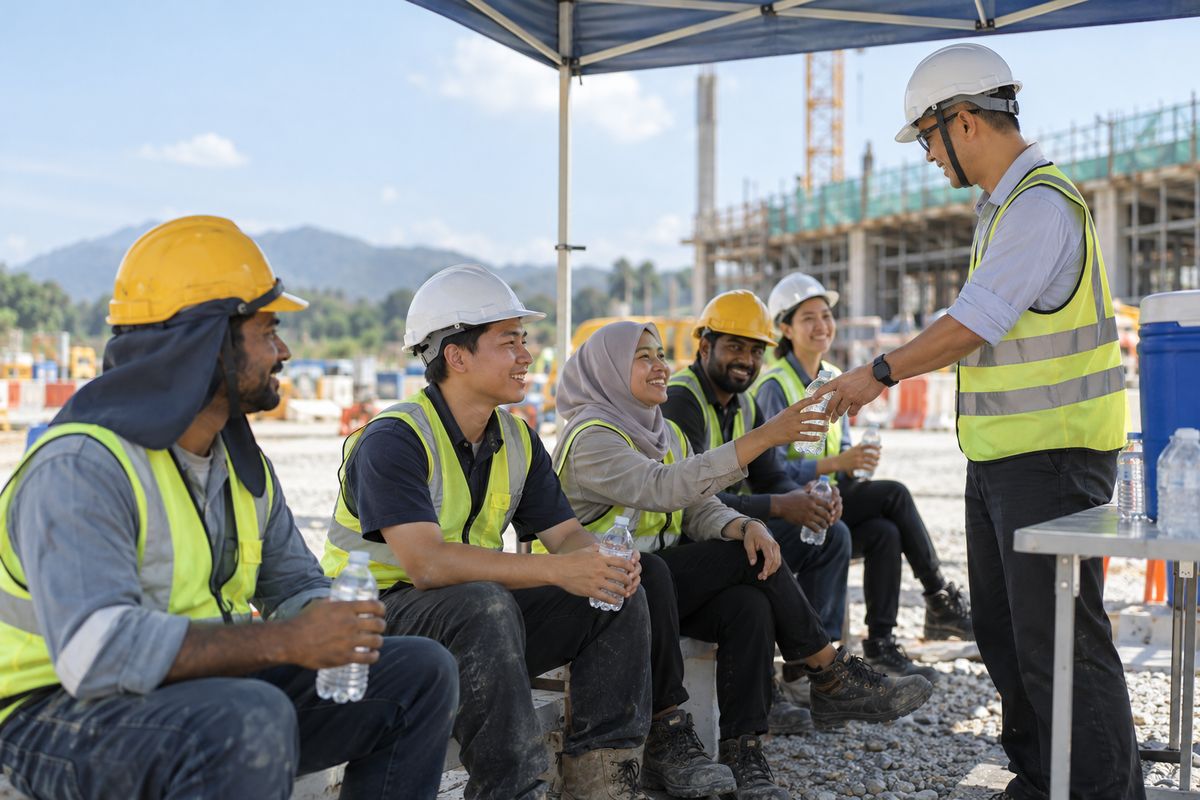
Malaysia is hot and humid all year, and humidity makes it harder for sweat to evaporate and cool the body. When heat builds faster than the body can shed it, core temperature rises. The result ranges from cramps and fatigue to heat exhaustion and, at worst, heat stroke, which can kill or cause lasting organ damage.
The Ministry of Health (KKM) monitors heat-related illness during hot spells. Its statement of 25 March 2026 reported 15 cases between 1 January and 24 March 2026: 11 heat exhaustion, 1 heat cramps and 3 heat stroke. KKM lists people doing outdoor physical work, such as labourers and farmers, among the groups at higher risk, along with adults over 40 and people with heart, blood pressure, diabetes or breathing conditions.
Heat stress is not only a construction or plantation issue. Security guards on patrol, delivery riders, landscapers, traffic marshals, warehouse staff under metal roofs, kitchen crews, boiler and furnace operators, and staff who do site visits or outdoor events can all be exposed. Heat also makes people tired and less careful, so it raises the risk of other accidents.
Heat stroke vs heat exhaustion: know the signs
| Condition | Typical signs | What to do |
|---|---|---|
| Heat cramps | Painful muscle cramps in the legs, arms or stomach during or after hard work | Stop work, rest in the shade, drink water or an oral rehydration drink, stretch gently |
| Heat exhaustion | Heavy sweating, headache, dizziness, nausea or vomiting, weakness, extreme tiredness, poor concentration, pale or clammy skin | Move to a cool, shaded place, loosen or remove tight clothing, cool with wet cloths and a fan, give sips of water, and stay with the person. Get medical help if they do not improve quickly |
| Heat stroke | Confusion, slurred speech, strange behaviour, collapse, fitting or unconsciousness; very hot skin, which may be dry or still sweating | Emergency: call 999. Cool the person as fast as possible with water, wet cloths, ice packs and fanning while waiting. Do not give drinks if they are not fully alert |
KKM's first aid advice for heat illness is to move out of the heat, remove tight clothing, apply cool wet cloths, use a fan, drink water regularly and get help if the condition cannot be controlled. The key message for supervisors: any change in behaviour or mental state in a hot worker is heat stroke until proven otherwise. Do not send them to rest alone in a vehicle or a locker room.
What the law and DOSH guidance say
There is no Malaysian regulation that sets a numerical heat limit. The legal duties come from the OSH Act 1994: section 15 requires employers to provide, so far as is practicable, a working environment that is safe and without risks to health, and section 18B, in force since 1 June 2024, requires a risk assessment and the controls it identifies. Heat is a hazard that belongs in that assessment for any outdoor or hot indoor work. Breaching these general duties carries a fine of up to RM500,000, up to two years in prison, or both.
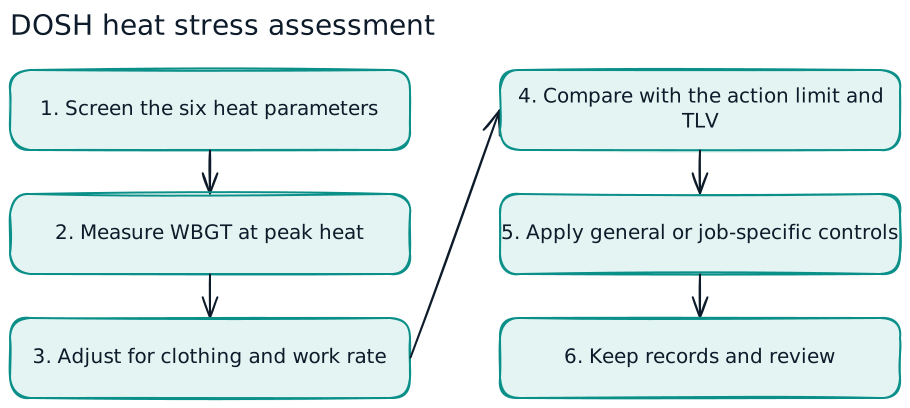
The practical method is in the DOSH Guidelines on Heat Stress Management at Workplace 2016. In summary:
- Screen: a checklist scores six parameters (air temperature, radiant temperature, air velocity, humidity, clothing and work rate). If three or more score above 1, there may be a heat stress risk and you move to measurement.
- Measure: a competent person measures the wet bulb globe temperature (WBGT) at the time and place heat is expected to peak. Outdoors in sun, WBGT = 0.7 natural wet bulb + 0.2 globe + 0.1 dry bulb temperature; indoors without sun, WBGT = 0.7 natural wet bulb + 0.3 globe temperature. The reading is adjusted for clothing and work rate.
- Evaluate: the adjusted WBGT is compared with the ACGIH action limit (for workers not yet acclimatised) and threshold limit value (for acclimatised workers), which vary with work intensity and work-rest pattern.
- Control: general controls when there is some risk, and job-specific engineering and administrative controls when limits are exceeded, with PPE such as cooling vests as the last resort.
Keep the screening checklist, WBGT readings, controls, training and health surveillance records. They show how you met your duties if DOSH asks.
Heatwave advisories in Malaysia
The Malaysian Meteorological Department (MetMalaysia) publishes a daily hot weather status by district on its website. As reported in April 2026, Level 1 (berjaga-jaga, caution) applies when the daily maximum temperature is 35 to 37°C for at least three days in a row, and Level 2 (gelombang haba, heatwave) when it is above 37°C to 40°C for at least three days in a row. Check the MetMalaysia status page for the current categories and your district.
A heat advisory is a trigger to act, not the measure of your workers' exposure. Use it to:
- review the heat plan at the morning briefing and remind crews of the signs of heat illness;
- move heavy outdoor work to the early morning and late afternoon where possible;
- increase rest breaks and water points, and add shade;
- pair workers up and step up supervision of new, returning and older workers;
- check WBGT on site rather than relying on the forecast temperature.
KKM also advises the public during hot spells to limit strenuous activity and long exposure to hot weather, and publishes prevention advice on its health information portal.
Controls that work: water, rest, shade and acclimatisation
Water and rest
- Provide cool drinking water close to the work, enough for everyone for the whole shift, and remind people to drink small amounts often rather than waiting until they are thirsty.
- For long, sweaty shifts consider oral rehydration drinks. Avoid relying on caffeinated, sugary or energy drinks.
- Set a work-rest regime based on the WBGT and the work rate, with rest in a shaded or cooled area. Let workers stop when they feel unwell without penalty.
Engineering controls
- Shade the work area and rest area; use portable canopies and fans or cooled rest rooms.
- Use mechanical aids to cut the physical effort; insulate or shield hot surfaces and equipment; ventilate hot indoor areas.
Acclimatisation
The body adapts to heat over about one to two weeks of gradual exposure. New workers, temporary workers and anyone returning after a week or more away (leave, illness, a posting in an air-conditioned office) are at much higher risk in their first days. Start them on shorter exposures and lighter tasks, and increase gradually.
People and supervision
- Train workers and supervisors to recognise heat illness and give first aid; use a buddy system so nobody works alone in the heat.
- Do pre-placement health screening and keep an eye on workers with medical conditions or on medication that affects heat tolerance.
- Provide light, loose, breathable clothing where PPE allows, and hats or neck shades for outdoor work.
The WorkQuest2U Heat Stress & Lightning and Working in the Heat lessons put staff on a hot outdoor site in a 3D scene, where they plan the work-rest pattern, check the WBGT and look after a colleague showing early signs.
Lightning safety for outdoor workers
Hot afternoons in Malaysia often end in thunderstorms, so heat plans and lightning plans go together. Lightning can strike well ahead of the rain, so do not wait for the storm to arrive.
- When you hear thunder, stop outdoor work. If you can hear it, you are close enough to be struck.
- Go to a safe shelter: a substantial building or a hard-topped metal vehicle with windows closed. Open-sided shelters, guard huts, tents, sheds and trees are not safe.
- Get off and away from high points: roofs, scaffolds, towers, poles, cranes, boom lifts and open ground. Keep clear of fences, metal structures, overhead lines and water.
- Stay sheltered until well after the last thunder; many organisations use a rule of 30 minutes after the last thunder before resuming.
- Plan ahead: check MetMalaysia thunderstorm warnings, name who calls the stop, and make sure crews know where the nearest safe shelter is.
- If someone is struck, call 999. A person struck by lightning carries no charge and can be touched safely; start CPR if they are not breathing.
Work at height and lightning are a dangerous mix. Our working at height guide covers getting crews down safely.
A simple heat stress plan
- Identify the jobs and areas with heat exposure, including indoor hot spots, and who does them.
- Assess with the DOSH screening checklist, then WBGT where needed, and record it in your risk assessment.
- Control: water, shade, work-rest regime, scheduling, mechanical aids, acclimatisation, buddy system.
- Prepare for emergencies: trained first aiders, cooling equipment, a clear 999 procedure and the site address ready for responders. Our first aid at work guide covers first aiders.
- Train and brief: signs of heat illness, how to report, when to stop. A toolbox talk at the start of hot days works well.
- Monitor and review after any heat illness case, near miss or heatwave advisory.
Common mistakes: relying on the forecast temperature instead of WBGT, putting new workers straight onto full shifts, water points too far from the work, and treating a confused worker as "just tired".
Practise it in WorkQuest2U
Short 3D lessons where staff walk the scene, spot the issues and make the calls. Free to try, with certificates and progress records for companies.
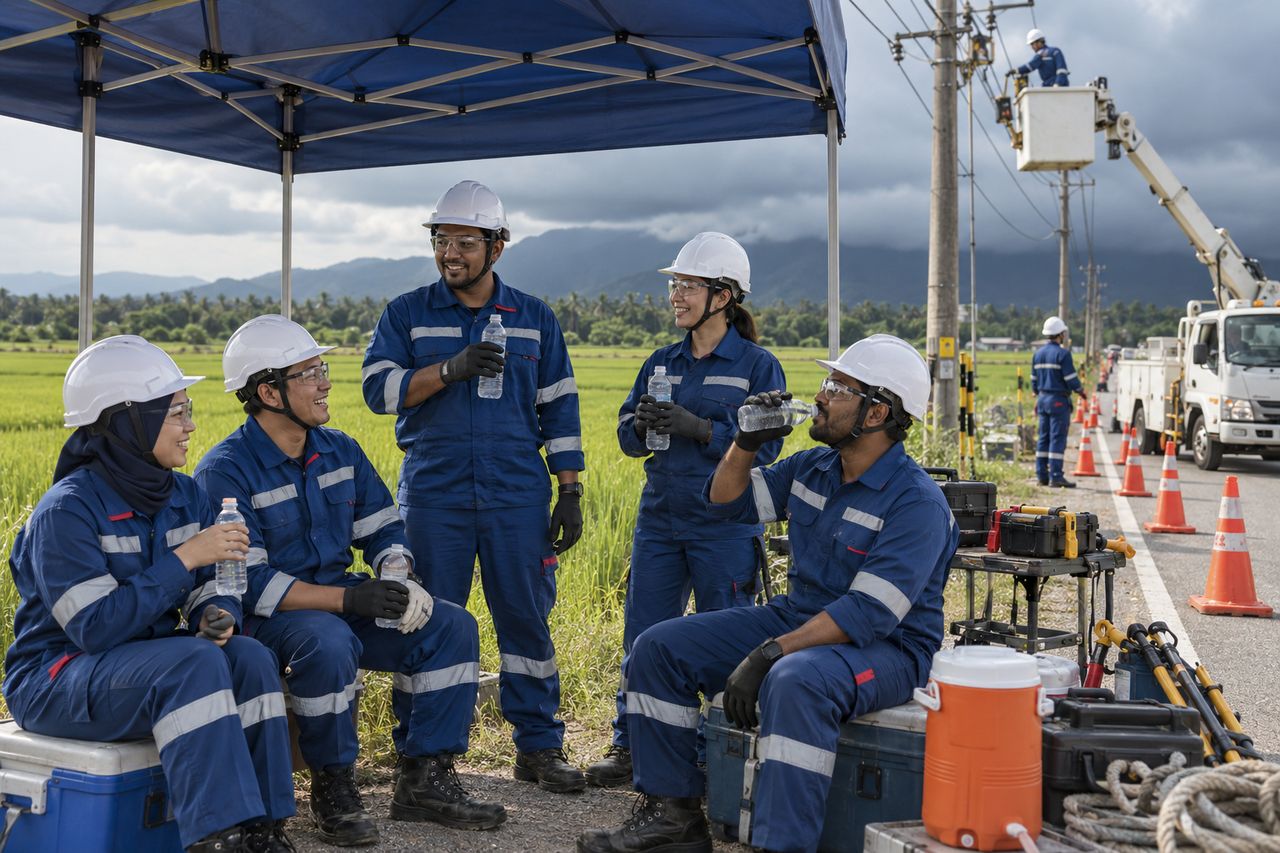 Health, Safety & EnvironmentHeat Stress & LightningA roadside line job on a hot afternoon with a storm coming: WBGT, work-rest planning, water, heat illness first aid and lightning shelter.
 Health, Safety, Security & EnvironmentWorking in the HeatMidday on an outdoor telco site: how heat stress builds, measuring it with WBGT, water, rest and shade, acclimatising new workers, buddy checks and the signs, and first aid for heat stroke.
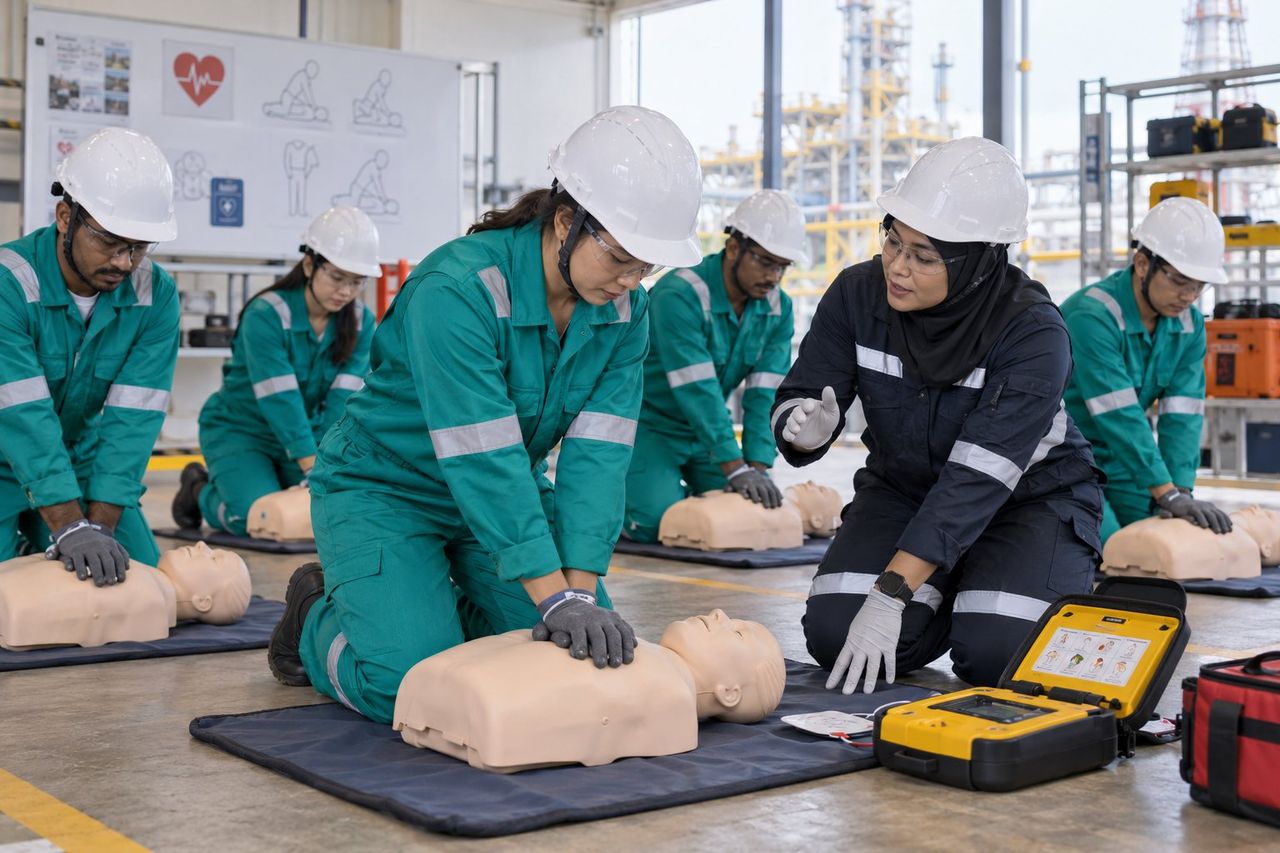 Health, Safety, Security & EnvironmentFirst Aid & CPRPractise the first minutes that save a life: DRSABCD, CPR and the AED, bleeding, burns, heat stroke and eye splashes, always within your training.
Frequently asked questions
Is there a legal maximum working temperature in Malaysia?
What is the difference between heat stroke and heat exhaustion?
What is WBGT?
How long does acclimatisation take?
What do MetMalaysia heat levels mean for work?
When should outdoor work stop for lightning?
Sources
- DOSH: Guidelines on Heat Stress Management at Workplace 2016 (industrial hygiene guidelines listing)
- Rajah & Tann Asia (law firm), 24 September 2026: Too Hot to Handle? Legal Realities of Workplace Heat Stress (summary of the DOSH 2016 guideline)
- Occupational Safety and Health (Amendment) Act 2022 [Act A1648]: sections 15 and 18B
- KKM media statement, 25 March 2026: hot weather and heat-related illness cases
- KKM MyHealth (Infosihat): Cuaca Panas, advice to the public
- MetMalaysia: hot weather status (Status Cuaca Panas)
- RTM Berita, 28 April 2026: MetMalaysia Level 1 and Level 2 hot weather criteria
This guide is general information for workplaces in Malaysia, checked against the sources above on 30 October 2026. It is not legal advice; laws and guidelines change, so confirm the current text before you act.