Working at height safety: ladders, scaffolds, MEWPs, harnesses and rescue
Working at height safety means planning any job where someone could fall and be hurt so that the fall cannot happen: avoid the height where you can, use guardrails, platforms or a MEWP where you cannot, and only then rely on a harness, with a rescue plan ready before work starts.

What counts as working at height
Work at height is any work where a person could fall a distance that could injure them. That includes work on ladders, scaffolds, roofs, mezzanines, loading bays, tanks, poles and towers, and work next to openings, pits, excavations or fragile surfaces such as skylights and old roof sheets. It also includes climbing up or down to reach the work.
The OSH Act 1994 does not set a single trigger height. Many organisations set their own rule, often 2 or 3 metres, above which fall protection and a permit are mandatory. That is a useful internal standard, but treat it as a floor, not a ceiling: people are seriously hurt by falls from a step ladder, a lorry bed or the edge of a loading dock. If the fall could injure someone, plan it as work at height.
DOSH figures show the scale. The Director General said in December 2024 that 1,144 falls from height were reported to the department in 2023, and that the most common causes were an unsafe environment (open edges and unguarded holes) and workers not wearing personal protective equipment. Work at height is one of the high-risk activities DOSH targets in its construction site operations.
What Malaysian law requires
The main legal duties come from the Occupational Safety and Health Act 1994, as amended by the OSH (Amendment) Act 2022 from 1 June 2024:
- Section 15: every employer and self-employed person must ensure, so far as is practicable, the safety, health and welfare at work of employees, including safe plant, safe systems of work, information, instruction, training and supervision, and procedures for dealing with emergencies.
- Section 18A: a principal has duties towards contractors and subcontractors working on its behalf, which matters for roof repair, signboard, facade and maintenance work that is usually contracted out.
- Section 18B: every employer, self-employed person and principal must carry out a risk assessment and implement the controls it identifies. For work at height, this is where you decide how the fall risk will be removed or controlled. See our HIRARC guide.
- Section 24: employees must take reasonable care, cooperate, and wear and use the protective equipment provided.
- Section 26A: an employee may remove themselves from imminent danger if the employer, once informed, fails to act.
Breaching the general duties in sections 15 to 18B carries a fine of up to RM500,000, up to two years in prison, or both. Our OSHA amendment 2022 guide covers these changes in detail.
DOSH also publishes the Guidelines for the Prevention of Falls at Workplaces 2007, which set out good practice for preventing falls and can be used as a basis for a workplace programme. The Factories and Machinery Act 1967 was repealed from 1 June 2024, and DOSH now lists the regulations made under it, including the 1986 building operations and works of engineering construction safety regulations, as abolished rules. Dedicated work at height regulations have been drafted but we could not confirm that they have been gazetted. Legal commentators differ on how far the old regulations still apply, so check the current position with DOSH or your adviser before relying on any one rule.
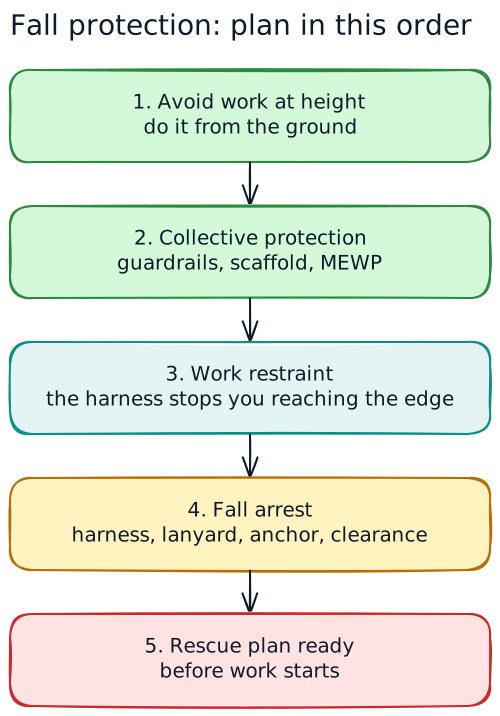
Plan it in the right order: avoid, prevent, arrest
Good fall protection planning follows a simple hierarchy. Work down it and stop at the first option that is reasonably practicable.
- Avoid work at height. Assemble on the ground and lift into place, use extendable tools from the ground, lower light fittings on winches, fit gauges where they can be read from floor level.
- Prevent falls with collective protection that protects everyone without any action by the worker: permanent guardrails and toe boards, covered and marked openings, a properly erected scaffold, a mobile tower, or a mobile elevating work platform (MEWP).
- Prevent falls with personal restraint: a harness and short lanyard that stops the worker reaching the edge at all.
- Arrest the fall: a full body harness with an energy-absorbing lanyard or self-retracting lifeline on a suitable anchor, or safety nets and airbags, so that a fall is stopped before the person hits anything.
Fall arrest is the last line because the person still falls. They can strike structure on the way down, the anchor can fail, and they are left hanging until rescued. Record your choice in the risk assessment, and for non-routine or high-risk work issue a permit to work that confirms the equipment, the inspection and the rescue arrangements before work starts.
Ladder safety
Ladders cause a large share of falls because they are cheap, quick and taken for granted. Use a ladder only for short, light work where a platform is not reasonably practicable, and where the user can keep three points of contact.
- Inspect before use: stiles, rungs, feet and locking bars intact; no bends, cracks, missing feet or homemade repairs. Remove damaged ladders from service and tag them.
- Set it up properly: firm, level ground; the classic angle of about 1 out for every 4 up; extended about 1 metre above the landing point; tied, footed or secured against slipping.
- Use it properly: face the ladder, keep your belt buckle between the stiles, do not stand on the top rungs, carry tools in a belt or haul them up, and never overreach. Move the ladder instead.
- Electrical risk: use non-conductive ladders near live equipment and keep clear of overhead lines.
- Step ladders: fully open with the spreaders locked, and never use one folded and leaning against a wall.
If the job needs both hands, heavy materials, or more than a few minutes in one spot, use a mobile tower, a podium step or a MEWP instead.
Scaffolds and mobile towers
A scaffold is a temporary structure, so it is only safe if it was designed, erected and inspected correctly, and nobody has changed it since. Erection, alteration and dismantling should be done by trained scaffolders under competent supervision, to the design and the manufacturer's instructions.
- Before use, check the scaffold has been inspected and tagged as safe to use. A clear tag system (for example green for safe, red for do not use) tells users the status at the access point.
- Look for sound base plates and sole boards, plumb standards, bracing and ties in place, fully boarded platforms with no gaps, guardrails, mid rails and toe boards on every open side, and safe ladder or stair access.
- Inspect again after alterations, heavy rain or strong wind, impact by vehicles or plant, and at regular intervals set by your procedure.
- Never remove ties, boards or guardrails to make work easier. If something is in the way, ask the scaffold supervisor to modify the scaffold.
- Mobile towers: lock the castors, keep to the height-to-base ratio in the instructions, never move a tower with anyone on it, and keep clear of overhead lines and edges.
Protect the area below too. Toe boards, brick guards, tool tethers and barricaded drop zones stop materials falling on people walking underneath.
MEWPs: boom lifts and scissor lifts
A mobile elevating work platform gives a guarded work position at height, which makes it safer than a ladder for many jobs. The main risks are overturning, being thrown from the basket, trapping against overhead structure, and contact with overhead power lines.
- Operators should be trained and authorised for the type of machine, and the machine should carry current inspection records.
- Do a pre-use check: controls, emergency lowering, guardrails and gate, tyres, outriggers, leaks and alarms.
- Check the ground: slopes, soft ground, drains, manhole covers and kerbs can tip a machine. Use outriggers and spreader plates where required.
- Keep within the safe working load and never climb on the guardrails or use planks or ladders in the basket to gain height.
- In a boom lift, wear a harness with a short restraint lanyard clipped to the designated anchor in the basket, so you cannot be catapulted out.
- Have a trained person on the ground who knows how to use the ground controls and emergency lowering.
Harnesses, anchor points and the rescue plan
When personal fall protection is needed, the whole system has to work, not just the harness.
The fall arrest system
- Anchor: a point designed or assessed to hold the load of an arrested fall, such as an engineered anchor, a rated beam clamp or a lifeline installed for the purpose. Handrails, pipes, cable trays and conduit are not anchors unless someone competent has said so.
- Connector: an energy-absorbing lanyard or a self-retracting lifeline, with locking karabiners or snap hooks. Use double lanyards so the worker stays clipped on while moving past obstructions (100% tie-off).
- Body support: a full body harness, correctly sized and adjusted, inspected before every use. Waist belts are not for fall arrest.
- Clearance: an energy-absorbing lanyard can extend well beyond its own length as it deploys. Check there is enough clear space below so the person stops before hitting the ground, a lower level or structure. Anchor overhead where you can, to cut the free fall and the swing.
The rescue plan
A person hanging in a harness can lose consciousness from restricted blood flow (often called suspension trauma) if they are left too long, so rescue must be quick. Before work starts, the plan should say how a fallen worker will be reached and brought down, what equipment is on site (rescue kit, MEWP, descent device), who is trained to use it, and how to raise the alarm. Practise it. Once the person is down, give first aid and get medical help, and report the incident as your procedures and the law require.
Fall prevention is a skill people learn faster by doing. In the WorkQuest2U Working at Height lesson staff walk a 3D work scene, spot missing guardrails and bad anchor points and choose the right access equipment, then go deeper with Scaffolding and Line of Fire & Dropped Objects.
Common working at height mistakes
- Going straight to the harness without asking whether the work could be done from the ground or a guarded platform.
- Clipping to whatever is nearby: handrails, pipes or cable trays that were never designed to hold a fall.
- No clearance check, so the arrest happens too late on a low roof or mezzanine.
- No rescue plan, or a plan nobody has practised.
- Leaving openings uncovered after a lift, delivery or inspection, or covers that are not fixed and marked.
- Using a damaged ladder, or a ladder for long, heavy, two-handed work.
- Scaffold altered by users without a scaffolder or re-inspection.
- Ignoring weather: wind, rain on smooth surfaces and lightning are reasons to stop. Our heat stress guide covers lightning safety.
Use a short toolbox talk at the start of each shift to brief the access method, anchor points and rescue arrangements for the day.
Practise it in WorkQuest2U
Short 3D lessons where staff walk the scene, spot the issues and make the calls. Free to try, with certificates and progress records for companies.
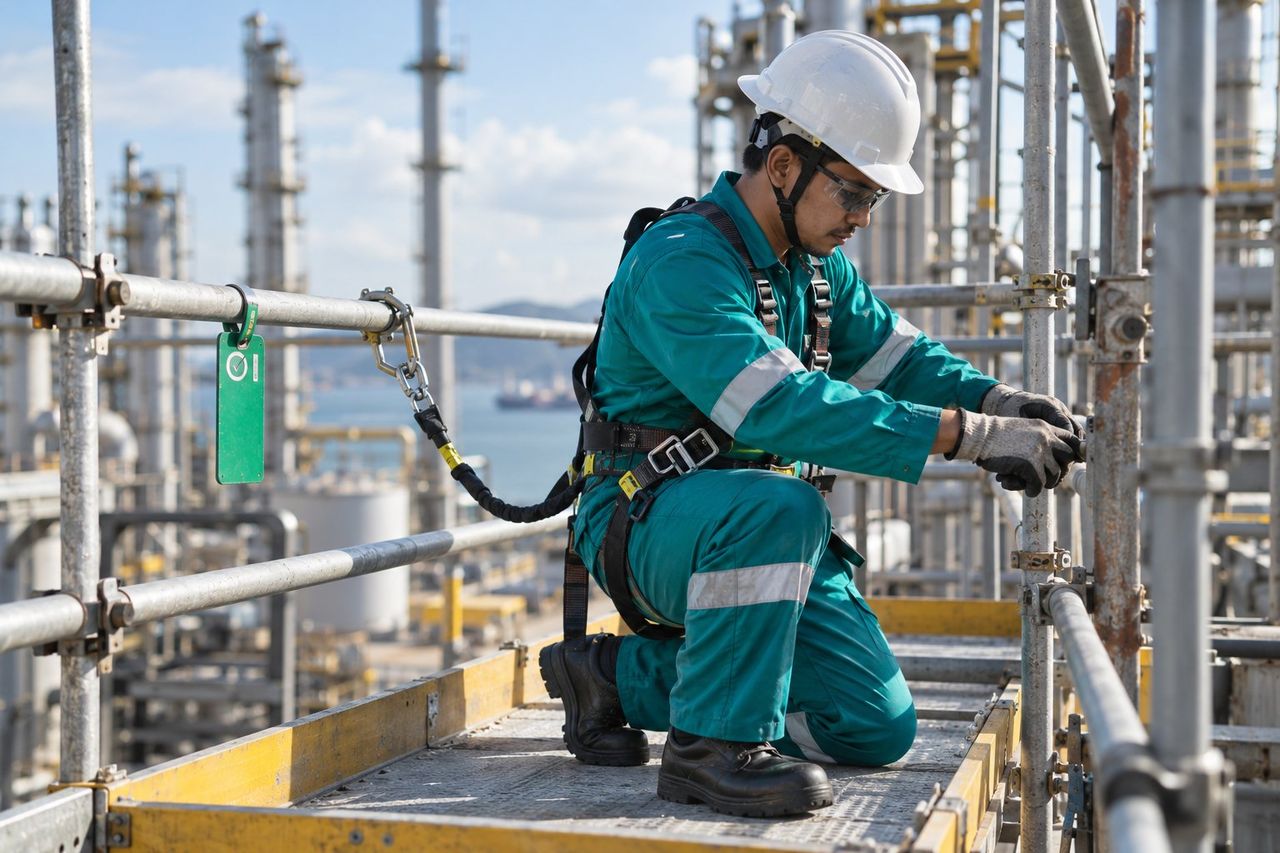 Health, Safety, Security & EnvironmentWorking at HeightScaffolds, ladders, harnesses, MEWPs, dropped objects and rescue: how to stop a fall before it happens.
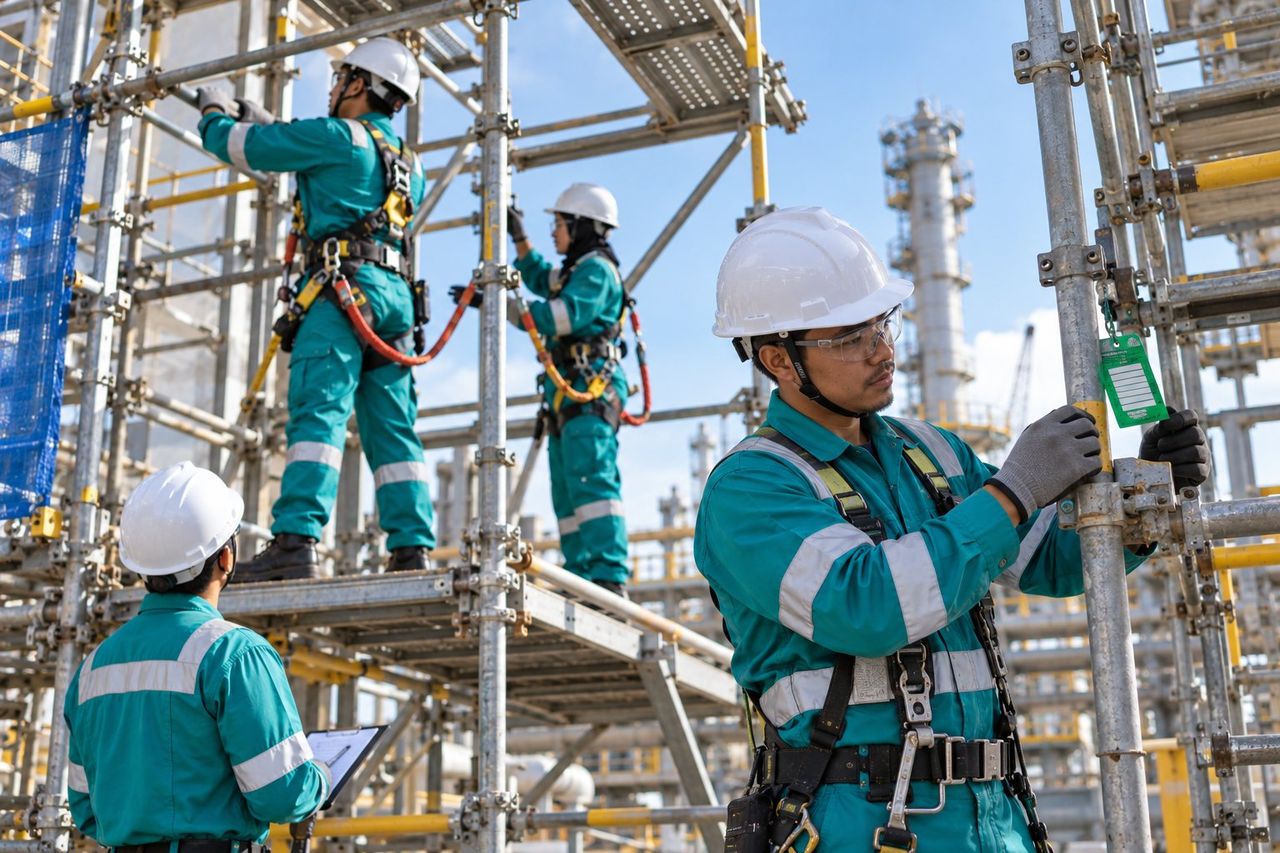 Health, Safety, Security & EnvironmentScaffolding (Erection & Inspection)How scaffolds are built, braced, tied, boarded, inspected and tagged, and what every user must check before climbing on.
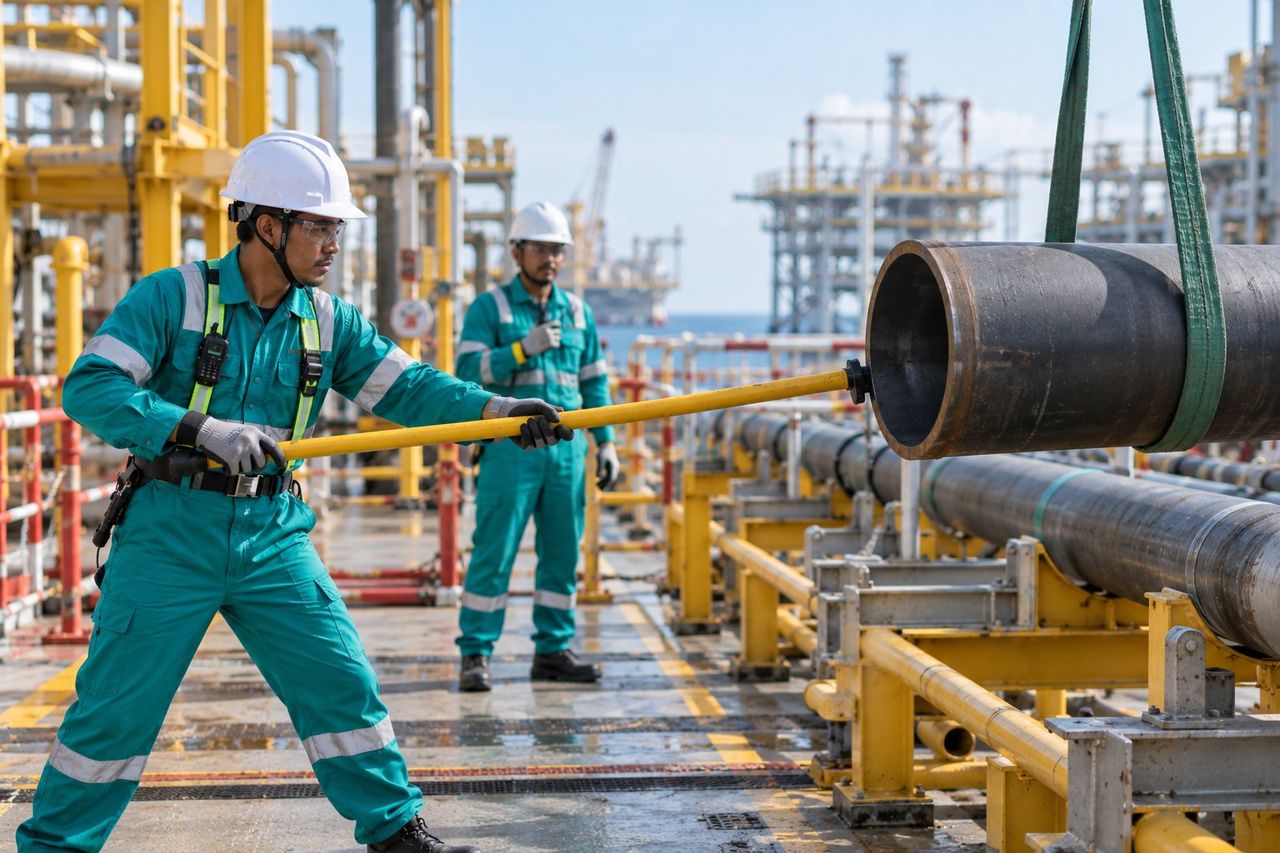 Health, Safety, Security & EnvironmentLine of Fire & Dropped ObjectsMoving loads, stored energy, pinch points, dropped objects and vehicles: learn to ask "where will it go if it fails?" and step out of the path.
 Health, Safety, Security & EnvironmentFalling ObjectsTool tethers, toe boards, brick guards, catch fans, debris chutes, loading platforms and covered walkways: keep everything up there from landing on someone down here.
 Health, Safety, Security & EnvironmentPoles, Ladders & Aerial CableClimb safely on a taman street: check the pole first, set and tie the ladder, use an aerial lift, tension cable, protect the drop zone and stop for lightning.
Frequently asked questions
What height is considered working at height in Malaysia?
Is fall protection a legal requirement?
What is the difference between fall restraint and fall arrest?
Can I tie off to a handrail or pipe?
Why is a rescue plan needed for harness work?
Which DOSH guideline covers falls?
Sources
- Occupational Safety and Health (Amendment) Act 2022 [Act A1648]: sections 15, 18A, 18B, 24, 26A
- P.U.(B) 128/2024: commencement on 1 June 2024 (DOSH)
- DOSH: Guidelines for the Prevention of Falls at Workplaces 2007 (listing)
- DOSH: Rules that have been abolished (regulations under the Factories and Machinery Act 1967)
- Factories and Machinery (Repeal) Act 2022 [Act 835] (DOSH)
- RTM Berita, 5 December 2024: JKKP Director General on 1,144 falls from height reported in 2023
This guide is general information for workplaces in Malaysia, checked against the sources above on 30 October 2026. It is not legal advice; laws and guidelines change, so confirm the current text before you act.