Fire safety training in Malaysia: Bomba rules, fire drills, fire wardens and extinguishers
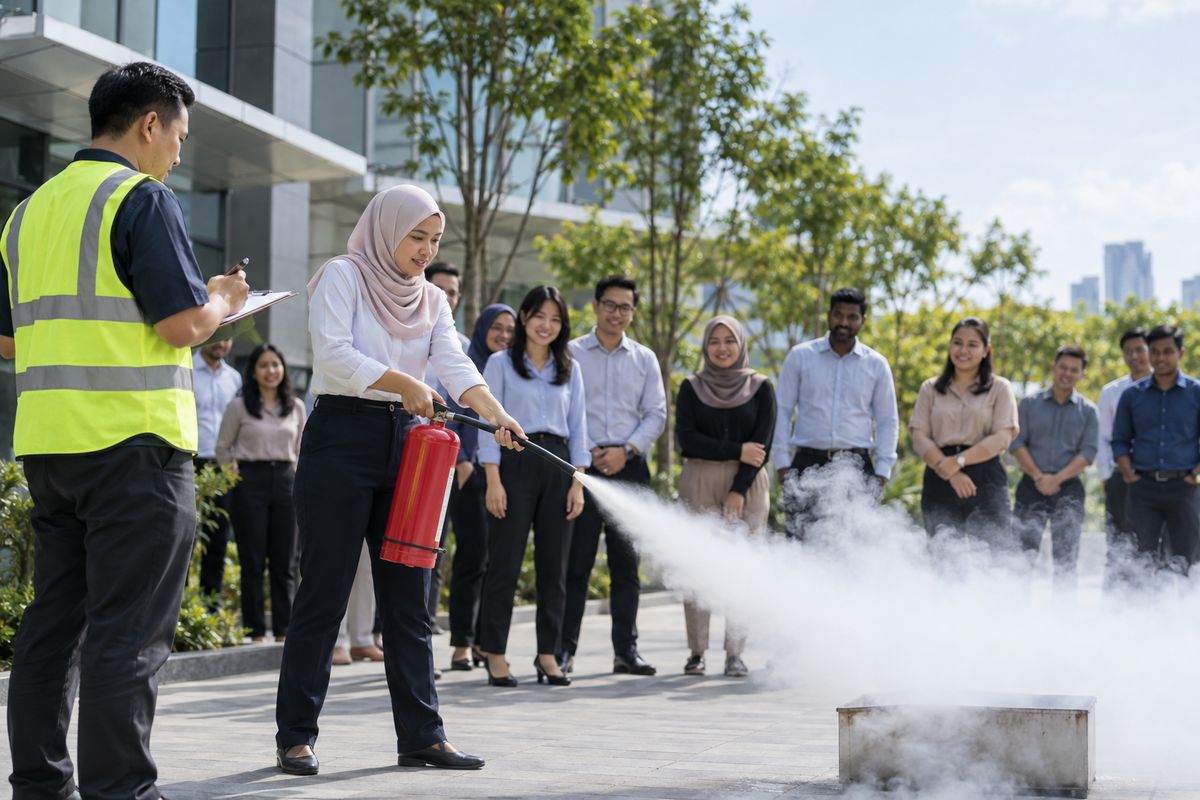
Fire safety training in Malaysia covers what every employee must do when a fire starts: raise the alarm, call 999, evacuate by the escape route, and use an extinguisher only if it is safe. Designated premises also need a fire certificate from Bomba and, under section 27A of the Fire Services Act 1988, a fire safety organisation that runs drills and training.
Which laws cover fire safety at work in Malaysia
Two laws do most of the work. The Fire Services Act 1988 (Act 341) covers buildings: fire hazards, fire-fighting equipment and fire safety installations, fire certificates and, since the amendments, the fire safety organisation inside larger buildings. It is enforced by the Fire and Rescue Department of Malaysia, known as Bomba or JBPM.
The Occupational Safety and Health Act 1994 covers people at work. Section 15 makes every employer responsible, so far as is practicable, for the safety, health and welfare of employees. The 2022 amendments, in force since 1 June 2024, added paragraph 15(2)(f): the development and implementation of procedures for dealing with emergencies that may arise while employees are at work. A fire is the most common emergency that duty has to plan for, and the new section 18B risk assessment should list fire hazards like any other. Our OSHA amendment 2022 guide covers the other changes.
The Fire Services Act also defines a fire hazard broadly. It includes unlawful alterations that make escape harder, overcrowding of public places, missing or faulty fire-fighting equipment or installations, inadequate means of exit, and anything else that materially increases the likelihood or danger of a fire. Bomba can serve a fire-hazard abatement notice under section 8, and failing to comply is an offence under section 10.
Fire certificates and designated premises
The Director General of Bomba decides, by order in the Gazette, which uses, sizes or locations of buildings are designated premises (the Fire Services (Designated Premises) Order 1998, as amended). Typical examples are large offices, factories, hotels, hospitals, shopping centres and high-rise buildings, but always check the current order or ask your local Bomba office whether your building is designated.
- Section 28: every designated premises requires a fire certificate, and it is renewable annually. Places of public religious worship and single private dwellings are exempt, though Bomba can still inspect them if there is a fire hazard.
- Section 29: Bomba issues the certificate when it is satisfied that the fire-fighting equipment and fire safety installations are adequate and in working order.
- Section 33: if no fire certificate is in force for a designated premises, the owner commits an offence, with a fine of up to RM50,000, up to five years in prison, or both.
The Fire Services (Fire Certificate) Regulations were amended from 1 October 2020. According to a law-firm summary of those amendments, an application now has to include the fire safety organisation's certificate of establishment, a Fire and Emergency Response Plan and a Fire Safety Report, and a renewal has to be made before the certificate expires.
The fire safety organisation, fire safety managers and officers
Section 27A of the Fire Services Act requires the owner, occupier or person with overall management of a designated premises to establish a fire safety organisation (Organisasi Keselamatan Kebakaran, OKK). The 2020 regulations, as summarised by a Malaysian law firm, describe it as one Fire Safety Manager and at least three Fire Safety Officers, appointed by the building's management and certified by Bomba.
The same summary lists the organisation's duties, including:
- giving evacuation instructions and using the equipment on site to fight or control a fire until Bomba arrives;
- removing fire hazards;
- preparing the Fire and Emergency Response Plan and the Fire Safety Report;
- maintaining fire-fighting equipment, installations and the fire command centre;
- running fire safety and emergency training for occupants at least once a year; and
- conducting a fire drill at least once a year.
The law was amended again in 2025. In October 2026 Bomba's Director General said the owners of 9,451 designated buildings must appoint Fire Safety Managers and Fire Safety Officers from 1 April 2027, with 6 to 18 months to prepare depending on when their certificate expires, and that annual inspection reports prepared by Fire Safety Managers will be used for fire certificate renewals. Check the dates and your building's position with your local Bomba office.
What fire safety training should cover
Bomba's rules concern the building and its fire safety organisation, but every employee needs the basics. A practical programme covers:
- How fire starts and spreads: the fire triangle (heat, fuel, oxygen), why smoke kills more people than flames, and how doors slow it down.
- Prevention: housekeeping, overloaded sockets and extension leads, hot work, smoking areas, flammable liquids and gas cylinders, and keeping fire doors shut.
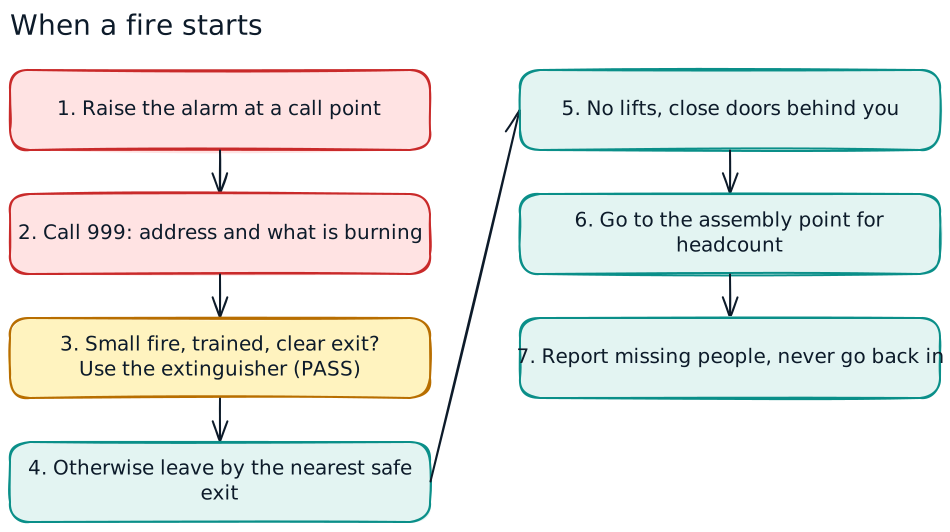
- Raising the alarm: break-glass call points, who calls 999, and what to tell the operator (address, what is burning, anyone trapped).
- Evacuation: two ways out from each area, no lifts, the assembly point and the headcount.
- First response: when to use an extinguisher or hose reel and when to leave. The rule is simple: only tackle a small fire, with your back to a clear exit, if you are trained and it is safe.
- Roles: fire wardens, the emergency response team, and how they hand over to Bomba.
New starters should hear this on their first day as part of the safety induction. Refresh it at least yearly, and after any change to the building, the layout or the emergency plan.
Fire extinguisher types and the PASS method
Use the right extinguisher for the fuel. The common classes and agents are:
| Class | Fuel | Suitable agents |
|---|---|---|
| A | Ordinary solids: paper, wood, fabric, plastics | Water, foam, ABC dry powder |
| B | Flammable liquids: petrol, solvents, paint | Foam, CO2, dry powder. Never water. |
| C | Flammable gases: LPG, natural gas | Isolate the gas supply first; dry powder only to aid escape |
| D | Combustible metals | Special dry powder for metal fires |
| F (K) | Cooking oils and fats | Wet chemical, fire blanket. Never water. |
| Electrical | Live electrical equipment | CO2 or dry powder, after isolating power if safe |
To use a portable extinguisher, remember PASS:
- Pull the pin (break the seal).
- Aim low, at the base of the fire, not the flames.
- Squeeze the handle.
- Sweep side to side across the base until the fire is out, then watch for re-ignition.
Read the label on your own units, because colour codes and agents vary. Check that extinguishers are mounted, visible, unobstructed and within their service dates. In the Fire Safety lesson staff practise choosing the extinguisher and applying PASS on a 3D fire ground before they ever face a real one.
Fire drills and evacuation
A drill tests the plan, the alarm, the routes and the people. Run at least one a year, and more often for high-risk sites, shift patterns or a high turnover of staff. A useful drill:
- Plan it with the fire safety organisation or building management, and tell Bomba or the alarm monitoring company if the alarm is linked.
- Sound the real alarm. Announced drills are fine for a first run; later drills should be unannounced to some staff.
- Time the evacuation from alarm to the last person at the assembly point.
- Take a headcount against the visitor log and attendance, and report missing people to the incident controller, not by going back in.
- Include people who need help: a personal evacuation plan and a buddy for anyone with limited mobility.
- Debrief and record: date, time taken, problems (blocked exits, doors wedged open, alarm not heard), and actions with an owner and date.
For larger incidents the drill should also exercise the emergency response team and incident command. The Emergency Response Centre lesson walks through raising the alarm, muster and headcount, and incident command.
Fire wardens and the emergency response team
Fire wardens (also called floor wardens) are employees who lead evacuation for their area. Typical duties:
- check their area daily for blocked exits, wedged fire doors and fire hazards;
- on the alarm, direct people to the nearest safe exit and sweep toilets, meeting rooms and stores;
- stop people using lifts or going back for belongings;
- report "area clear" or missing people to the chief warden at the assembly point.
Appoint enough wardens to cover every floor and shift, plus deputies for leave. Display their names. An emergency response team goes further: trained members who may use hose reels, isolate utilities, give first aid and meet Bomba on arrival. Where the building has a fire safety organisation under section 27A, agree who does what so the employer's wardens and the building's Fire Safety Officers work to one plan. Pair this guide with first aid at work, because burns and smoke inhalation are the injuries your first aiders will face.
Free training matrix template (printable, A4 landscape)
Track fire warden, emergency response team and first aid training with completion and refresher dates. Print it or save as PDF; no sign-up.
Practise it in WorkQuest2U
Short 3D lessons where staff walk the scene, spot the issues and make the calls. Free to try, with certificates and progress records for companies.
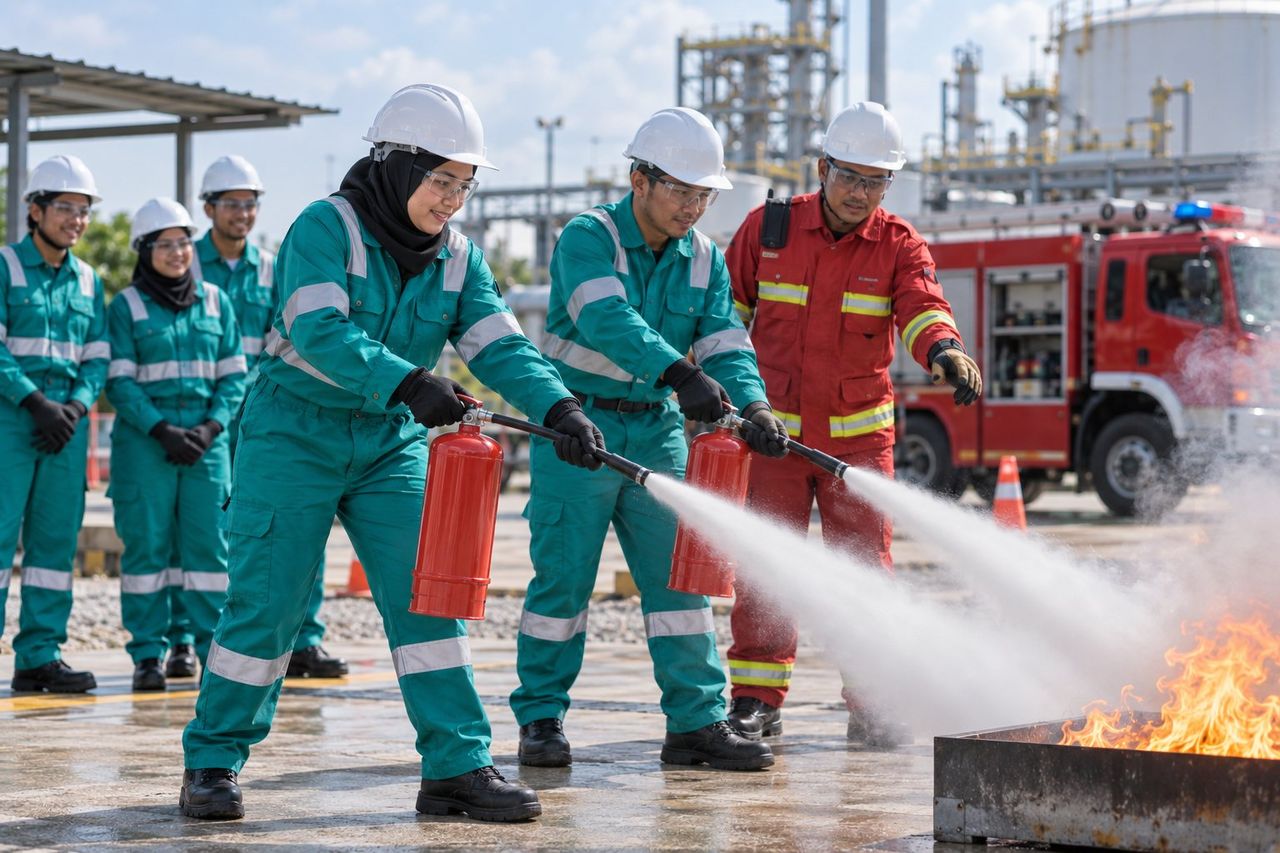 Health, Safety, Security & EnvironmentFire SafetyTrain on a fire ground: fire triangle, classes and extinguishers, PASS, smoke, gas fires and the muster.
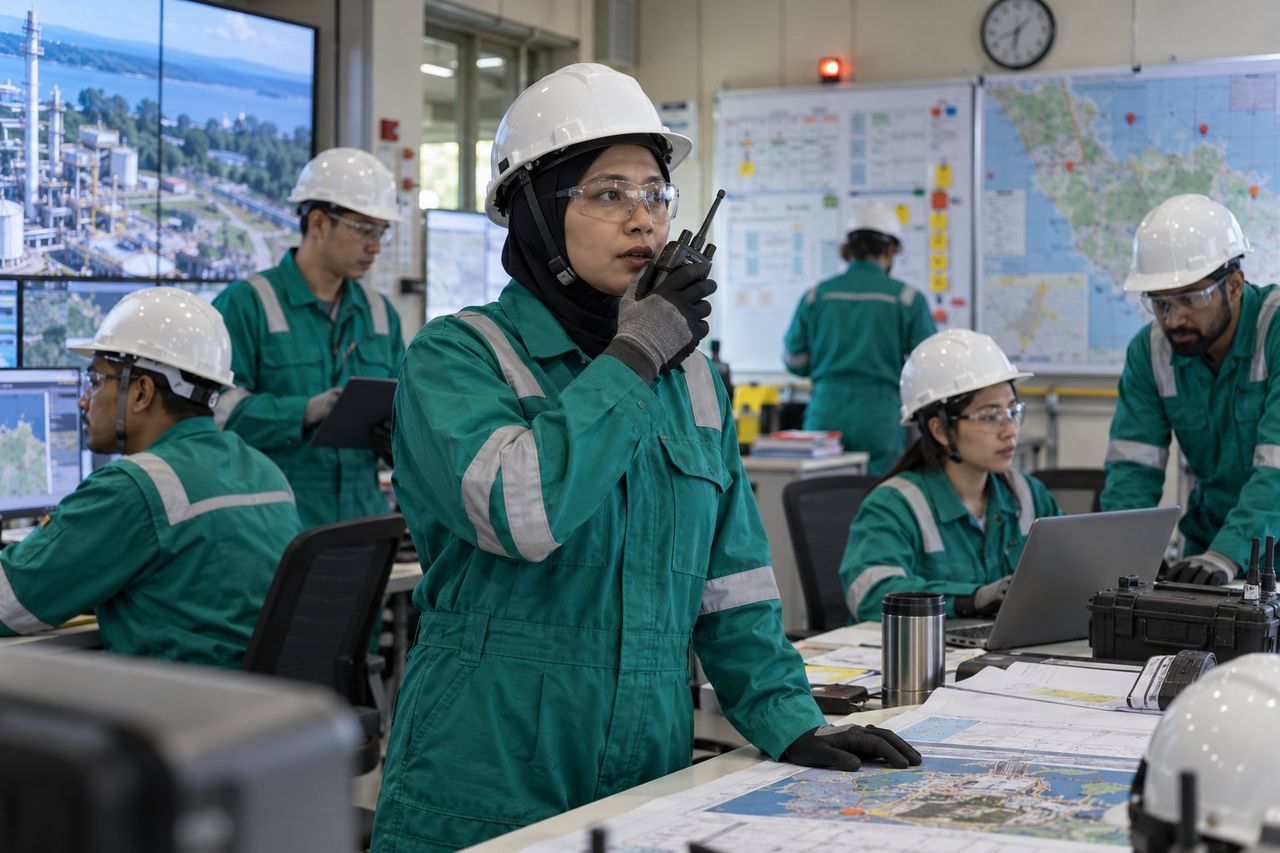 Health, Safety, Security & EnvironmentEmergency Response CentreWhen things go wrong: raising the alarm, muster and headcount, incident command, triage, mutual aid and media.
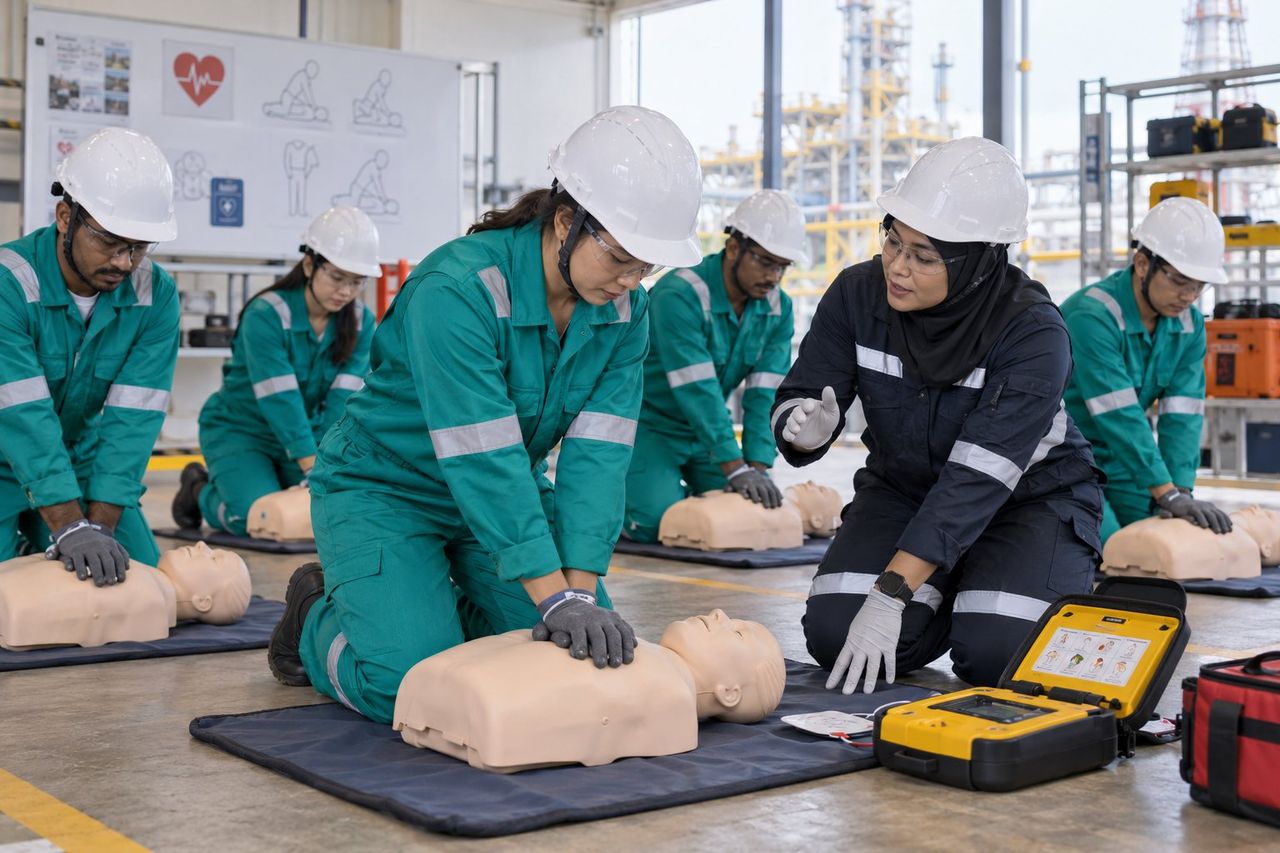 Health, Safety, Security & EnvironmentFirst Aid & CPRPractise the first minutes that save a life: DRSABCD, CPR and the AED, bleeding, burns, heat stroke and eye splashes, always within your training.
 Health, Safety, Security & EnvironmentHome & Festive SafetySafety does not stop at the plant gate: balik kampung driving, mercun, LPG, electrics, fire, water and DIY at home.
Frequently asked questions
Is fire safety training mandatory in Malaysia?
How often should a fire drill be conducted?
What is a fire certificate and who needs one?
What does PASS stand for?
What is the difference between a fire warden and a Fire Safety Officer?
Can a WorkQuest2U lesson replace Bomba-recognised training?
Sources
- Fire Services Act 1988 [Act 341], reprint as at 1 October 2018 (sections 2, 8, 10, 27A, 28, 29, 33)
- Skrine (law firm): Fire safety requirements enhanced, November 2020 (2020 fire certificate amendments, fire safety organisation duties)
- Malay Mail / Bernama, 6 October 2026: designated buildings must appoint Fire Safety Managers from April 2027
- Occupational Safety and Health (Amendment) Act 2022 [Act A1648], section 15(2)(f)
- P.U.(B) 128/2024: commencement on 1 June 2024 (DOSH)
This guide is general information for workplaces in Malaysia, checked against the sources above on 30 October 2026. It is not legal advice; laws and guidelines change, so confirm the current text before you act.