Noise exposure regulations 2019 Malaysia: limits, noise risk assessment and hearing tests
The Occupational Safety and Health (Noise Exposure) Regulations 2019 (P.U.(A) 60/2019) came into force on 1 June 2019. Employers must identify excessive noise (above 82 dB(A) daily), appoint a registered noise risk assessor, keep employees below the 85 dB(A) exposure limit, and provide hearing protection and annual audiometric testing where the limit is exceeded.

What the Noise Exposure Regulations 2019 are
The Occupational Safety and Health (Noise Exposure) Regulations 2019 were made under section 66 of the OSH Act 1994 (Act 514), gazetted as P.U.(A) 60 on 1 March 2019, and came into operation on 1 June 2019. They replaced the Factories and Machinery (Noise Exposure) Regulations 1989, which DOSH lists as revoked in 2019. Because they sit under the OSH Act rather than the Factories and Machinery Act, they apply to every workplace the OSH Act covers, not only factories.
The Regulations set out a sequence: identify whether anyone may be exposed to excessive noise, get a noise risk assessment, control exposure, provide hearing protection, test hearing, and keep records. DOSH also publishes the Industry Code of Practice for Management of Occupational Noise Exposure and Hearing Conservation 2019, which gives practical guidance on putting the Regulations into a hearing conservation programme.
Exposure limit and action level
The Regulations use two sets of numbers. The lower set defines excessive noise, which works as the action level that triggers assessment, information and training. The higher set is the noise exposure limit that no employee may exceed.
| Measure | Excessive noise (action level, regulation 2) | Exposure limit (regulation 6) |
|---|---|---|
| Daily noise exposure level (8-hour) | Above 82 dB(A) | Above 85 dB(A) |
| Daily personal noise dose | Above 50% | Above 100% |
| Maximum sound pressure level, at any time | Above 115 dB(A) | Above 115 dB(A) |
| Peak sound pressure level | Above 140 dB(C) | Above 140 dB(C) |
The daily noise exposure level is the equivalent continuous sound level corrected to a normal eight-hour working day, and the daily dose is the same idea expressed as a percentage. dB(A) is the A-weighted scale used for everyday noise; dB(C) is used for the peak of impact noise such as hammering, steam vents or breakers.
Identification and noise risk assessment
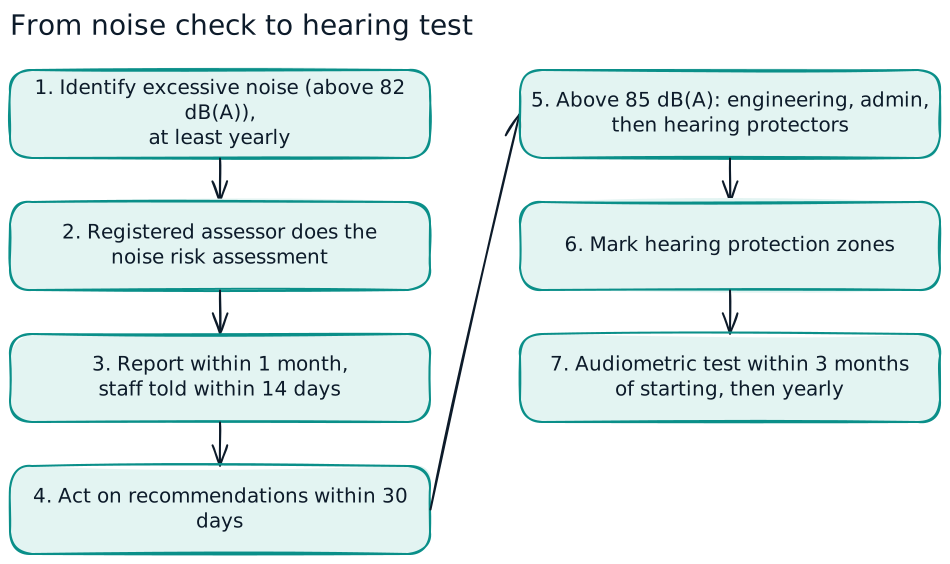
Identify first (regulation 3). Every employer must identify whether employees may be exposed to excessive noise, in the manner DOSH determines. The identification must be repeated whenever machinery, equipment, processes, work, controls or operations change, when DOSH directs, and in any case not more than one year after the previous one.
Noise risk assessment (regulation 4). If the identification shows employees may be exposed to excessive noise, the employer must appoint a noise risk assessor who is registered with the Director General of DOSH and holds a valid DOSH certificate to carry out noise risk assessment. The assessor must use measuring equipment that meets International Electrotechnical Commission standards. The OSH (Amendment) Act 2022 also lists noise monitoring and audiometric testing among the Fifth Schedule activities that only a registered competent person may carry out.
The timeline after the assessment is tight:
- The assessor submits the report, with findings and recommendations, within one month of completing the assessment.
- The employer tells exposed employees the findings and recommendations within 14 days of receiving the report.
- The employer carries out the recommended actions within 30 days of receiving the report.
- The assessment is reviewed not more than five years after the previous one, or earlier if DOSH directs.
For noise that changes with the task, such as maintenance in a turbine hall, make sure the assessor sees the noisy jobs, not only the normal running condition.
Controlling noise: engineering first, hearing protection last
Where the assessment shows anyone is above the exposure limit, regulation 6 requires the employer to reduce the noise and first assess whether engineering or administrative control is practicable. The order is fixed:
- Engineering control where practicable: quieter machines, enclosures, silencers, vibration isolation, barriers, maintenance of worn parts.
- Engineering plus administrative control where engineering alone is not enough.
- Administrative control alone where the first two are not practicable: job rotation, limiting time in noisy areas, scheduling noisy work when fewer people are present.
- Other effective measures, including personal hearing protectors, where administrative control is not practicable either.
The employer must write up this assessment and give DOSH a copy within 30 days of a written request, and must keep engineering controls in efficient working order.
Hearing protectors (regulation 7) must be suitable and efficient, inspected, maintained and always available, approved by DOSH, and able to bring the wearer’s exposure below the limit when worn properly. That last part depends on fit: an earplug half inserted gives far less protection than its rating.
Hearing protection zones (regulation 8). Any area where people are exposed above the limit must be marked “HEARING PROTECTION ZONE” (or as DOSH determines), demarcated with warning signs where practicable, and stocked with hearing protectors. Everyone in the zone, employees and visitors, must wear them.
The Hearing Conservation lesson walks through measuring and mapping noise, controlling it at the source and fitting hearing protection properly, practised in a 3D power-station scene.
Information, training and audiometric testing
Training (regulation 5). Employees the report shows are exposed to excessive noise must get information on how noise affects hearing and on audiometric testing, training on the correct use of hearing protectors, and supervision of noise controls. The training must be given at least once a year.
Audiometric testing (regulations 9 and 10). Where an employee is exposed above the exposure limit, the employer must arrange audiometric testing through a DOSH-approved audiometric testing centre:
- within three months of the employee starting work in the area, and then annually;
- at no cost to the employee;
- after at least 14 hours of quiet (no exposure above 80 dB(A)) without hearing protectors, so temporary shifts do not hide the true result.
An occupational health doctor appointed by the centre interprets each audiogram, and examines any employee with an abnormal result. The centre reports to the employer within 30 days, and the employer must tell the employee the result within 21 days of receiving it.
If the test shows a temporary standard threshold shift (a standard threshold shift is an average shift of 10 dB or more at 2000, 3000 and 4000 Hz compared with the baseline audiogram), the employee must be retested within three months and protected from further damage. If it shows noise-induced hearing loss, hearing impairment or a permanent shift, the employer must notify the nearest DOSH office within seven days, provide hearing protectors if none were given, and train the employee to use them. The doctor separately notifies DOSH within seven days of diagnosing occupational hearing loss.
Hearing loss from noise is permanent and painless, so these tests are often the only early warning. The Health & Wellbeing lesson covers noise and hearing alongside other workplace health checks.
Records, penalties and a compliance checklist
Records (regulation 11). Keep the noise risk assessment report for at least 30 years, and each employee’s audiometric test reports for as long as they work for you plus five years after they leave. If the business is taken over, the records pass to the new owner. Before disposing of records at the end of these periods, give DOSH at least three months’ written notice.
Penalties. Contravening the main duties on identification, assessment, training, exposure limits, hearing protectors, hearing protection zones, audiometric testing and records is an offence carrying a fine of up to RM10,000, imprisonment of up to one year, or both. Carrying out a Fifth Schedule activity such as noise monitoring without competent person registration is a separate offence under section 31B of the OSH Act.
- Walk the site and identify where excessive noise may exist; repeat at least yearly and after changes.
- Appoint a DOSH-registered noise risk assessor and check the certificate.
- Tell exposed staff the findings within 14 days and act on recommendations within 30 days.
- Apply engineering controls before administrative controls and hearing protectors.
- Mark hearing protection zones and stock DOSH-approved protectors at the entrances.
- Train exposed employees every year, including fit checks for protectors.
- Book baseline and annual audiometric tests with an approved centre, and follow up every threshold shift.
- File reports and audiograms for the required periods, and diary the five-year review.
This guide is general information, not legal advice. WorkQuest2U lessons are awareness and practice, not the registered assessment or testing the Regulations require. For other site hazards see HIRARC and toolbox talk topics.
Practise it in WorkQuest2U
Short 3D lessons where staff walk the scene, spot the issues and make the calls. Free to try, with certificates and progress records for companies.
 Health, Safety & EnvironmentHearing ConservationNoise at a power station: where it comes from, how it is measured and controlled, how to wear hearing protection that works, and why hearing tests matter.
 Health, Safety, Security & EnvironmentHealth & WellbeingFitness to work, heat stress, fatigue, dengue, haze, hearing and mental health at a Malaysian plant.
 Health, Safety, Security & EnvironmentDust, Noise & VibrationSilica dust from cutting and hacking, noise from grinders and breakers, and vibration in the hands: invisible harms that show up years later.
Frequently asked questions
What is the noise exposure limit in Malaysia?
What is the action level under the 2019 Regulations?
Who can carry out a noise risk assessment?
How often is audiometric testing required?
How often must a noise risk assessment be reviewed?
What replaced the Factories and Machinery (Noise Exposure) Regulations 1989?
Sources
- DOSH: Occupational Safety and Health (Noise Exposure) Regulations 2019 [P.U.(A) 60/2019], gazette text
- DOSH: Regulations under the Occupational Safety and Health Act 1994 (current list)
- DOSH: Factories and Machinery (Noise Exposure) (Revocation) Regulations 2019 (listing)
- DOSH: Industry Code of Practice for Management of Occupational Noise Exposure and Hearing Conservation 2019 (listing)
- Occupational Safety and Health (Amendment) Act 2022 [Act A1648], section 31B and Fifth Schedule
This guide is general information for workplaces in Malaysia, checked against the sources above on 30 October 2026. It is not legal advice; laws and guidelines change, so confirm the current text before you act.