Minimum wage Malaysia: current rate, hourly and daily rates, and employer duties
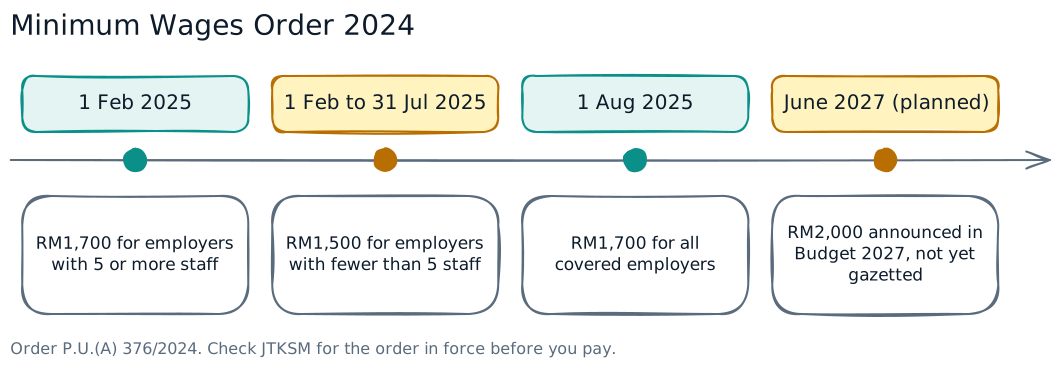
The minimum wage in Malaysia is RM1,700 a month, or RM8.72 an hour, under the Minimum Wages Order 2024. It has applied to employers with five or more employees, and to professional activities, since 1 February 2025, and to all other employers since 1 August 2025. Budget 2027 announced a rise to RM2,000 from June 2027, but no new order has been gazetted yet.

The current minimum wage in Malaysia
Minimum wages are set under the National Wages Consultative Council Act 2011 [Act 732]. The National Wages Consultative Council recommends a rate, and once the Government agrees, the Minister of Human Resources makes a minimum wages order in the Gazette (section 23).
The order in force is the Minimum Wages Order 2024, P.U. (A) 376, made on 2 December 2024 and published on 4 December 2024. It revoked the Minimum Wages Order 2022 [P.U. (A) 140/2022], which had set RM1,500. The 2024 Order sets one rate for Peninsular Malaysia, Sabah and Sarawak alike:
| Monthly | Daily: 6-day week | Daily: 5-day week | Daily: 4-day week | Hourly |
|---|---|---|---|---|
| RM1,700 | RM65.38 | RM78.46 | RM98.08 | RM8.72 |
The Order does not apply to domestic servants as defined in the Employment Act 1955 and the Sabah and Sarawak Labour Ordinances. Act 732 defines the employees it covers by reference to the schedules of the Employment Act 1955 and the Sabah and Sarawak Labour Ordinances, so the starting point is the same group of employees those laws protect.
Effective dates and the small-employer deferral
The 2024 Order came in two stages:
| Period | Employers covered | Rate |
|---|---|---|
| From 1 February 2025 | Employers with five or more employees, and any employer carrying out a professional activity classified under the Malaysia Standard Classification of Occupations (MASCO), regardless of headcount | RM1,700 |
| 1 February to 31 July 2025 | Employers with fewer than five employees, other than professional activities | RM1,500 (RM7.21 an hour) |
| From 1 August 2025 | Employers with fewer than five employees, other than professional activities | RM1,700 |
So the deferral is over. Since 1 August 2025 every covered employer, large or small, must pay at least RM1,700. A clinic, accounting practice, architecture firm or similar professional business with only two staff has had to pay RM1,700 since 1 February 2025.
Hourly and daily rates, and part-time workers
The daily and hourly figures in the Order are the floor for employees who are paid by the day or by the hour. They line up with the monthly rate:
- Daily rate: RM65.38 for a 6-day week, RM78.46 for 5 days and RM98.08 for 4 days. Each equals RM1,700 × 12 months ÷ (52 weeks × working days per week).
- Hourly rate = RM8.72, whatever the number of days in the working week.
Part-time workers are not excluded. A part-timer paid by the hour must get at least RM8.72 for every hour worked, and a part-timer paid by the day at least the daily rate for their working pattern. Agree the hourly or daily rate in writing, and make sure rosters, timesheets and payroll use the same hours.
Two quick checks for payroll:
- For an hourly employee, basic pay ÷ hours worked in the period must be at least RM8.72.
- For a daily employee on a 5-day week, basic pay ÷ days worked must be at least RM78.46.
What counts as wages for the minimum wage
Act 732 defines minimum wages as basic wages. That is the figure to compare with RM1,700. Allowances, overtime, bonuses and incentives are paid on top; they cannot be used to top up a basic wage that is below the floor.
- Contracts below the rate are overridden. Section 24 says that where the basic wage in a contract of service (including a collective agreement) is lower than the minimum, it is replaced by a rate not lower than the minimum. An employee cannot agree to less.
- Higher pay cannot be cut. Where the agreed basic wage is already above the minimum, section 24 says it must not be reduced to a lower rate. Employers cannot restructure pay downwards to absorb a rise.
- Piece rate, tonnage, task, trip or commission. An employee who gets no basic wage and is paid only on output must still receive at least RM1,700 a month under the Order.
- Knock-on payments. Some payments are calculated from basic wages. If an employer is convicted, the court can order it to pay both the shortfall in basic wages and the other payments that should have been calculated on the correct basic wage (section 44).
The Pay, Payslips & Claims lesson shows staff how to read a payslip line by line, including basic pay, allowances and statutory deductions, so they can spot an underpayment early.
Penalties under the National Wages Consultative Council Act 2011
| Provision | What it says |
|---|---|
| Section 43 | An employer who fails to pay basic wages as specified in the minimum wages order commits an offence: fine of up to RM10,000 for each employee. |
| Section 44 | On conviction, the court may order the employer to pay the difference, including outstanding arrears, and other payments accrued from the correct basic wage. If the employer does not pay, the court can issue a warrant to levy the employer’s property. |
| Section 46 | Continuing offence: an extra daily fine of up to RM1,000 for each day the offence continues after conviction. |
| Section 47 | Repeated offence: fine of up to RM20,000 or imprisonment of up to 5 years. |
| Sections 48 and 49 | The employer is liable for offences by its directors, officers, employees or agents, and directors, managers and similar officers of a company can be charged too. |
Enforcement officers under the Act are the officers appointed under the Employment Act 1955 and the Sabah and Sarawak Labour Ordinances, in practice the Labour Department. The Ministry of Human Resources names the Labour Departments of Peninsular Malaysia (JTKSM), Sabah and Sarawak as the complaint channels for underpaid workers.
What is next: RM2,000 announced for June 2027
Act 732 requires the Council to review the minimum wages order at least once every two years (section 25). In the Budget 2027 speech on 9 October 2026, the Prime Minister announced that the minimum wage will rise from RM1,700 to RM2,000 a month from June 2027, with a temporary exemption for micro, small and medium enterprises with annual sales below RM50 million. The Government also announced a separate RM2,500 monthly minimum for semi-skilled workers and graduates; details were not published at the time.
As of the review date of this guide, no new minimum wages order had been gazetted. Until it is, RM1,700 remains the legal minimum. When the order appears, check the exact effective date, the exemption criteria and any new hourly and daily rates before changing payroll. If your business might be exempt, keep the sales evidence you would need to rely on it.
Employer compliance checklist
- Check every employee’s basic wage against RM1,700, or the daily or hourly rate for their pay basis. Include interns on employment contracts, probationers, part-timers and foreign workers.
- Review output-based pay: commission-only, piece-rate and trip-rate staff must reach at least RM1,700 a month.
- Do not use allowances to make up the floor, and do not cut basic pay that is already above it.
- Fix contracts and offer letters that still show the old RM1,500 rate.
- Pay any arrears since 1 February 2025 (or 1 August 2025 for small, non-professional employers) and keep the calculation.
- Keep records: contracts, timesheets, payslips and payroll reports that show basic wages separately.
- Plan for RM2,000: model the cost now, and watch for the gazetted order and the MSME exemption rules.
- Brief managers and staff. Supervisors approve hours and claims; staff need to read their payslips.
HR teams can pair this with the HR Service Centre lesson on contracts and who the law covers, and the Shift Change Room lesson on working hours, overtime and honest clocking, both played in short 3D scenes.
Practise it in WorkQuest2U
Short 3D lessons where staff walk the scene, spot the issues and make the calls. Free to try, with certificates and progress records for companies.
 HR Compliance & Respect at WorkPay, Payslips & ClaimsA payroll and finance office with a claims drop box: read your payslip, know your EPF, SOCSO, EIS and PCB, and claim honestly.
 HR Compliance & Respect at WorkHR Service CentreStart here: your contract, the employee handbook, who the law covers, the HR portal, probation and keeping personnel records confidential.
 HR Compliance & Respect at WorkShift Change RoomA plant shift-change room and time-clock gate: working hours, rest days, overtime, shift handover, public holidays, honest clocking and fatigue.
 HR Compliance & Respect at WorkLeave & Time OffThe HR leave counter, a team leave planner and the panel clinic: annual, sick, hospitalisation, maternity and paternity leave, planned fairly.
Frequently asked questions
What is the minimum wage in Malaysia now?
What is the minimum hourly wage in Malaysia?
Do part-time workers get the minimum wage?
Do allowances count towards the RM1,700 minimum wage?
When will the minimum wage become RM2,000?
What is the penalty for not paying minimum wage?
Sources
- Minimum Wages Order 2024 [P.U. (A) 376], Federal Gazette 4 December 2024 (copy)
- National Wages Consultative Council Act 2011 [Act 732], reprint hosted by JTKSM
- Ministry of Human Resources (KESUMA): media statement on the RM1,700 minimum wage
- The Star, 9 October 2026: Budget 2027, minimum wage to rise to RM2,000 from June 2027
This guide is general information for workplaces in Malaysia, checked against the sources above on 30 October 2026. It is not legal advice; laws and guidelines change, so confirm the current text before you act.