Anti-Sexual Harassment Act 2022: the Tribunal, employer duties and your workplace policy
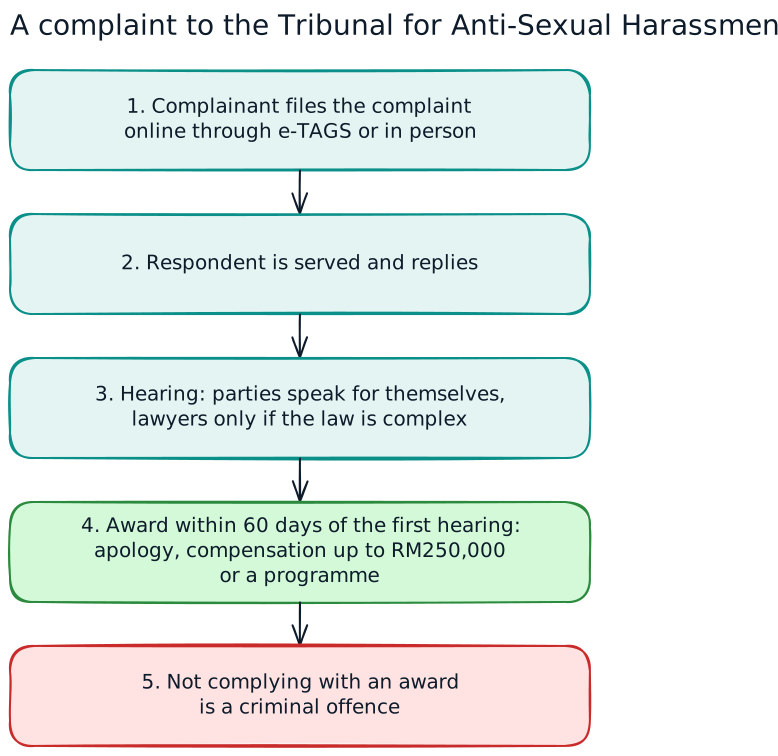
The Anti-Sexual Harassment Act 2022 (Act 840) set up the Tribunal for Anti-Sexual Harassment (TAGS), which has heard complaints since 8 March 2024. Anyone sexually harassed, at work or elsewhere, can file a complaint against the harasser. The Tribunal decides within 60 days of the first hearing and can order an apology, compensation of up to RM250,000, or attendance at a programme.

What the Anti-Sexual Harassment Act 2022 is
The Anti-Sexual Harassment Act 2022 (Act 840) gives people who have been sexually harassed a route to redress that is faster and cheaper than going to court. It came into force in stages: sections 1, 2, 24, 25 and 26 on 28 March 2023, and the Tribunal for Anti-Sexual Harassment (Tribunal Anti Gangguan Seksual, or TAGS), established under section 3, began operating on 8 March 2024, when the Tribunal regulations came into operation. The Ministry of Women, Family and Community Development (KPWKM) is responsible for the Act.
The Act defines sexual harassment as any unwanted conduct of a sexual nature, in any form, whether verbal, non-verbal, visual, gestural or physical, directed at a person, which is reasonably offensive or humiliating or is a threat to their well-being.
Unlike the Employment Act, Act 840 is not limited to the workplace or to employer and employee. A complaint can be about a colleague, a client, a supplier’s staff, or someone the complainant has never worked with. That is why it matters to employers: conduct that happens at a work dinner, in a team chat or on a client site can end up at the Tribunal, and the employer may be asked for evidence or witnesses.
The Act creates no new crime of sexual harassment. Filing a Tribunal complaint does not stop anyone from making a police report about related criminal conduct under other laws.
Who can complain, and how
Any individual who has been sexually harassed can file a complaint against the individual who harassed them. A guardian or next friend can file for a minor or a person with a disability. Law firm guidance notes the Tribunal covers incidents from 8 March 2024 onwards, and complaints are subject to the Limitation Act 1953.
The process, set out in the Anti-Sexual Harassment (Tribunal for Anti-Sexual Harassment) Regulations 2024:
- File Form 1 (the complaint) with a fee of RM30, at the TAGS office or online at etags.kpwkm.gov.my, where fees can also be paid.
- Serve it. The complainant serves the sealed Form 1 on the respondent within 14 working days of receiving it back.
- Defence. The respondent files a statement of defence (Form 2) with a fee of RM10 within 14 working days.
- Hearing. Notice of the hearing is served at least 14 working days ahead. Hearings are held in private. Parties may not be represented by lawyers unless the matter involves complex issues of law, though they can take legal advice on the paperwork.
- Award. Under section 19(1), the Tribunal must make its award without delay and, where practicable, within 60 days from the first day of the hearing.
An employee does not need to use the employer’s grievance process first, and can go to the Tribunal whatever the internal inquiry found. The same issues, however, cannot be pursued against the same party in both the Tribunal and the civil courts.
Tribunal awards and enforcement
If the complaint is proven, the Tribunal may order the respondent to do one or more of the following:
- issue a statement of apology to the complainant;
- publish the apology, where the harassment happened in public;
- pay compensation or damages of up to RM250,000;
- attend a programme the Tribunal considers necessary.
It may also dismiss a complaint it finds frivolous or vexatious. Awards are final and enforceable as court orders. Failing to comply with an award is an offence under section 21, punishable by a fine of up to twice the compensation awarded, imprisonment of up to two years, or both.
The Tribunal’s first award, announced by KPWKM in July 2024, ordered a male employer to apologise to the complainant. By 7 June 2026, the Tribunal had received 99 complaints and resolved 80 of them within 60 days of the first hearing. In June 2026, the High Court upheld a RM60,000 award in a case about the misuse of private photographs after a relationship ended, the first contested Tribunal ruling to be upheld in court.
How it sits with the Employment Act: employer duties
Act 840 gives the complainant a claim against the harasser. It does not replace the employer’s own duties, which sit in Part XVA of the Employment Act 1955 and, since 1 January 2023, apply to all employees regardless of wage.
| Duty | What it means |
|---|---|
| Inquire into complaints | On receiving a complaint of sexual harassment, the employer must inquire into it in the prescribed manner. |
| Refuse only on set grounds | An employer may refuse to inquire only if the complaint was already inquired into and not proven, or it considers the complaint frivolous, vexatious or not made in good faith. It must tell the complainant in writing, with reasons, within 30 days of receiving the complaint. |
| Act on findings | If harassment is proven, the employer must take disciplinary action, which may include dismissal without notice, downgrading, or another punishment it considers just. |
| Display a notice | Section 81H, added by the 2022 amendment, requires employers to display a notice conspicuously at the workplace to raise awareness of sexual harassment. |
| Penalty | Failing to meet these duties is an offence under section 81F, with a fine of up to RM50,000 (raised from RM10,000 on 1 January 2023). |
So a single incident can run on two tracks: the employer’s internal inquiry under the Employment Act, and the employee’s complaint to the Tribunal under Act 840. Run your inquiry properly regardless, keep records, and expect the Tribunal to ask you to preserve evidence or let witnesses attend. For other 2022 Employment Act changes, see Employment Act amendment 2022.
What a sexual harassment policy should include
Law firm commentary is clear that the Act does not require a written policy, but without one the Employment Act duties are hard to meet consistently. A workable policy covers:
- A plain definition with workplace examples: comments, jokes, messages and images in chats, staring, unwanted touching, requests for dates linked to work benefits.
- Scope: employees, interns, contractors, clients and visitors, and settings beyond the office such as site visits, travel, work events and online channels.
- Several reporting routes, including at least one that bypasses the line manager, and how anonymous concerns are handled.
- The inquiry procedure: who receives complaints, the 30-day decision on whether to inquire, how the inquiry is run, and how both sides are heard.
- Interim protection: separating the parties, changing reporting lines or shifts, without disadvantaging the complainant.
- No retaliation against complainants or witnesses, and what happens if it occurs.
- Confidentiality and how records are kept, in line with the PDPA.
- Outcomes: the range of disciplinary action, and support for the complainant.
- External routes: the Tribunal, the Labour Department and the police, so staff know their options.
- Training and review: who is trained, how often, and when the policy is reviewed.
Display the section 81H notice where staff will see it, and put the policy in the induction pack.
Manager and bystander duties
Most complaints first reach a line manager, informally. What happens in that first conversation decides whether the employer’s duty to inquire is met.
Managers should:
- treat any report as a possible complaint, even if the person says “I don’t want to make it formal”;
- listen, write down what was said, and pass it to HR the same day;
- not investigate alone, confront the alleged harasser, or judge the report themselves;
- watch for retaliation in rosters, appraisals and team dynamics afterwards.
Bystanders can use the familiar options: interrupt or distract, speak to the person targeted afterwards, report what they saw, or ask a manager to step in. Doing nothing signals that the behaviour is acceptable.
The Anti-Sexual Harassment lesson puts staff in an office, a corridor, a team chat and an HR room to practise these moments, including the employer’s duty to inquire and the Tribunal. Respectful Workplace covers stepping in safely, and How to Raise a Grievance shows the internal route from a quiet word to a written outcome.
Common mistakes employers make
- Waiting for a “formal” complaint. The duty to inquire starts when a complaint is received; a manager who hears it is part of the employer.
- Missing the 30-day reply when deciding not to inquire.
- Letting the line manager investigate a report about their own team, or about themselves.
- Mediation as a substitute for an inquiry, or pressure to settle quietly.
- Moving the complainant instead of the respondent.
- Policy only on paper: no notice displayed, no training, managers unsure what to do.
- Assuming the Tribunal is not your problem because it is between two individuals. Your records, witnesses and response will be examined.
Practise it in WorkQuest2U
Short 3D lessons where staff walk the scene, spot the issues and make the calls. Free to try, with certificates and progress records for companies.
 HR Compliance & Respect at WorkAnti-Sexual HarassmentAn office floor, a corridor, a team chat and a private HR room: what counts as sexual harassment, consent and power, the employer's duty to inquire, the Tribunal and how to report safely.
 HR Compliance & Respect at WorkRespectful WorkplaceAn office, a video call, the canteen and a team dinner: recognise harassment, bullying and discrimination, step in safely, and know how to report.
 HR Compliance & Respect at WorkHow to Raise a GrievanceA noticeboard, the grievance desk and a meeting room: raise a work concern the right way, from a quiet word to a written outcome and appeal, and know the outside routes.
 HR Compliance & Respect at WorkSpeak Up & WhistleblowingA quiet room, the speak-up kiosk, a manager's office and the investigation room: when and how to raise concerns, and how reporters are protected.
 HR Compliance & Respect at WorkAnti-bullying & Psychosocial SafetyA plant site office and control room: what bullying is and is not, its forms, why it is a safety hazard, the law, manager duties, intervening, recording and getting support.
Frequently asked questions
What is the maximum compensation under the Anti-Sexual Harassment Act 2022?
How do I file a complaint with the Tribunal for Anti-Sexual Harassment?
Do I need a lawyer for the Tribunal?
How long does the Tribunal take to decide?
Can an employee go to the Tribunal if the company already investigated?
What happens if the harasser does not comply with the award?
Sources
- e-TAGS: Tribunal for Anti-Sexual Harassment online complaints (KPWKM)
- Lee Hishammuddin Allen & Gledhill: the framework of Malaysia’s Anti-Sexual Harassment Tribunal (law firm summary)
- Skrine: Anti-Sexual Harassment Tribunal issues its first award (law firm summary)
- Richard Wee Chambers: filing a complaint with TAGS (law firm summary)
- Legal 500: Anti-Sexual Harassment Act 2022 (law firm summary, commencement)
- Donovan & Ho: employers’ statutory obligations against sexual harassment (law firm summary)
- New Straits Times: 99 sexual harassment complaints filed with tribunal since 2024 (June 2026)
This guide is general information for workplaces in Malaysia, checked against the sources above on 30 October 2026. It is not legal advice; laws and guidelines change, so confirm the current text before you act.