Workplace bullying in Malaysia: the law, employer duties and what managers must do
Malaysia has no statute just for workplace bullying, but it is covered from several sides: since 11 July 2025 the Penal Code (sections 507B to 507G) makes harassing, threatening and abusive conduct a crime, the OSH Act 1994 makes psychosocial risks part of the employer’s safety duty, and serious bullying an employer ignores can support a constructive dismissal claim.

What workplace bullying is, and what it is not
Workplace bullying is repeated, unreasonable behaviour directed at a worker or group that creates a risk to their health and safety. It is usually a pattern rather than a single bad day. Common forms include:
- Verbal: shouting, insults, belittling remarks, threats, jokes at someone’s expense.
- Work-related: setting impossible deadlines, withholding information needed to do the job, overloading or stripping away duties, unfair rostering.
- Social: deliberately excluding someone from meetings, chats or team events, spreading rumours.
- Online: abusive messages in team chats, email or social media, sharing someone’s personal details to embarrass or frighten them.
- Physical: pushing, blocking, damaging belongings, intimidating body language.
Bullying is not reasonable management action carried out in a reasonable way. Setting clear targets, giving honest feedback on poor performance, running a fair disciplinary process or refusing leave for an operational reason are part of normal work. The test is how it is done: feedback given privately and specifically is management; the same message shouted in front of the team every week is not.
Sexual harassment is a separate legal track with its own Act and Tribunal. See Anti-Sexual Harassment Act 2022.
Is workplace bullying a crime in Malaysia? The 2025 Penal Code amendments
The Penal Code (Amendment) Act 2025 received Royal Assent on 25 February 2025, was gazetted on 7 March 2025 and came into force, together with amendments to the Criminal Procedure Code, on 11 July 2025. It added new sections 507B to 507G. They apply to everyone, including colleagues and managers at work, and they cover conduct online as well as face to face.
| Section | What it covers | Maximum penalty |
|---|---|---|
| 507B | Threatening, abusive or insulting words, communication or acts intended to cause harassment, distress, fear or alarm | 3 years’ jail, a fine, or both |
| 507C | Such words or acts that are likely to make a person feel harassed, distressed, fearful or alarmed | 1 year’s jail, a fine, or both |
| 507D | Causing a person to believe harm will be caused to them or someone else; or provoking a person to harm themselves or another | 1 year; up to 10 years for provoking harm |
| 507E, 507F | Publishing someone’s identity information (doxing) to harass or frighten them, or to facilitate harm | 3 years’ jail, a fine, or both |
| 507G | Definitions, including “harm” (physical or mental) and “identity information” | - |
The penalty summary above follows a law-firm review of the amending Act; check the gazetted text before relying on it. For employers, the practical point is that serious bullying is no longer “just an HR matter”. A victim can make a police report, and an internal investigation should not be used to discourage that.
The employer’s duty under the OSH Act and DOSH’s PRisMA 2024
Under the Occupational Safety and Health Act 1994, employers must ensure, so far as is practicable, the safety, health and welfare at work of their employees. Health includes mental health. Since the 2022 amendments, section 18B also requires every employer, self-employed person and principal to carry out a risk assessment of the safety and health risks from their work and to implement controls where needed. The Act provides a fine of up to RM500,000 for breaching section 18B. See OSHA amendment 2022 for the wider changes.
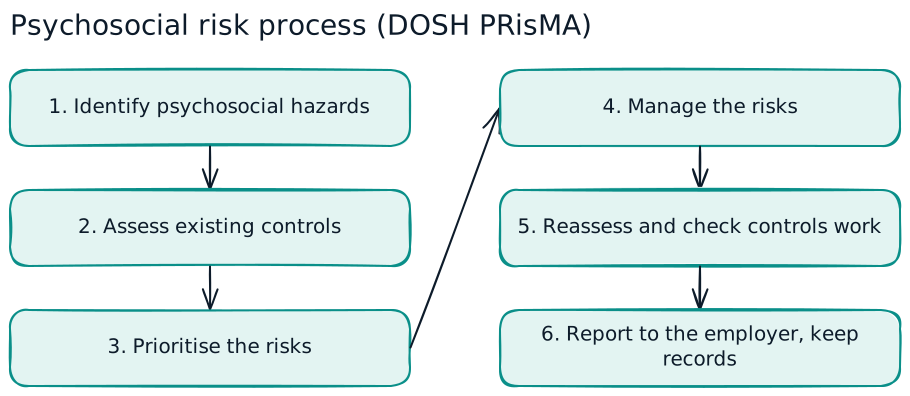
In 2024 the Department of Occupational Safety and Health issued the Guidelines on Psychosocial Risk Assessment and Management at the Workplace (PRisMA) 2024. They list “organisational culture: bullying, harassment or discrimination” among the psychosocial risk factors, alongside workload, job control, role clarity and work-life balance. The guidelines say employers shall conduct risk assessments as the Act requires and should appoint a Psychosocial Trained Person (PTP) to help. The PTP process has six steps:
- Identify psychosocial hazards in the workplace.
- Assess existing control measures.
- Prioritise the risks found.
- Manage the risks.
- Reassess and check whether the controls work.
- Present findings to the employer and keep records.
PRisMA also gives employees a duty: cooperate with the assessment and report psychosocial issues to the employer. In other words, a bullying problem the employer knows about, or would find with a proper assessment, belongs in the same risk register as a slippery floor.
Constructive dismissal: when bullying pushes someone out
Some bullied employees resign. If they believe the employer’s conduct forced them out, they can claim constructive dismissal under section 20 of the Industrial Relations Act 1967. Malaysian courts apply the contract test from Wong Chee Hong v Cathay Organisation: did the employer’s conduct amount to a significant breach going to the root of the contract? Later cases set out four conditions:
- There was a breach of contract by the employer.
- The breach was serious enough to justify resigning.
- The employee left because of the breach, not for another reason.
- The employee did not delay too long, which can be treated as accepting the situation.
An employee who claims dismissal without just cause must file a representation with the Director General of Industrial Relations within 60 days of the dismissal. Where a manager bullies with the employer’s backing, or the employer ignores repeated complaints, an employee may argue that this is the kind of breach the test describes. Whether it succeeds depends on the facts and the evidence, which is why records of complaints and how they were handled matter so much on both sides.
Grievance handling: from first report to outcome
A fair, quick and confidential grievance route is the employer’s best defence and the employee’s best chance of a fix. A workable process looks like this:
- More than one door. Staff can report to their manager, the next level up, HR or a confidential channel, so nobody has to report to the person bullying them.
- Written acknowledgement within a set number of working days, and a named person handling the case.
- Interim protection where needed: change reporting lines, rosters or seating, without moving or penalising the complainant.
- A fair investigation by someone independent of the people involved, with both sides heard, witnesses interviewed and evidence such as chat logs preserved.
- A written outcome with reasons, any action taken under the disciplinary policy, and a right of appeal.
- No retaliation, stated in the policy and checked afterwards in appraisals, rosters and team dynamics.
- Outside routes stay open. Make clear that using the internal route does not stop anyone making a police report or going to the authorities.
The How to Raise a Grievance lesson walks a learner from a quiet word to a written outcome and appeal, and Discipline & Due Process shows how a fair domestic inquiry runs when the investigation supports a complaint.
What managers must do
Most bullying is first noticed, or first reported, at team level. What a manager does in the first conversation often decides whether the employer meets its duty.
- Model the standard. Give feedback privately and specifically, and never use public humiliation as a management tool.
- Step in early. Stop insulting “banter” and exclusion when you see them; say plainly that the behaviour is not acceptable.
- Treat every report as a possible complaint, even if the person says “don’t make it formal”. Listen, write down what was said, and pass it to HR the same day.
- Do not investigate alone or confront the alleged bully yourself. Agree interim steps with HR.
- Watch for warning signs: sudden absence, a drop in performance, a team member always left out, fear of a particular supervisor.
- Point people to support, such as the employee assistance programme, and know the urgent-help route if someone talks about self-harm.
- Follow up after the case closes to check the behaviour has stopped and there is no retaliation.
The Anti-bullying & Psychosocial Safety lesson puts managers in a 3D site office and control room to practise these steps: telling bullying apart from firm management, intervening, recording and getting support. Respectful Workplace covers stepping in safely as a bystander, and Wellbeing & Mental Health covers checking in on a colleague who is struggling.
Anti-bullying policy checklist for HR
- A clear definition of bullying with workplace examples, including online conduct, and what reasonable management action looks like.
- A statement that serious bullying may also be a crime under the Penal Code, and that staff may report to the police.
- Reporting channels, timelines, confidentiality rules and a no-retaliation clause.
- Investigation and disciplinary steps that match your existing disciplinary policy.
- Psychosocial hazards, including bullying, included in the OSH risk assessment, with a PTP or other trained person involved.
- Support: EAP or counselling contacts, and adjustments while a case is open.
- Training for all staff, and deeper training for managers and HR on handling reports.
- Records: a confidential case log, outcomes and trend reports to management, reviewed at least yearly.
A policy only works if people know it exists and believe it will be used. Short practice in realistic scenes builds that confidence faster than a signed handbook page.
Practise it in WorkQuest2U
Short 3D lessons where staff walk the scene, spot the issues and make the calls. Free to try, with certificates and progress records for companies.
 HR Compliance & Respect at WorkAnti-bullying & Psychosocial SafetyA plant site office and control room: what bullying is and is not, its forms, why it is a safety hazard, the law, manager duties, intervening, recording and getting support.
 HR Compliance & Respect at WorkRespectful WorkplaceAn office, a video call, the canteen and a team dinner: recognise harassment, bullying and discrimination, step in safely, and know how to report.
 HR Compliance & Respect at WorkHow to Raise a GrievanceA noticeboard, the grievance desk and a meeting room: raise a work concern the right way, from a quiet word to a written outcome and appeal, and know the outside routes.
 HR Compliance & Respect at WorkWellbeing & Mental HealthA wellbeing hub, the pantry, a quiet room and a site rest area: stress and burnout, fatigue, the EAP, checking in on a colleague, getting urgent help and returning to work.
 HR Compliance & Respect at WorkDiscipline & Due ProcessAn HR investigation room and a domestic inquiry hearing room: misconduct, show-cause letters, suspension, fair hearings, penalties, appeals and unfair dismissal claims.
Frequently asked questions
Is workplace bullying illegal in Malaysia?
What can an employee do if they are bullied at work?
Does the OSH Act cover bullying?
Can bullying lead to constructive dismissal?
Is strict performance management a form of bullying?
Sources
- DOSH, Guidelines on Psychosocial Risk Assessment and Management at the Workplace (PRisMA) 2024 (PDF copy)
- Y Kong, Wong & Partners (law firm): Penal Code sections 507B to 507G and the workplace
- The Star, 11 July 2025: amended Penal Code and Criminal Procedure Code come into force
- Department of Industrial Relations (JPP): dismissal representations under section 20
- Thomas Philip (law firm): constructive dismissal and the contract test
This guide is general information for workplaces in Malaysia, checked against the sources above on 30 October 2026. It is not legal advice; laws and guidelines change, so confirm the current text before you act.