Manual handling in Malaysia: the DOSH lifting guidelines and ergonomic risk assessment
Manual handling in Malaysia is covered by the general duties of the OSH Act 1994 and the DOSH Guidelines for Manual Handling at Workplace 2018: do an initial manual handling risk assessment against the recommended weights, reduce them for frequent or twisting lifts, and move to an advanced ergonomic risk assessment and better controls where the task exceeds them.
What manual handling covers
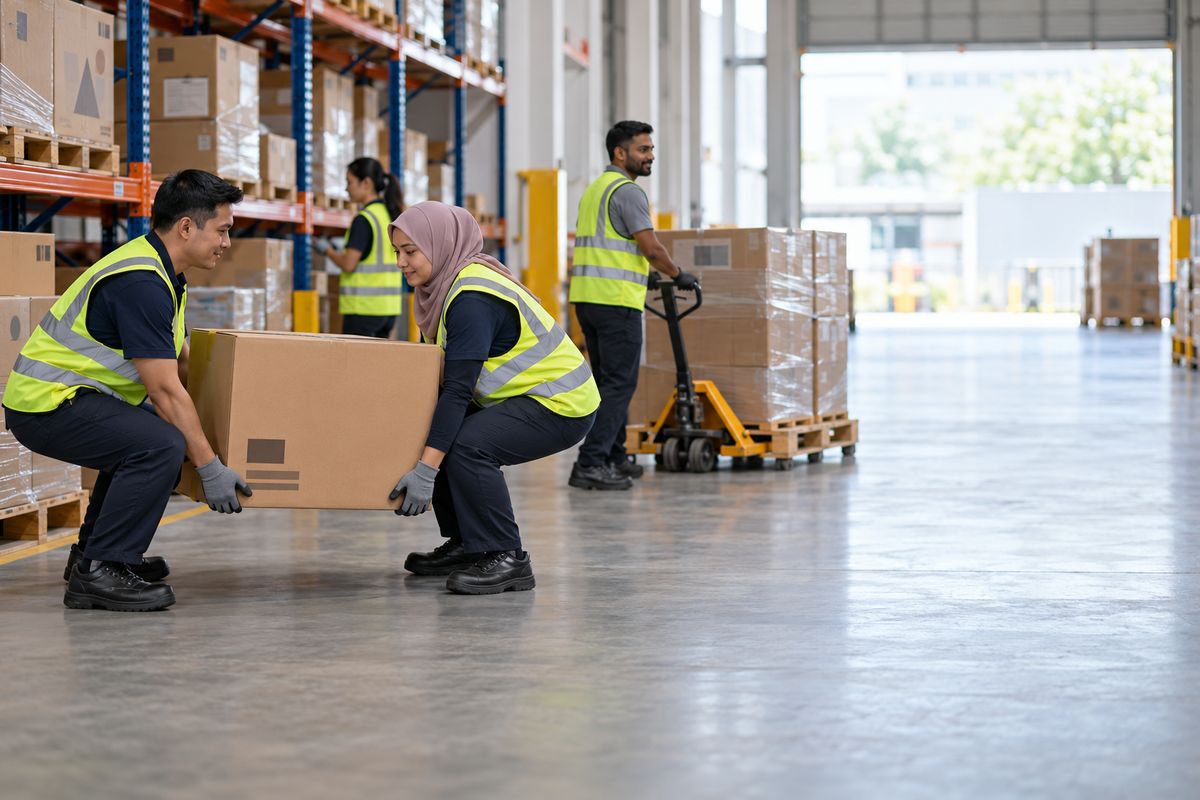
The DOSH Guidelines for Manual Handling at Workplace 2018 describe manual handling as transporting or supporting a load by human effort, including lifting, lowering, pushing, pulling, carrying, restraining or holding. That covers far more than warehouse work: stocking shelves, moving patients or furniture, carrying toolboxes to site, pushing trolleys and cages, loading vehicles, handling gas cylinders and bags of cement, and repetitive picking on a production line.
The guideline says these activities contribute to 40% of reported musculoskeletal disorder (MSD) cases in Malaysia. MSDs usually build up over months of overload, awkward posture and repetition, rather than from one dramatic lift, which is why they are easy to miss until someone is off work with a back injury.
Risk depends on the task (how far from the body, how high or low, how often, twisting, distance), the load (weight, size, grip, stability), the environment (floor, space, slopes, steps, lighting, heat) and the individual (health, pregnancy, age, experience, recent injury).
What Malaysian law requires
There is no Malaysian law that sets a maximum weight a worker may lift. The duty comes from the Occupational Safety and Health Act 1994:
- Section 15(1) requires every employer and self-employed person to ensure, so far as is practicable, the safety, health and welfare at work of all employees.
- Section 15(2)(b) specifically covers arrangements for safety and absence of risks to health in the use, handling, storage and transport of plant and substances.
- Section 18B, in force since 1 June 2024, requires a risk assessment and the controls it identifies. Manual handling tasks belong in it. Our HIRARC guide shows the general method.
Breaching these general duties carries a fine of up to RM500,000, up to two years in prison, or both. The 2018 guideline also refers to section 12 of the Factories and Machinery Act 1967 ("no person shall be employed to lift, move or carry any load so heavy as to be likely to cause bodily injury"), but that Act was repealed from 1 June 2024, so rely on the OSH Act duties.
The DOSH guidelines are guidance rather than law. They show the method DOSH expects, and following them is the practical way to show you have done what is practicable.
The initial manual handling risk assessment
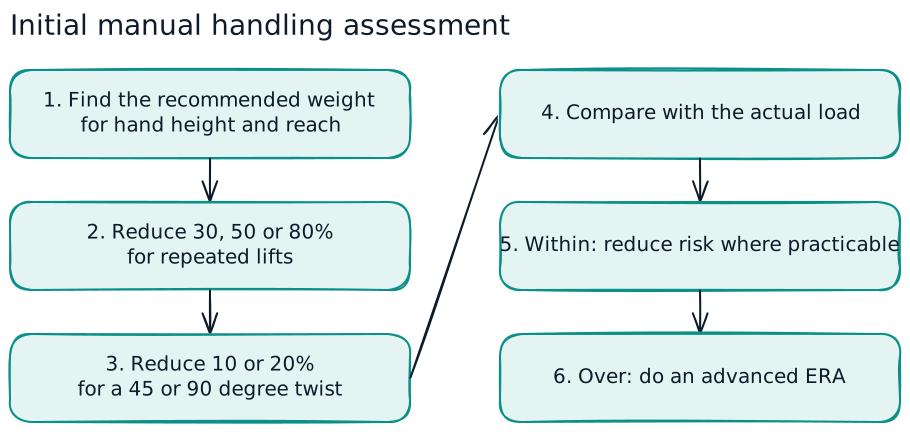
The 2018 guideline starts with an initial manual handling risk assessment, a quick filter to find which tasks need a closer look. Before it, run a musculoskeletal pain and discomfort survey so you know where people are already hurting.
Lifting and lowering
The guideline gives recommended weights for men and women by hand height (floor to mid-lower leg, mid-lower leg to knuckle, knuckle to elbow, elbow to shoulder, above shoulder) and by whether the load is close to the body or further away. If the hands pass through more than one zone during the lift, the smallest figure applies. Its own worked example uses 25 kg for a man lifting between knuckle and elbow height with the load close to the body.
The basic figures assume infrequent lifts, up to about 30 an hour. Reduce them for frequency and twisting:
| Condition | Reduce the recommended weight by |
|---|---|
| Once or twice per minute | 30% |
| Five to eight times per minute | 50% |
| More than 12 times per minute | 80% |
| Twisting 45° from facing forward | 10% |
| Twisting 90° from facing forward | 20% |
The guideline's worked example: 25 kg, minus 2.5 kg for a 45° twist, minus 12.5 kg for five to eight lifts a minute, gives a recommended weight of 10 kg.
Pushing, pulling and carrying
For pushing and pulling, the figures apply only where the force is applied with the hands between knuckle and shoulder height, over less than 20 m, with the load on wheels and a well-maintained handling aid. For carrying, the guideline treats 2 to 10 m as acceptable on a dry, flat, clear route; more than 10 m, poor or wet floors, slopes, steps, closed doors, ladders, poor lighting or extreme temperatures call for an advanced assessment. Handling while seated has its own figures.
The guideline is clear that these values protect around 95% of working men and women and must not be treated as safe or maximum limits. Even tasks inside them should be made easier where practicable, and tasks more than about twice the figures are a serious risk.
When you need an advanced ergonomic risk assessment
The 2018 guideline sends you to an advanced ergonomic risk assessment (ERA) under the DOSH Guidelines on Ergonomics Risk Assessment at Workplace 2017 when, for example:
- the load exceeds the recommended weight after reductions;
- the conditions behind the figures are not met, such as a load that cannot be gripped with both hands;
- the person has reduced capacity, for example through ill health or pregnancy;
- the hands work outside the zones in the diagram, or there are extra risk factors such as uneven floors or cramped spaces;
- the load must be pushed or pulled with hands outside knuckle to shoulder height, or moved more than about 20 m without a break.
The 2017 ERA guideline also covers risks beyond manual handling: awkward and static postures, forceful exertion, repetitive motion, vibration and environmental factors such as lighting, temperature and noise. DOSH's ergonomics training framework sets out the advanced ERA as five steps: review the initial ERA and existing controls, gather more information, assess the risk level and the workstation, summarise the ERA, and set priorities for improvement. Recognised methods for posture, force and repetition are used at this stage, and the findings go into a written report that is reviewed and kept on record.
Controls: mechanical aids first, technique last
Training people to lift "properly" does not fix a badly designed task. The guideline groups controls into an engineering approach, an administrative approach and PPE.
Engineering
- Mechanical aids: trolleys, pallet jacks, sack trucks, hoists, vacuum tube lifters, lift tables, conveyors and roller tracks, forklifts and automated guided vehicles. Powered equipment comes with its own training and maintenance needs.
- Workstation redesign: bring loads to between knuckle and elbow height, use turntables and tilting stands, remove reaching above shoulder or below knee.
- Change the load: smaller bags, lighter containers, better handles.
- Low-cost automation on existing equipment can take out the worst repetitive lifts.
Administrative
- Safe work procedures, team lifting where appropriate, and training in technique and in reporting early symptoms.
- Job rotation, job enlargement and a sensible work-rest ratio with short recovery breaks in repetitive work.
- Good housekeeping and maintenance: clear routes, dry floors, working trolley wheels.
PPE and back belts
Gloves, knee and elbow pads protect against specific hazards. The guideline does not treat back belts and braces as PPE and does not recommend them unless advised and supervised by a treating doctor, because the evidence is weak and they can give a false sense of security.
Safe lifting technique and team lifts
Where a person still has to lift, a good basic lift, built on the guideline's appendix on body mechanics, looks like this:
- Plan the lift and the route; clear obstacles and know where the load is going.
- Get close to the load, feet apart with one foot slightly forward.
- Keep the back straight and bend at the hips and knees to get down to the load.
- Get a firm grip with both hands and bring the load close to the body.
- Look forward and lift smoothly with the legs, keeping the load close.
- Do not twist: turn by moving the feet (the pivot technique).
- Put the load down the same way, then adjust its position.
The guideline adds that it is safer to push than to pull, and that overhead lifts should be avoided where possible.
Team lifts
Team lifting can share a load, but it is harder to coordinate and the international lifting standard behind the recommended weights does not cover lifts by two or more people. If you use team lifts: choose people of similar height and strength, agree one person to give the commands, plan the route and the set-down, and check everyone has a good grip. If a load regularly needs a team, it usually needs a mechanical aid instead.
In the WorkQuest2U Manual Handling & Ergonomics lesson staff assess tasks in a 3D workplace and choose aids before lifting, and Lifting & Rigging covers loads that need cranes and slings.
Common manual handling mistakes
- Treating the recommended weight as a safe limit and forgetting the reductions for frequency and twisting.
- Technique training as the only control, with no change to the task, the layout or the equipment.
- Trolleys and hoists not used because they are broken, far away or slower. Keep aids where the work is and maintain them.
- Ignoring carrying distance, steps and slopes on the route.
- Not considering the individual: pregnant workers, new or young workers, and those returning from injury.
- No early reporting: aches and pains go unreported until they become a lost-time injury. A discomfort survey picks them up early.
- Back belts handed out instead of fixing the job.
Brief the crew on the lifting plan for the day in a short toolbox talk, and record serious injuries as described in our accident reporting guide.
Practise it in WorkQuest2U
Short 3D lessons where staff walk the scene, spot the issues and make the calls. Free to try, with certificates and progress records for companies.
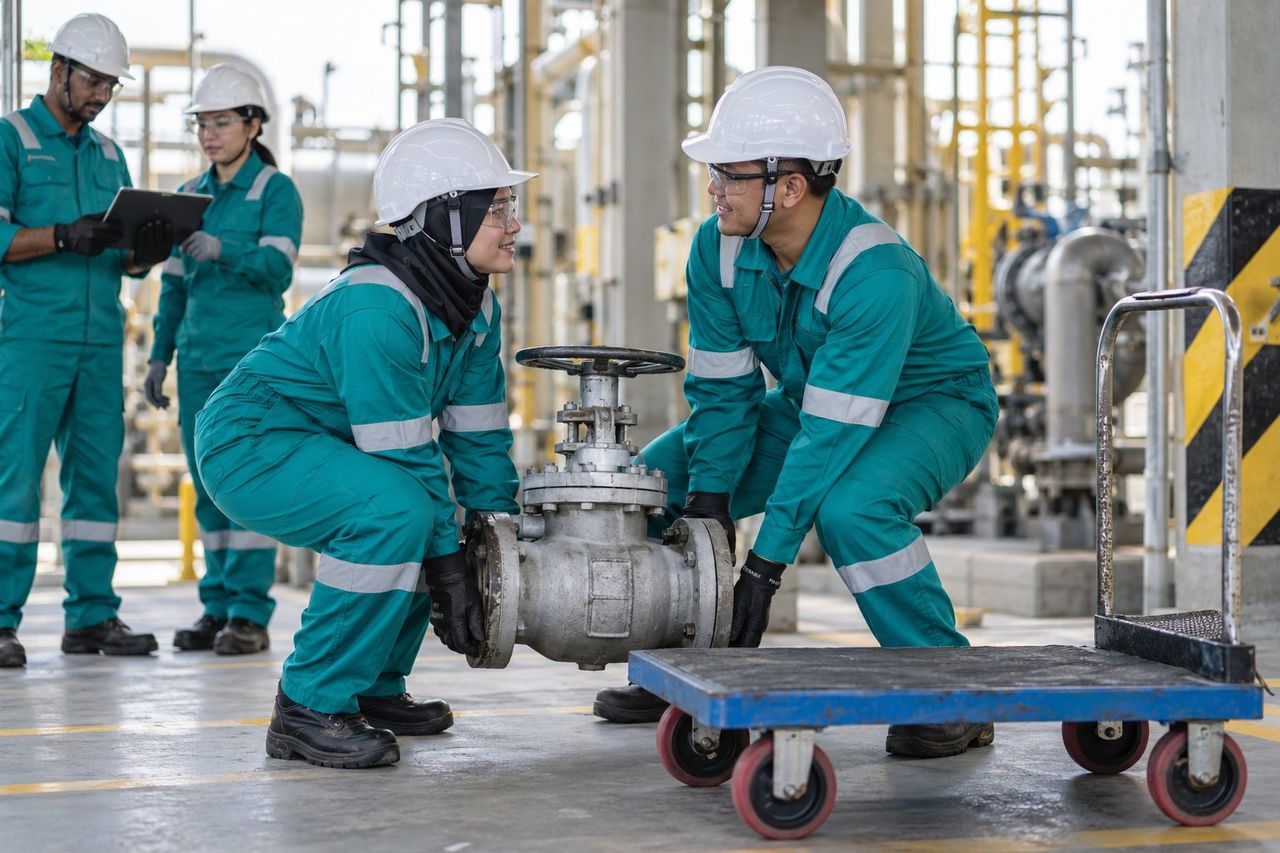 Health, Safety, Security & EnvironmentManual Handling & ErgonomicsLift, push, carry, turn valves and type without wrecking your back: assess the task with TILEO and let machines take the load.
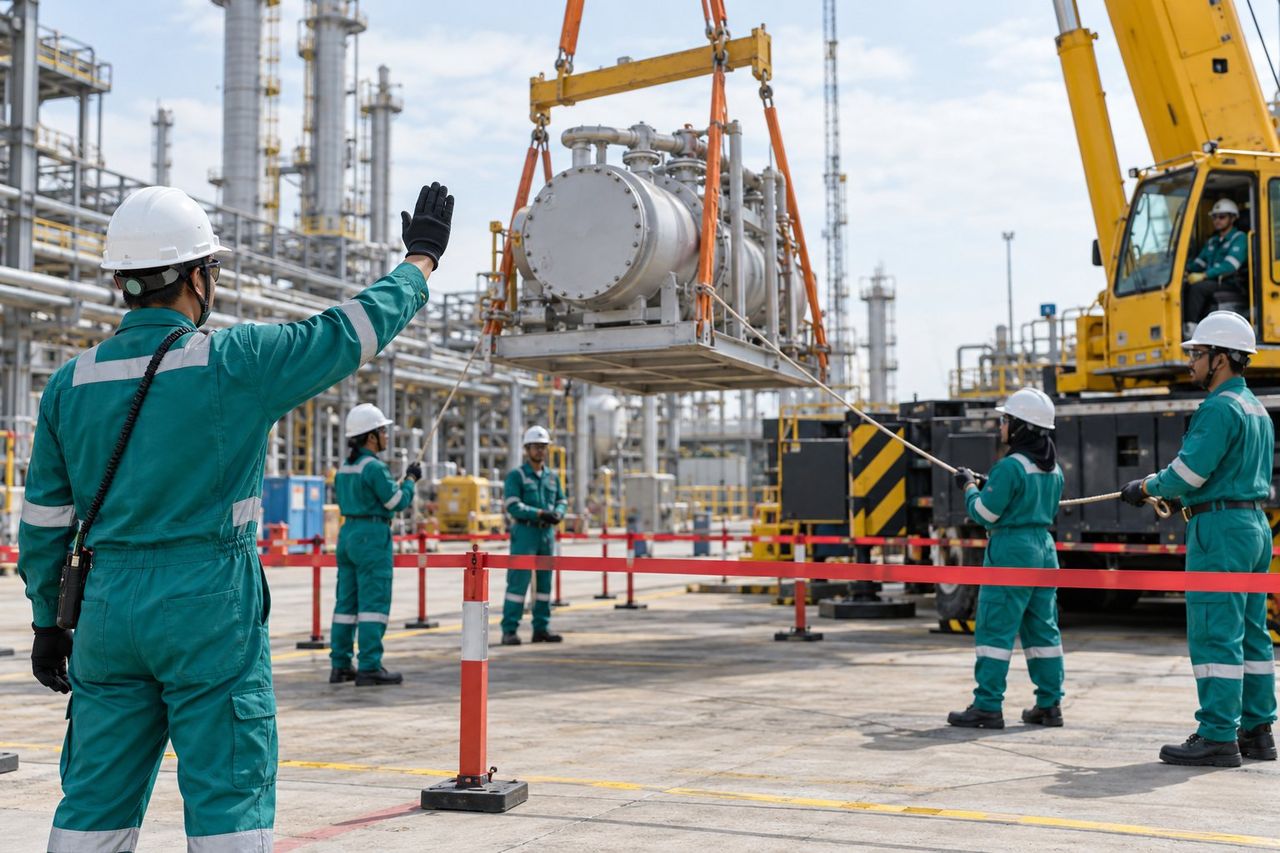 Health, Safety, Security & EnvironmentLifting & RiggingLift plans, slings and shackles, exclusion zones, signals, ground conditions and lifting emergencies.
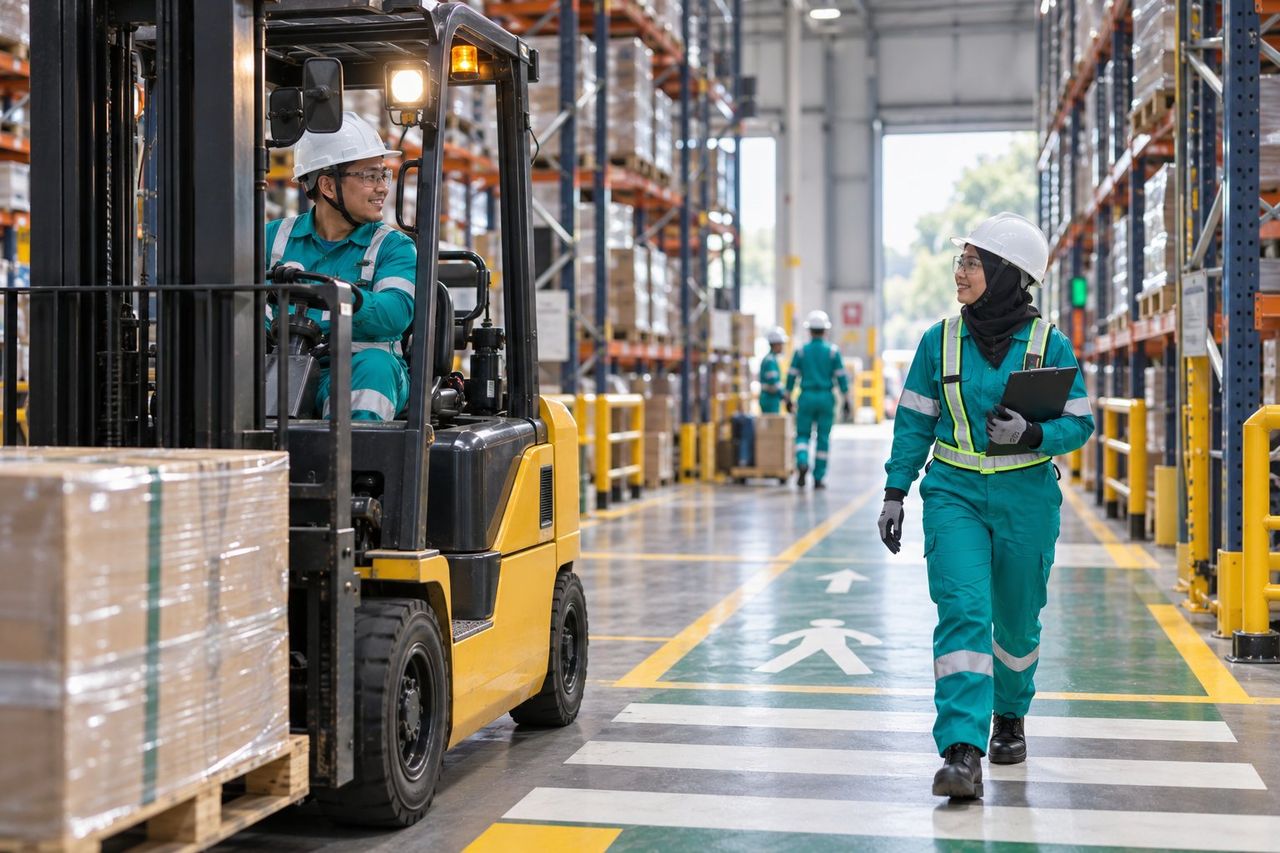 Health, Safety, Security & EnvironmentWarehouse & Supply BaseAn offshore supply base: forklifts and walkways, racking, loading docks, dangerous goods and manual handling.
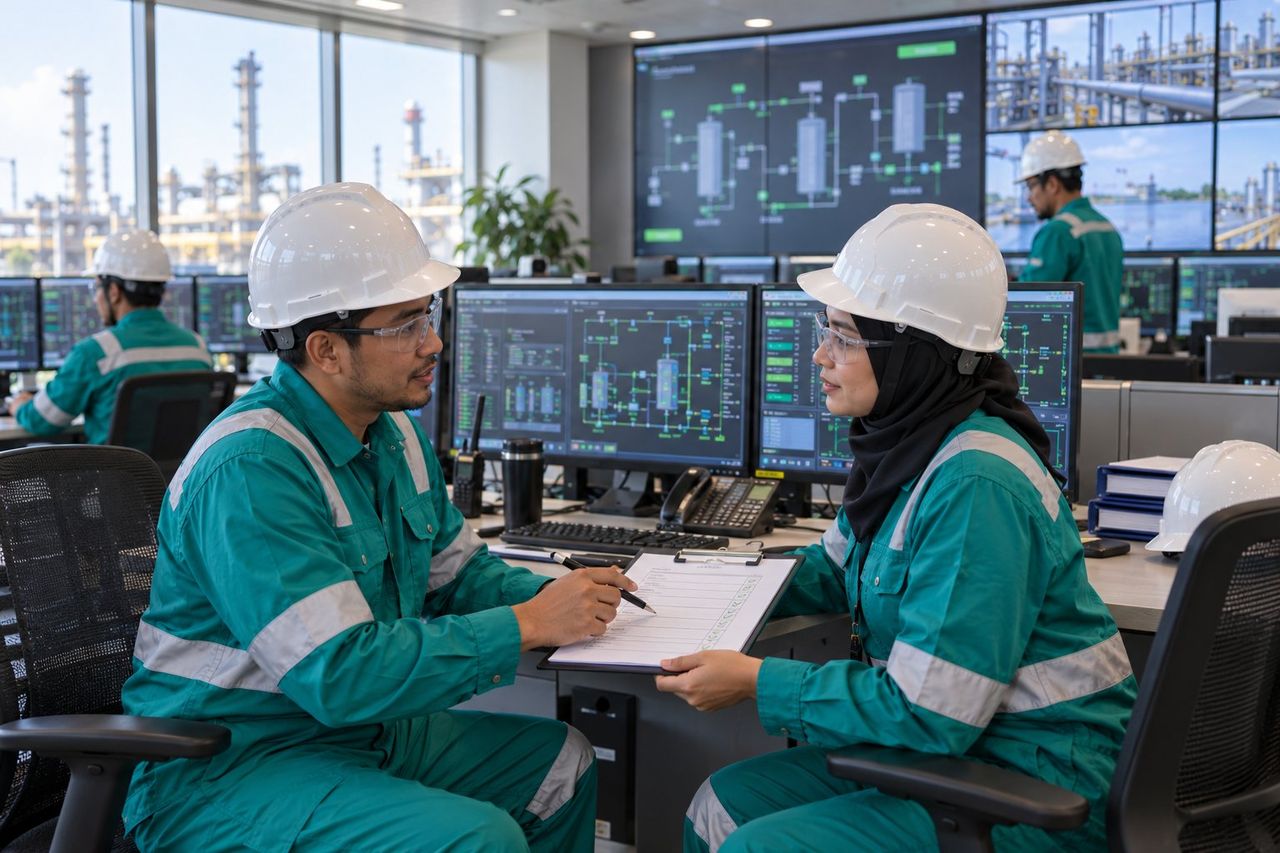 Health, Safety, Security & EnvironmentHuman FactorsSlips, lapses, mistakes and violations: see why good people make errors and the defences that catch them.
Frequently asked questions
What is the maximum weight a worker can lift in Malaysia?
How much should the weight be reduced for repetitive lifting?
What is an ergonomic risk assessment (ERA)?
Are back support belts recommended?
Is manual handling training a legal requirement?
Sources
- DOSH: Guidelines for Manual Handling at Workplace 2018, full text (copy hosted by Universiti Malaya)
- DOSH: Ergonomics management course training module checklist (initial and advanced ERA steps)
- Occupational Safety and Health (Amendment) Act 2022 [Act A1648]: sections 15 and 18B
- Factories and Machinery (Repeal) Act 2022 [Act 835] (DOSH)
This guide is general information for workplaces in Malaysia, checked against the sources above on 30 October 2026. It is not legal advice; laws and guidelines change, so confirm the current text before you act.