How to report an accident to DOSH: NADOPOD, JKKP 6, JKKP 7 and JKKP 8
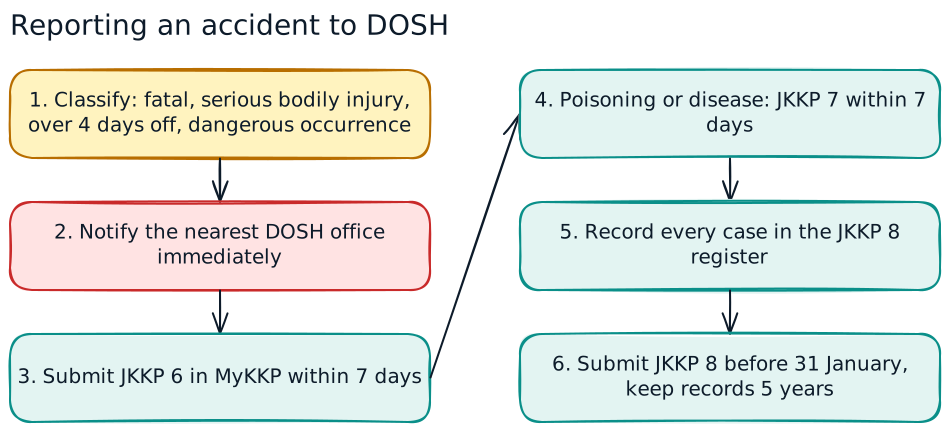
Under section 32 of the OSH Act 1994 and the NADOPOD Regulations 2004, an employer must tell the nearest DOSH (JKKP) office immediately, by the quickest means, of a death, a serious bodily injury, an injury keeping someone off normal work for more than four days, or a dangerous occurrence, then submit form JKKP 6 within seven days. Occupational poisoning and disease go on JKKP 7, and every case goes in the JKKP 8 register.

The law: section 32 and NADOPOD
Section 32(1) of the Occupational Safety and Health Act 1994 says an employer shall notify the nearest occupational safety and health office of any accident, dangerous occurrence, occupational poisoning or occupational disease which has occurred or is likely to occur at the place of work. Section 32(2) requires registered medical practitioners and medical officers to report occupational diseases and poisoning they diagnose to the Director General.
The detail is in the Occupational Safety and Health (Notification of Accident, Dangerous Occurrence, Occupational Poisoning and Occupational Disease) Regulations 2004, known as NADOPOD. DOSH (Jabatan Keselamatan dan Kesihatan Pekerjaan, JKKP) also publishes Guidelines on NADOPOD, which explain how to decide whether a case must be notified and how to fill in the forms. As of October 2026, DOSH and its MyKKP system still work from the 2004 regulations, read with the amended Act.
The OSH (Amendment) Act 2022, in force since 1 June 2024, changed the picture in two ways that matter here:
- It defined "serious bodily injury" in the Act itself, as any injury listed in a new Fourth Schedule.
- It amended section 32(2) so that doctors report "the occupational diseases or occupational poisoning specified", rather than diseases listed in the old Factories and Machinery Act schedule.
What must be reported
NADOPOD covers four kinds of event arising out of or in connection with work:
- Fatal accidents: death immediately or within one year of the accident.
- Serious bodily injury: any injury on the Fourth Schedule list below.
- Other injuries causing incapacity for more than 4 calendar days: the person cannot do their normal job for more than four days in a row. The DOSH guideline counts from the day after the accident.
- Dangerous occurrences: events listed in the Second Schedule of NADOPOD, even if nobody is hurt. They include the collapse of scaffolding more than 5 metres high, collapse of a building or structure under construction, an electrical short circuit with fire or explosion that stops plant for more than 24 hours, an uncontrolled release of a substance that could cause serious injury or damage to health, and explosions, fires or structural failures affecting the safety of a workplace or plant.
- Occupational poisoning and occupational disease: the classes listed in the regulations, such as poisoning by chemicals and diseases caused by exposure at work.
The duty covers your own employees and also other people injured at a workplace under your control. The DOSH guideline says that where several employers share a workplace, the employer with overall control should report, and the contractor whose worker was hurt should also report. Employers of domestic helpers in a private home are exempt.
The Fourth Schedule: serious bodily injury
Since 1 June 2024, any of these injuries is a serious bodily injury under the OSH Act, whatever the number of days lost:
- Emasculation
- Permanent loss of sight of either eye
- Permanent loss of hearing of either ear
- Loss of any member or joint
- Destruction or permanent impairment of the powers of any member or joint
- Permanent disfiguration of the head or face
- Fracture or dislocation of a bone
- Amputation of the arm, hand, finger, thumb, leg, foot or toe
- Crush injury to the head or torso causing damage to the brain or internal organs
- Burn injury (including scalding) covering more than 10% of the body surface, or causing significant damage to the eyes, respiratory system or other vital organs
- Any degree of scalding needing treatment by a registered medical practitioner
- Any other injury from working in an enclosed space that leads to hypothermia or heat-induced illness
- Loss of consciousness caused by head injury or asphyxia
- Electrical injury
- Loss of consciousness or acute illness from absorbing, inhaling or swallowing a substance, needing treatment by a registered medical practitioner
- Acute ill health believed to result from exposure to an isolated pathogen or infected material
- Any other work-related injury or burn that leads to immediate admission to hospital for more than 24 hours
So a fractured finger with two days' medical leave is notifiable, because fracture is on the list. A sprained ankle with three days' leave is not notifiable, but it still goes in your register.
Timelines and forms
| Event | First notice | Written report | Register |
|---|---|---|---|
| Death, serious bodily injury, dangerous occurrence | Immediately, by the quickest means, to the nearest DOSH state office | JKKP 6 within 7 days | JKKP 8 |
| Other injury with more than 4 days' incapacity | Immediately, by the quickest means | JKKP 6 within 7 days | JKKP 8 |
| Occupational poisoning or disease | Through JKKP 7 | JKKP 7 within 7 days of knowing the case exists (doctors: within 7 days of diagnosis) | JKKP 8, after the employer's investigation |
| Injury with 4 days or fewer off, other recordable cases | Not notifiable | None | JKKP 8 |
The 2004 DOSH guideline reads "seven days" as seven working days for JKKP 6. Do not plan around that margin: report as soon as you have the facts, and update DOSH if details change.
Two more forms appear in the guideline. JKKP 9 (accident investigation details) and JKKP 10 (poisoning and disease investigation details) are filled in when the Director General asks for further information, which means you need to have done your own investigation first. In MyKKP, JKKP 9 is completed from the JKKP 6 case for fatal, permanent and non-permanent disability cases and dangerous occurrences.
A work injury may also need a separate report to PERKESO (SOCSO) for the worker's benefits, using its own accident notice (Borang 34). That is a different scheme with its own rules; reporting to one agency does not cover the other.
Reporting online in MyKKP
DOSH's online system is MyKKP (Sistem Keselamatan dan Kesihatan Pekerjaan) at mykkp.dosh.gov.my. DOSH's MyKKP user manuals (version 2, March 2025, in Bahasa Malaysia) describe the steps:
- Log in and choose the workplace (Tempat Kerja/Kilang) module.
- Open Pemberitahuan Kemalangan, Kejadian Berbahaya dan Penyakit Pekerjaan under online services, or Pelaporan Sepanjang Masa (year-round reporting).
- Choose Pelaporan Baru: JKKP6, 7 dan 8, then the type: occupational accident or dangerous occurrence (JKKP 6), occupational poisoning or disease (JKKP 7), or a non-fatal injury not on the Fourth Schedule with 4 days or fewer off (JKKP 8).
- Check for duplicates using the injured person's IC number and the date, then fill in the notifier, the person involved and the accident details, upload attachments, and submit. The system gives a reference number.
Year-round reporting is only open to the employer's level 1 representative for a workplace already registered in MyKKP, so register your workplace and assign that role before you need it. The JKKP 6 case is investigated by the DOSH state office for the place where the accident happened, and its record may be updated with the investigating officer's decision.
Keeping records: the JKKP 8 register
The register is where small events become useful data. Under the DOSH guideline:
- Record every accident, dangerous occurrence, occupational poisoning and occupational disease at the workplace, whether notifiable or not.
- Keep a separate register for each establishment (each factory, warehouse, office or site).
- Submit the register for the year ending 31 December to the Director General before 31 January. If there were no recordable cases, tell the Director General in writing. In MyKKP, entries are logged through the year and can be updated until the submission period closes.
- Keep the register for at least 5 years, and update earlier entries if the outcome of a case changes. A new owner of the establishment keeps the records for the rest of the period.
- Make records available to DOSH officers on request.
Failing to notify or keep records is an offence. The 2004 guideline put the penalty at up to RM10,000 or one year in prison; the 2022 amendment raised the Act's general penalty in section 51 from RM10,000 to RM100,000 for offences with no specific penalty. Check the current regulations for the figure that applies.
A practical procedure for your site
- Respond first. Make the area safe, give first aid and call 999 if needed.
- Preserve the scene after a serious event, except to rescue people or prevent further harm.
- Escalate within the hour to the person who decides notification (usually the safety and health officer or site manager), with a short fact sheet.
- Classify: fatal, Fourth Schedule, more than 4 days, dangerous occurrence, poisoning or disease, or register only. When unsure, notify.
- Notify DOSH immediately by phone or the quickest means, then submit JKKP 6 or JKKP 7 in MyKKP.
- Track medical leave. An injury that starts as 2 days off can become more than 4 later, which makes it notifiable.
- Investigate to the root cause and brief the safety and health committee; see our guide to root cause analysis.
- Update the JKKP 8 register and diarise the 31 January submission.
Supervisors make the first calls in this chain. The Incident Investigation and Emergency Response Centre lessons let them practise those first decisions in a 3D scene before a real event.
Practise it in WorkQuest2U
Short 3D lessons where staff walk the scene, spot the issues and make the calls. Free to try, with certificates and progress records for companies.
 Health, Safety, Security & EnvironmentIncident Investigation & Root CauseMake the scene safe, gather the 4Ps of evidence, interview without blame, build the timeline and dig past the immediate cause to the root.
 Health, Safety, Security & EnvironmentEmergency Response CentreWhen things go wrong: raising the alarm, muster and headcount, incident command, triage, mutual aid and media.
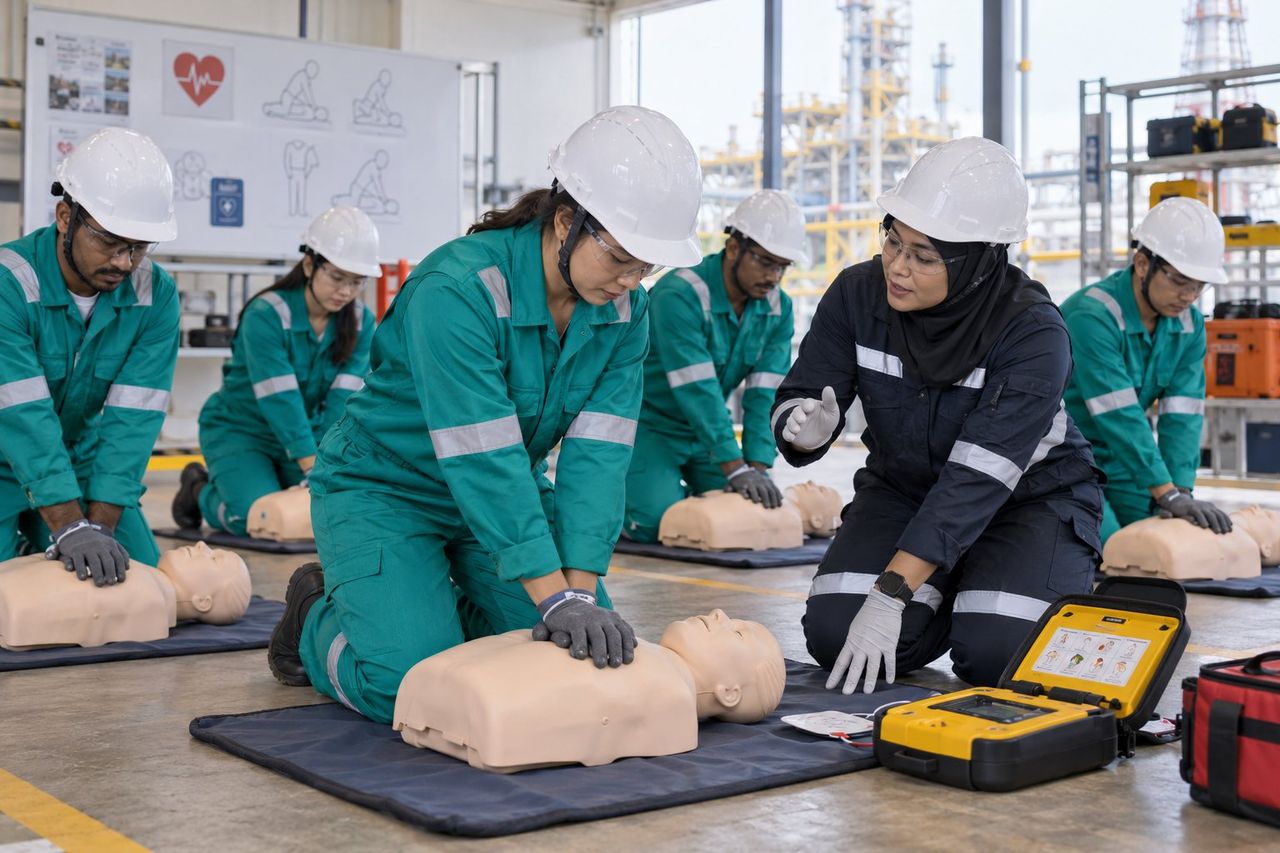 Health, Safety, Security & EnvironmentFirst Aid & CPRPractise the first minutes that save a life: DRSABCD, CPR and the AED, bleeding, burns, heat stroke and eye splashes, always within your training.
 Health, Safety, Security & EnvironmentHuman FactorsSlips, lapses, mistakes and violations: see why good people make errors and the defences that catch them.
Frequently asked questions
How long do I have to report an accident to DOSH?
What is JKKP 6, JKKP 7 and JKKP 8?
Do I need to report an injury with less than 4 days of medical leave?
Can I report a workplace accident to DOSH online?
Who must report when a contractor's worker is injured?
How long must accident records be kept?
Sources
- Occupational Safety and Health Act 1994 (Act 514), section 32 (copy hosted by USM)
- Occupational Safety and Health (Amendment) Act 2022 [Act A1648]: serious bodily injury, Fourth Schedule, sections 32 and 51
- P.U.(B) 128/2024: commencement of Act A1648 on 1 June 2024 (DOSH)
- DOSH: Guidelines on the NADOPOD Regulations 2004 (copy hosted by Universiti Malaya)
- DOSH MyKKP user manual: Pemberitahuan Kemalangan (JKKP6) dan JKKP9, ver. 02 (2025)
- DOSH MyKKP user manual: Pemberitahuan JKKP8, ver. 02 (2025)
- PERKESO: Panduan Mengisi Borang 34 (accident notice)
This guide is general information for workplaces in Malaysia, checked against the sources above on 30 October 2026. It is not legal advice; laws and guidelines change, so confirm the current text before you act.