Gamified safety training: what works, VR versus browser 3D, and how to choose a provider
Gamified safety training uses game elements such as scenarios, choices, consequences and scoring to make workers practise safety decisions rather than just read about them. Research supports engaging, active formats for safety training, especially for high-hazard work, but the benefit comes from realistic practice and feedback, not from points and badges on their own.
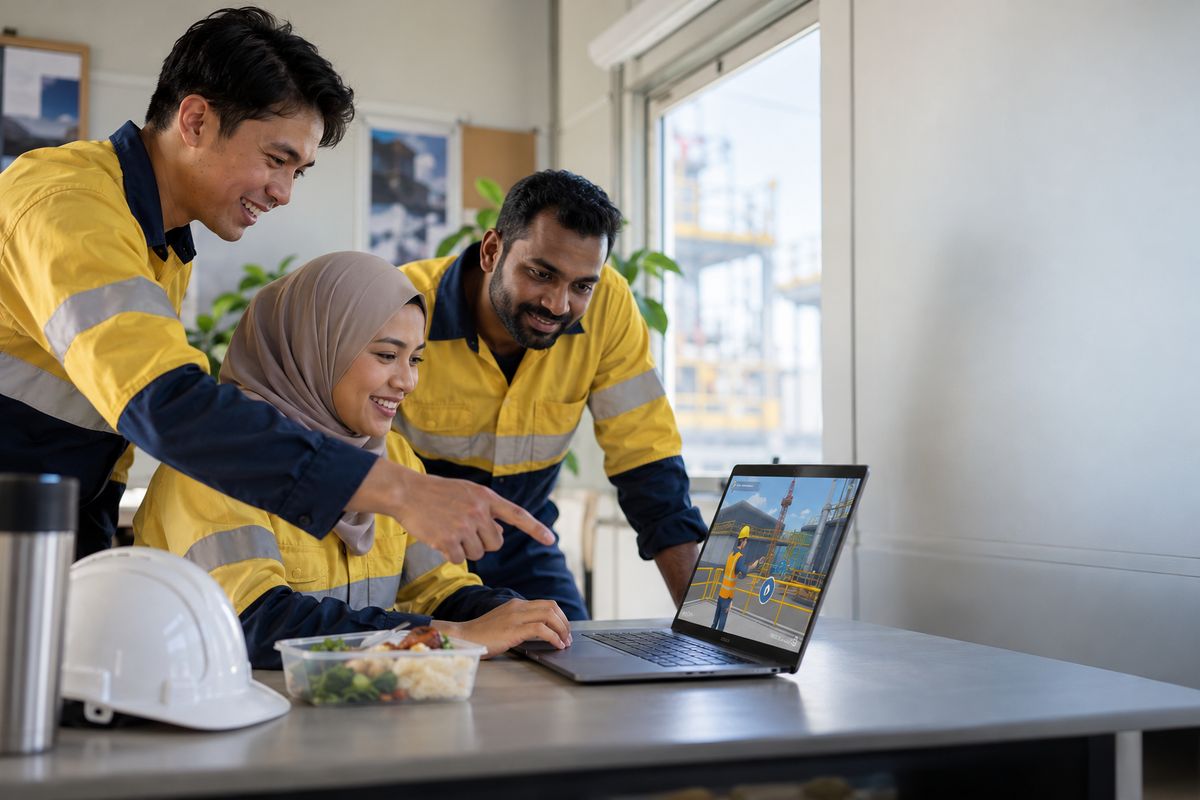
What gamified safety training means
"Gamified" covers a wide range of things, and it helps to separate them before you buy:
- Gamification: adding game elements to ordinary training, such as points, badges, levels, leaderboards, timers or a storyline.
- Scenario-based learning: the learner faces a realistic situation, makes decisions and sees the consequences. A contractor wants to start hot work without a gas test; what do you do?
- Serious games and 3D simulations: the learner moves through a virtual workplace, finds hazards, chooses controls and practises procedures. This is usually what people mean by 3D safety training or interactive safety training.
- Virtual reality (VR) safety training: the same idea in a headset, with full immersion and sometimes hand controllers.
The common thread in the formats that work is active practice with feedback. A badge for finishing a slide deck is gamification; walking a site, spotting the unguarded edge and choosing the right control is practice.
What research says about engagement and retention
The evidence is stronger than the marketing in some places and weaker in others. These are peer-reviewed studies worth knowing:
- Burke et al. (2006), American Journal of Public Health: a meta-analysis of 95 studies with about 21,000 workers grouped safety training by how engaging it was. The most engaging methods (behavioural modelling, hands-on training) were linked to greater knowledge gains and larger reductions in accidents, illnesses and injuries than the least engaging (lectures, pamphlets, videos). All methods improved behaviour to some degree.
- Burke et al. (2011), Journal of Applied Psychology, "The dread factor": 113 studies covering about 24,700 workers in 16 countries. Highly engaging training was more effective than less engaging training for safety knowledge and performance when hazard severity was high; the advantage shrank where hazards were mild. The authors suggest that active training makes the danger feel real, which motivates learning.
- Wouters et al. (2013), Journal of Educational Psychology: a meta-analysis of serious games found them more effective than conventional instruction for learning (d = 0.29) and retention (d = 0.36), but not significantly more motivating.
- Sailer and Homner (2020), Educational Psychology Review: a meta-analysis of gamification in learning found small positive effects on cognitive (g = 0.49), motivational (g = 0.36) and behavioural (g = 0.25) outcomes. Only the cognitive effect held up in the most rigorous studies, and game fiction and social interaction were linked to stronger behavioural effects.
- Makransky, Terkildsen and Mayer (2019), Learning and Instruction: in an experiment with 52 students, a lab simulation in an immersive VR headset gave a much stronger sense of presence than the same simulation on a desktop, but less learning and higher cognitive load.
Put together: engaging, scenario-based practice is well supported for safety training, especially where the hazards are serious. Game elements help a little. Immersion is not the same as learning, and more spectacle can get in the way.
VR safety training versus browser 3D
Both put the learner in a virtual workplace. The difference is mostly about who you can reach and what it takes to run.
| VR headset | Browser 3D | |
|---|---|---|
| Hardware | Headsets for each learner or a rotation, charging, storage, hygiene | The phones, laptops and tablets people already use |
| Reach | Usually in a training room or on a set schedule | Any site, shift or contractor with a link, at their own pace |
| Presence | Highest; strong for practising physical procedures and rare emergencies | Lower, but enough to walk a site, spot hazards and make decisions |
| Learner comfort | Some people feel motion sickness or disorientation; sessions need to be short | Familiar controls; can be paused and resumed |
| Cognitive load | Can be high (see Makransky et al.) | Easier to keep focused on the decision |
| Tracking and records | Varies; may need a separate system | Usually built into the platform with assessments and reports |
| Best for | Hands-on rehearsal for specific high-risk tasks with a facilitator | Hazard recognition, decisions, inductions and refreshers at scale |
Often the answer is both: browser 3D for everyone, and VR or physical drills for the few tasks where hands-on rehearsal matters most.
What good scenario-based safety training looks like
- Real tasks and real hazards. Scenes built around the work people actually do, using the hazards from your risk assessment: height, line of fire, energy isolation, confined spaces, vehicles, heat.
- Decisions, not just recall. "What do you do next?" is better than "What does PTW stand for?" Include the pressure moments: a supervisor pushing a shortcut, a missing permit, a colleague without a harness.
- Consequences and feedback. Show what happens after a wrong choice and why, then let the learner try again.
- Short and focused. One topic per lesson, so it fits between tasks and the key points stay clear.
- Local rules. References to the OSH Act 1994, DOSH guidance and the way Malaysian sites work, not generic overseas content.
- Accessible language. Plain English, Bahasa Malaysia and narration for frontline crews.
- A proper assessment at the end, against a pass mark, so completion means something.
Pitfalls of gamification for its own sake
- Points for clicking. Rewards for finishing quickly or clicking through teach people to rush. Reward correct decisions instead.
- Leaderboards that punish caution. Ranking people on speed in a safety lesson sends the wrong message. If you use competition, make it about accuracy or team completion.
- Spectacle over substance. Impressive graphics with thin content are still thin content.
- Trivialising serious harm. Cartoon deaths and jokes about fatalities undermine the message. The "dread factor" research suggests that taking hazards seriously is part of why engaging training works.
- Treating the game as the whole programme. Interactive lessons build awareness and judgement. They do not replace practical training, supervision on site or competent-person courses.
- Measuring completion only. Look at assessment results and changes over time, and at leading indicators on site such as near-miss reporting.
How to evaluate a gamified safety training provider
Ask for a working demo with your own people, not a video, and check:
- Content: Does it cover your top hazards? Is it accurate for Malaysian law and DOSH guidance? Who wrote and reviewed it?
- Design: Does the learner make decisions and see consequences, or mostly read and click "next"?
- Assessment: Is there a scenario-based assessment with a pass mark? Can you see results by question to find weak spots?
- Records: Timestamped results, certificates, exports you can use in a training matrix and for audits.
- Administration: Can you import staff, assign by department, set due dates and see who is overdue?
- Access: Does it run on the phones and laptops your workers already have, without installing anything? Does it work for shift workers and contractors?
- Language: Is it available in the languages your workforce uses?
- Data: Where is learner data held, who can see it, and how is it separated from other customers? See our PDPA guide for the questions to ask.
- Legal fit: Under section 31B of the OSH Act 1994, no person may conduct an occupational safety and health training course unless registered with DOSH as a registered training provider, and the Fifth Schedule reserves OSH training, assessment and examination for registered competent persons. Section 31A also lets the Minister require specific courses from registered providers. For any course your site needs to satisfy the law, ask the provider for its DOSH registration in writing. Use interactive awareness lessons to prepare people for those courses and to refresh what they learned, not to replace them.
Our compliance training platform guide covers the wider buying checklist.
How WorkQuest2U approaches it
WorkQuest2U is built around scenario practice rather than points. Each lesson is a 3D work scene that runs in the browser on desktop, tablet or phone, with nothing to install. A guide walks the learner through checkpoints with short briefings; the learner spots the hazards or red flags, watches animated explainers of how things work, answers scenario questions and finishes with an assessment against a pass mark. Lessons are in English; the AI for Everyone and AI for Data Science topics are also available in Bahasa Malaysia.
WorkQuest2U lessons are awareness and practice content. Unless we confirm otherwise in writing for a specific course, they are not offered as OSH training courses conducted by a registered training provider under section 31B, and they do not replace any course, licence or competency the law requires.
Try Construction Site, Working at Height or Line of Fire & Dropped Objects to see the format, or Phishing & Social Engineering for the same approach applied to office risks. For companies, the workspace adds assignments with due dates, progress by person and department, certificates with unique IDs and timestamped CSV exports. The sample workspace shows it with synthetic data, and topics lists the cross-industry programmes.
Practise it in WorkQuest2U
Short 3D lessons where staff walk the scene, spot the issues and make the calls. Free to try, with certificates and progress records for companies.
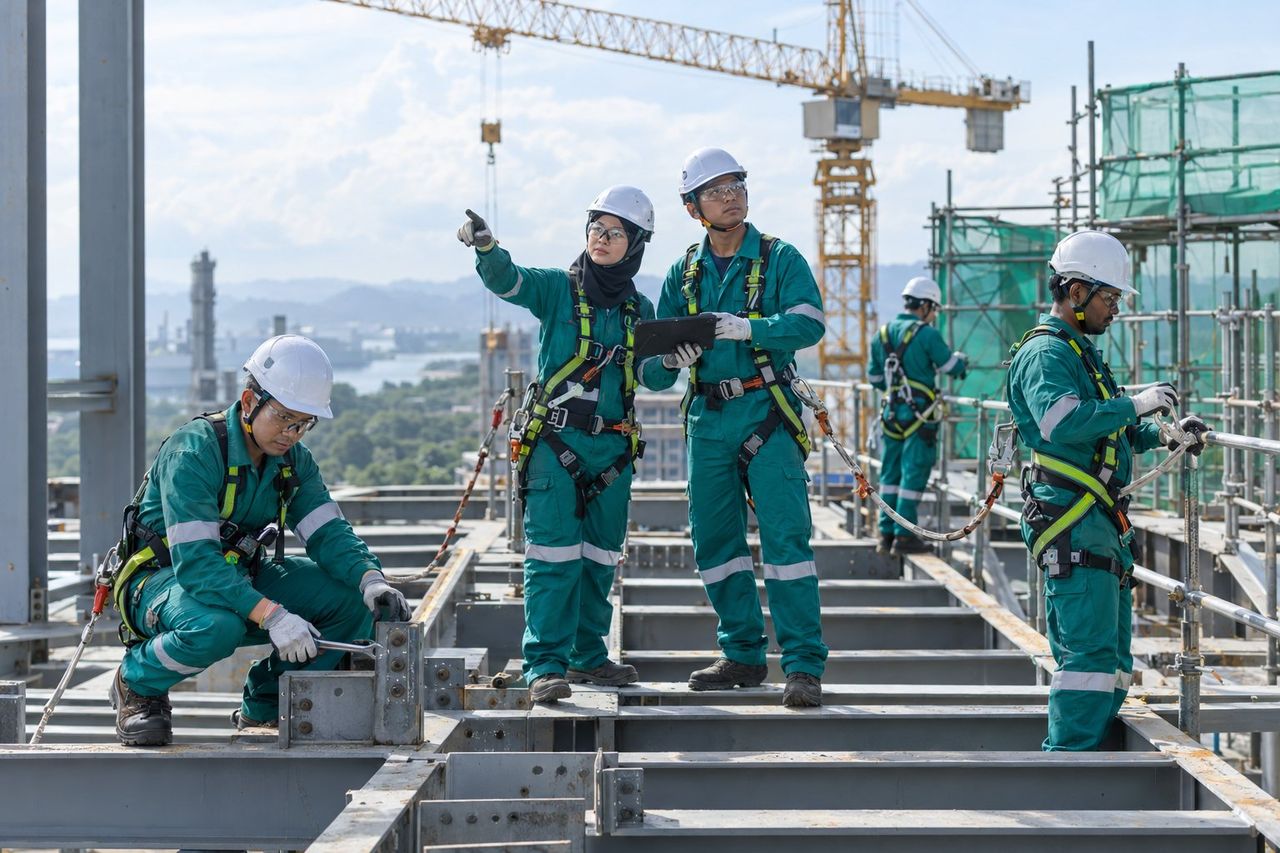 Health, Safety, Security & EnvironmentConstruction SiteA live building site: green cards, scaffolds and edge protection, excavations, cranes, reversing trucks and site power.
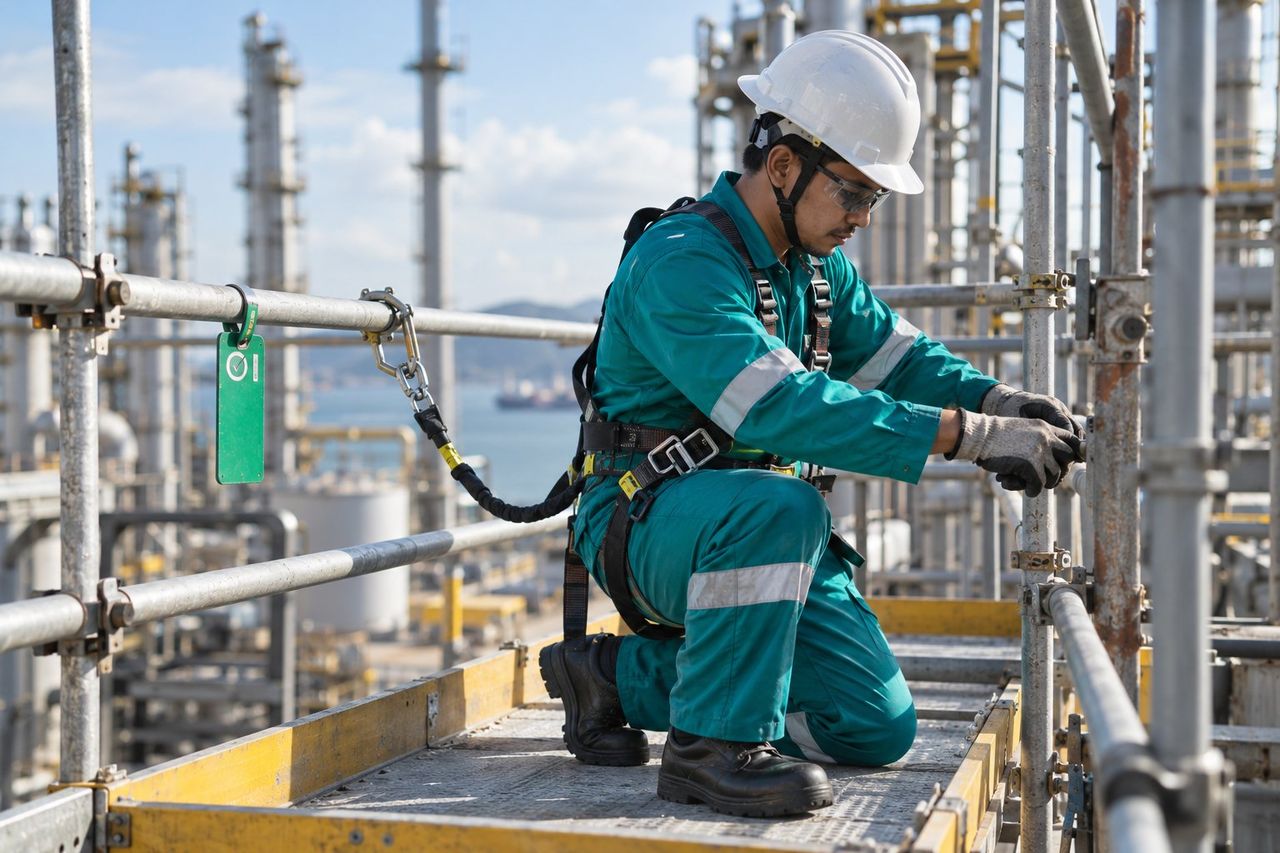 Health, Safety, Security & EnvironmentWorking at HeightScaffolds, ladders, harnesses, MEWPs, dropped objects and rescue: how to stop a fall before it happens.
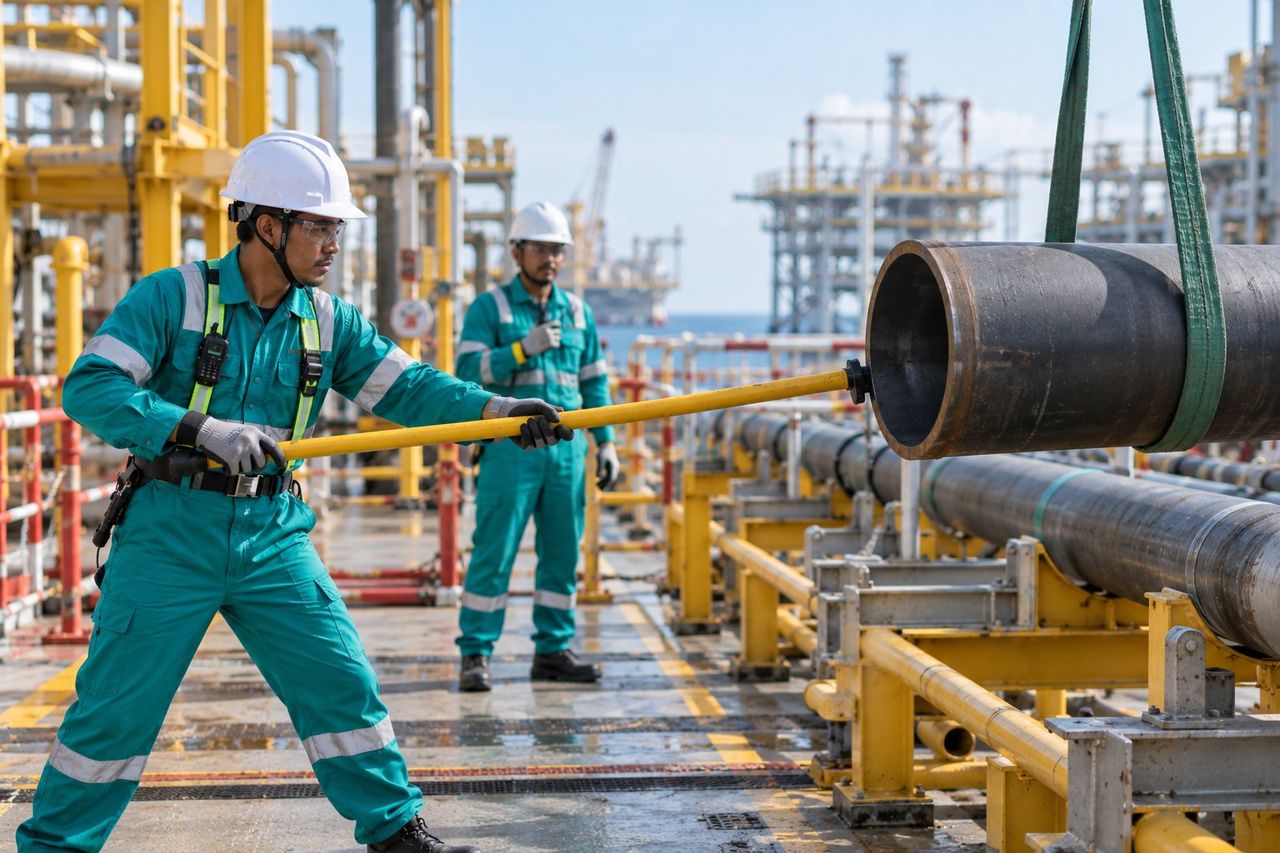 Health, Safety, Security & EnvironmentLine of Fire & Dropped ObjectsMoving loads, stored energy, pinch points, dropped objects and vehicles: learn to ask "where will it go if it fails?" and step out of the path.
 Health, Safety, Security & EnvironmentSpeak Up & Stop WorkRole-play the moments when pressure pushes a shortcut, and practise the words that stop a job safely and respectfully.
 Cybersecurity & Data ProtectionPhishing & Social EngineeringA tower lobby and office floor: pretexting, tailgating, phishing emails, checking links, vishing, SMS and WhatsApp scams, QR-code phishing and what to do if you clicked.
Frequently asked questions
Does gamified safety training actually work?
Is VR better than other safety training?
What is 3D safety training?
Can gamified training replace classroom or practical safety training?
How do you measure whether gamified training is working?
Sources
- Burke et al. (2006), Relative effectiveness of worker safety and health training methods, American Journal of Public Health 96(2), 315–324
- Burke et al. (2011), The dread factor: how hazards and safety training influence learning and performance, Journal of Applied Psychology 96(1), 46–70
- Wouters et al. (2013), A meta-analysis of the cognitive and motivational effects of serious games, Journal of Educational Psychology 105(2), 249–265
- Sailer and Homner (2020), The gamification of learning: a meta-analysis, Educational Psychology Review 32, 77–112
- Makransky, Terkildsen and Mayer (2019), Adding immersive virtual reality to a science lab simulation causes more presence but less learning, Learning and Instruction 60, 225–236
- Occupational Safety and Health Act 1994 [Act 514], reprint as at 1 June 2024 (DOSH): sections 31A and 31B
This guide is general information for workplaces in Malaysia, checked against the sources above on 30 October 2026. It is not legal advice; laws and guidelines change, so confirm the current text before you act.