Safety and health committee in Malaysia: the 40-employee rule, members, meetings and duties
Under section 30 of the OSH Act 1994, every employer with 40 or more persons employed at a place of work, or directed by the DOSH Director General, must set up a safety and health committee. The Safety and Health Committee Regulations 1996 set its members, a meeting and a workplace inspection at least once every three months, and minutes kept for seven years.

When you must have a safety and health committee
Section 30(1) of the Occupational Safety and Health Act 1994 requires every employer to establish a safety and health committee at the place of work if:
- there are forty or more persons employed at the place of work; or
- the Director General of DOSH directs that one be set up.
The test is per place of work, so a company with several sites counts each one. Count the persons employed at that place of work. Section 30(3) adds a broader duty: the employer must consult the committee on arrangements that let management and employees cooperate in promoting safety and health and in checking how well the measures work.
The penalty rose with the 2022 amendments, in force since 1 June 2024. A breach of section 30 is now an offence with a fine of up to RM100,000, imprisonment of up to one year, or both (it was RM5,000 and six months). The detailed rules are in the Occupational Safety and Health (Safety and Health Committee) Regulations 1996 (P.U.(A) 616/1996), in force since 1 January 1997, which carry their own penalty of up to RM5,000, six months in prison, or both, for each breach.
Who sits on the committee
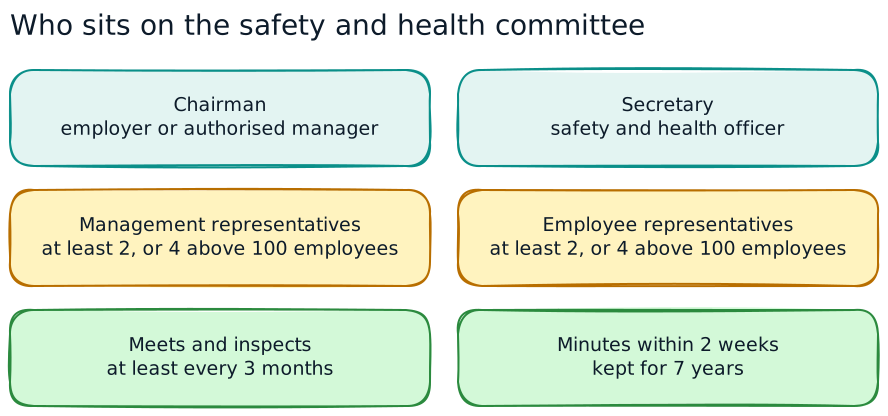
Regulation 5 says the committee consists of a chairman, a secretary, employer representatives and employee representatives.
| Role | Who | Rule |
|---|---|---|
| Chairman | The employer or an authorised manager | Reg 6(1) |
| Secretary | The safety and health officer employed at the place of work. If there is none, the chairman appoints someone or the members elect one by ballot. | Reg 6(2), (3) |
| Management representatives | At least 2 where 100 or fewer persons are employed; at least 4 where more than 100 | Reg 5(2) |
| Employee representatives | At least 2 where 100 or fewer; at least 4 where more than 100. They should represent the various sections of the workplace. | Reg 5(2), 8 |
Employee representatives are nominated by the employees. If more people are nominated than there are seats, hold a ballot; if too few come forward, the employer appoints enough to meet the minimum (regulation 7). The employer must not penalise members for time away from their normal work on committee business, and must let them attend meetings during working hours.
A vacancy is filled the same way the previous member was chosen. The committee may remove a member who misses three consecutive meetings without the chairman's leave, who leaves the workplace (for an employee representative), or who is convicted of certain offences, among other grounds in regulation 10.
What the committee does
Section 31 of the Act gives the committee three core jobs: keep under review the measures taken to ensure safety and health; investigate any matter that a member or employee considers unsafe or a risk to health and that has been brought to the employer's attention; and try to resolve it, asking the Director General to inspect if it cannot. The 1996 Regulations add detail.
- Policy and programmes (reg 11): help develop safety and health rules and safe systems of work, review the effectiveness of safety and health programmes, study trends in accidents, near misses, dangerous occurrences, occupational poisoning and disease, and review the safety and health policy.
- Workplace inspection (reg 12): inspect the place of work at least once every three months, discuss the findings, record unsafe circumstances in a report, and recommend remedies to the employer.
- After an incident (reg 13): inspect the scene as soon as it is safe after any accident, near miss, dangerous occurrence, occupational poisoning or disease, discuss the cause and recommend measures to prevent recurrence. The safety and health officer's investigation report goes to the chairman, who convenes a meeting.
- Complaints (regs 16 and 17): the employer must keep a system for employees to raise safety concerns. If the employer cannot resolve one, it goes to the committee, which investigates and recommends. The employer must implement the recommendations or explain why not; if the committee disagrees, it can ask the Director General to inspect.
- Rules and promotion (regs 18 and 19): help prepare the workplace safety and health rules, which every employee receives, and support safety talks, campaigns and competitions.
Good committees spend their time on the incident and inspection findings, not on reading reports aloud. The Incident Investigation & Root Cause lesson is a useful shared starting point for members who will review investigations, and our incident investigation guide covers the method.
Meetings: frequency, quorum and minutes
Part IV of the Regulations sets the meeting rules.
- Frequency (reg 21): as often as the risks of the work require, but not less than once in three months. Members get reasonable written notice with the agenda.
- Emergency meetings (reg 21(3)): call one immediately after an accident causing death or serious bodily injury, a near miss, a dangerous occurrence or any situation needing urgent attention.
- Inaugural meeting (reg 23): convened by the employer, who sets out the safety and health policy, plans and proposals.
- Quorum (reg 24): the chairman, the secretary and at least half of the remaining members.
- Guests (reg 25): the committee may invite people involved in or with knowledge of an incident, or anyone else with relevant expertise.
- Agenda (reg 26): only safety and health matters may be discussed.
- Minutes (reg 27): sent to every member and the employer within two weeks, kept at the place of work for at least seven years, and given to a DOSH officer on request.
A simple standing agenda keeps quarterly meetings useful: actions from the last meeting; incidents, near misses and first aid cases since then; inspection findings; complaints; new work, equipment or changes needing a risk assessment; training and campaigns; any other safety business.
Training, information and records the employer must provide
The Regulations put duties on the employer to make the committee effective:
- ensure members have a basic understanding of the committee's functions under the Act (reg 28);
- provide adequate training in occupational safety and health, so far as reasonably practicable, so members can do the job (reg 29);
- make available the Act and its regulations, relevant codes of practice and guidelines, safety plans and proposed changes, technical information on hazards and precautions, and operating procedures and substance data (reg 30);
- provide a suitable place to meet (reg 22).
The employer does not have to share information that is prejudicial to national security, prohibited by law, about an identifiable individual without consent, commercially damaging for reasons unrelated to safety, or obtained for legal proceedings (reg 31).
Records to keep ready for a DOSH visit: the committee membership and how members were nominated or appointed; notices and agendas; minutes (seven years); quarterly inspection reports with the employer's decisions recorded on them, which must also be kept for seven years (reg 14(3)); complaint records; and training records for members.
Smaller workplaces: the OSH coordinator
Workplaces under the 40-person threshold are not exempt from consultation. The 2022 amendments added section 29A, in force since 1 June 2024: an employer whose place of work is not in a gazetted class that must employ a safety and health officer, and who employs five or more employees, must appoint one of them as an occupational safety and health coordinator to coordinate safety and health issues at the place of work. An employer who has appointed a safety and health officer is treated as complying. The penalty for not appointing one is a fine of up to RM50,000, up to six months in prison, or both.
The coordinator and the committee are different roles. The coordinator is one employee; the committee is a joint management and employee body with its own legal functions. A workplace with 40 or more persons employed needs the committee regardless, and its OSH coordinator or safety and health officer is the natural person to support the secretary. See our OSHA amendment 2022 guide for the other new duties.
Making the committee work in practice
Common weaknesses to check for:
- Meetings missed or held without quorum, so the three-month rule is broken.
- Hand-picked employee representatives instead of nominations and a ballot.
- Inspections skipped or done as a walk past the office, with no written report.
- Recommendations with no response: the employer's decision is not recorded on the report as regulation 14 requires.
- Minutes late or lost after a change of secretary.
- Members untrained, so they cannot spot hazards or challenge a weak investigation.
Fixes are simple: a fixed calendar of four meetings and four inspections a year, an action log with owners and due dates reviewed at every meeting, and a short induction for new members. The Safety Leadership and Human Factors lessons let members practise safety conversations and understand why errors happen, in a 3D workplace scene. They are awareness lessons with a WorkQuest2U completion certificate, not the statutory training or competencies DOSH requires for specific roles.
Practise it in WorkQuest2U
Short 3D lessons where staff walk the scene, spot the issues and make the calls. Free to try, with certificates and progress records for companies.
 Health, Safety, Security & EnvironmentSafety LeadershipWalk the plant with the site manager: visible felt leadership, safety conversations, the right KPIs, fair consequences and owning Stop Work.
 Health, Safety, Security & EnvironmentIncident Investigation & Root CauseMake the scene safe, gather the 4Ps of evidence, interview without blame, build the timeline and dig past the immediate cause to the root.
 Health, Safety, Security & EnvironmentHuman FactorsSlips, lapses, mistakes and violations: see why good people make errors and the defences that catch them.
 Health, Safety, Security & EnvironmentPermit to Work & Risk AssessmentHow high-risk work is authorised: permits, roles, JHA and the risk matrix, toolbox talks, handovers and SIMOPS.
Frequently asked questions
Is a safety and health committee compulsory in Malaysia?
How many members must a safety and health committee have?
How often must the safety and health committee meet?
How long must committee minutes be kept?
Who is the chairman and secretary of the committee?
What if my workplace has fewer than 40 employees?
Sources
- Occupational Safety and Health Act 1994 [Act 514], sections 30 and 31 (USM copy)
- Occupational Safety and Health (Safety and Health Committee) Regulations 1996, P.U.(A) 616/1996 (copy hosted by Universiti Malaya)
- Occupational Safety and Health (Amendment) Act 2022 [Act A1648], sections 29A and 30(4)
- P.U.(B) 128/2024: commencement on 1 June 2024 (DOSH)
This guide is general information for workplaces in Malaysia, checked against the sources above on 30 October 2026. It is not legal advice; laws and guidelines change, so confirm the current text before you act.