CHRA Malaysia: chemical health risk assessment under the USECHH Regulations 2000
A chemical health risk assessment (CHRA) is the written assessment that regulation 9 of the OSH (Use and Standards of Exposure of Chemicals Hazardous to Health) Regulations 2000 requires before any work that may expose employees to chemicals hazardous to health. It must be done by an assessor registered with DOSH, reviewed at least every five years, and kept for 30 years.

What CHRA means in Malaysia, and which law applies
CHRA stands for chemical health risk assessment. In Malaysia it is the assessment of risk to health required by Part IV of the Occupational Safety and Health (Use and Standards of Exposure of Chemicals Hazardous to Health) Regulations 2000, usually shortened to USECHH. The Regulations were made under section 66 of the OSH Act 1994 (Act 514), published as P.U.(A) 131/2000 and came into operation on 4 April 2000.
People often ask whether USECHH has been replaced. DOSH ran a public consultation on a draft revision, referred to as the USECHH Regulations 202X, in 2020. As of October 2026 no replacement has been gazetted, and the regulations list on the DOSH website still shows the 2000 Regulations alongside the newer 2024 and 2025 instruments on fees, construction design and management, certificates of fitness and special inspection. Use the 2000 Regulations, and check the DOSH site before each CHRA review in case the revision is finalised.
USECHH applies to every place of work under the OSH Act where chemicals hazardous to health are used. “Use” is wide: production, processing, handling, storage, transport, disposal and treatment. It does not cover radioactive materials, foodstuffs, pharmaceutical products, or chemicals that are hazardous only because they are explosive, flammable, hot, cold or under pressure. Those risks belong in your general risk assessment, such as a HIRARC.
The chemical register and safety data sheets
Regulation 5 is the starting point. The employer must identify and record in a register all chemicals hazardous to health used at the place of work, keep it in good order and update it. The register must contain:
- a list of all chemicals hazardous to health used;
- the current safety data sheet (SDS) for each one, or for pesticides the information in Schedule III;
- the average quantity used, produced or stored per month or per year;
- the process and work area where each chemical is used; and
- the name and address of each supplier.
The register must be accessible to every employee who is, or is likely to be, exposed. A register locked in the HSE office does not meet that test.
Two other rules keep the SDS useful. Under regulation 24, if a chemical arrives without a label or SDS, you must get the information from the supplier and must not use the chemical until you have it. Under regulation 25, the current SDS must be kept in a conspicuous place close to each location where the chemical is used. Labels must not be removed or defaced, and decanted containers that are not used up within a normal shift must be relabelled (regulations 20 and 21).
Where CLASS 2013 fits. The Occupational Safety and Health (Classification, Labelling and Safety Data Sheet of Hazardous Chemicals) Regulations 2013 (P.U.(A) 310/2013), known as CLASS, brought the Globally Harmonized System (GHS) into Malaysian law. CLASS puts the duty on suppliers to classify the hazardous chemicals they supply, label them and provide an SDS with all 16 sections. USECHH then puts the duty on the employer who uses them. If a supplier’s SDS is out of date or missing sections, ask for a current one before you put it in the register.
What a CHRA must cover
Regulation 9 says an employer shall not carry out any work that may expose employees to a chemical hazardous to health unless a written assessment has been made. The assessment must contain:
- the potential risks to employees from exposure;
- the methods and procedures used in handling the chemicals;
- the nature of the hazard to health;
- the degree of exposure;
- the risk created by the use and release of chemicals from work processes;
- the measures and procedures needed to control exposure;
- the measures, procedures and equipment needed to control accidental emissions from leaks, spills or process or equipment failure;
- whether an exposure monitoring programme is needed;
- whether a health surveillance programme is needed; and
- the training and retraining employees need.
The assessment is also how you show compliance with the permissible exposure limits in Schedule I. Regulations 6 and 7 require that exposure never exceeds a chemical’s ceiling limit, stays below its eight-hour time-weighted average, and never exceeds its maximum exposure limit, a 15-minute average set at three times the eight-hour value.
The Chemicals & H2S lesson lets workers practise reading SDS and GHS labels, choosing chemical PPE and decanting safely in a 3D chemical yard, which is the kind of everyday practice a CHRA usually asks for.
Who can do a CHRA: registered assessors
Regulation 11 says the employer must ensure the assessment is conducted by an assessor, defined in regulation 2 as an employee or other person appointed by the employer and registered with the Director General of DOSH to carry out assessments of risks to health.
The OSH (Amendment) Act 2022 (Act A1648) strengthened this. It inserted Part VIIA on competent persons into the OSH Act. Under section 31B, no person may carry out an activity listed in the Fifth Schedule unless registered as a competent person, on pain of a fine of up to RM100,000. The Fifth Schedule lists, among others:
- conducting health risk assessment for any chemical that is hazardous to health;
- carrying out medical surveillance and health examination;
- monitoring or testing the work environment, including chemical exposure monitoring; and
- fabricating, installing, testing, inspecting or maintaining engineering control equipment.
In practice that means three registered roles around a CHRA: the assessor who writes it, the hygiene technician who monitors exposure and tests engineering controls, and the occupational health doctor who runs medical surveillance. Check the person’s current DOSH registration before you appoint them, and keep a copy with the report.
Under regulation 12 the assessor must give you the report within one month of finishing the assessment, and must tell you immediately if anything is likely to cause immediate danger to life or property.
How the DOSH CHRA manual structures the assessment
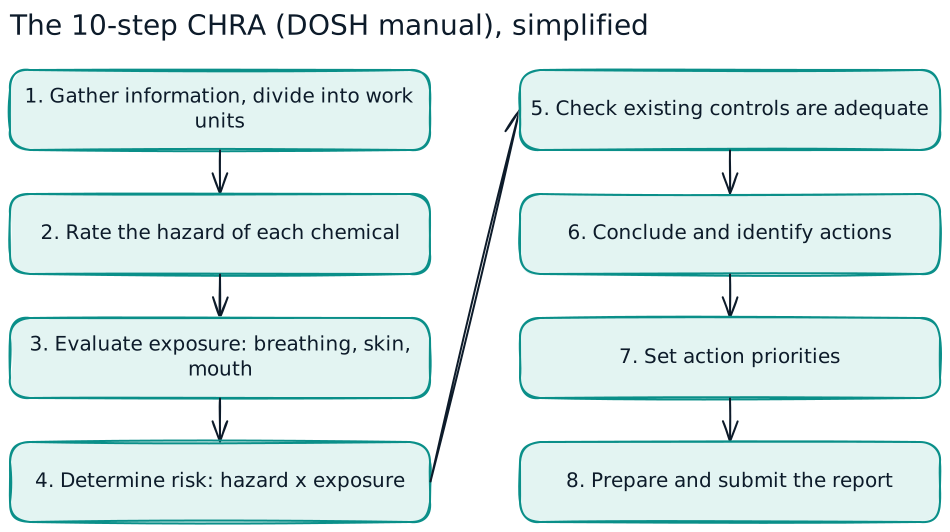
DOSH’s Manual of Recommended Practice on Assessment of the Health Risks Arising from the Use of Chemicals Hazardous to Health at the Workplace (3rd edition, first reprint 2018, with a corrigenda issued by DOSH) is the method assessors follow. It sets out ten steps:
- Gather information.
- Divide the workplace into work units (groups of workers with similar tasks and exposures).
- Determine the degree of hazard of each chemical in each work unit.
- Evaluate exposure from all routes: inhalation, skin and ingestion.
- Determine the level of risk.
- Assess whether existing controls are adequate.
- Conclude the assessment.
- Identify the actions to be taken.
- Make recommendations and assign action priorities.
- Prepare, present and submit the report.
For inhalation, the manual scores a hazard rating (HR, 1 to 5, for the severity of health effects) and an exposure rating (ER, 1 to 5, for the chance of overexposure), and multiplies them: RR = HR × ER. A risk rating of 1 to 4 is low, 5 to 12 moderate and 15 to 25 high. Skin exposure is rated separately from the chemical’s hazardous properties, the extent of contact and its duration.
The manager’s job is to give the assessor accurate information: the chemical register, SDS, process descriptions, shift patterns, existing controls and any previous monitoring or medical results.
After the report: controls, monitoring and health surveillance
Act within one month. Where the report says action is needed, regulation 14 gives the employer one month from receiving it to carry out the action, and the controls must bring exposure to the lowest practicable level, and below any permissible exposure limit.
Follow the order of control. Regulation 15 lists the measures in order: elimination, substitution, total enclosure, isolation, changing process parameters, engineering control equipment, safe work systems, and approved PPE. Under regulation 16, PPE is for when the other measures are impracticable, as an interim measure, or as a top-up. Engineering control equipment must be inspected at least monthly and examined and tested by a hygiene technician at least every 12 months; local exhaust ventilation must be designed and tested by a registered professional engineer.
Exposure monitoring (regulation 26). Where the CHRA says monitoring is needed, a hygiene technician monitors exposure by an approved method. For chemicals in Schedule II, monitoring is repeated at intervals of not more than six months until the assessor is satisfied it is no longer needed.
Health surveillance (regulation 27). Where the CHRA says it is needed, the employer runs a health surveillance programme, with the medical part carried out by an occupational health doctor. For Schedule II chemicals, medical surveillance is at intervals of not more than twelve months. Under regulation 28, an employee the doctor finds at increased risk must be removed from the exposure. The Health & Wellbeing lesson shows workers what fitness-to-work and health checks are for, and Agrochemicals & Your Health walks through medical surveillance for pesticide users.
Training (regulation 22). Exposed employees must get information, instruction and training on the risks and precautions, including monitoring results and collective health surveillance results. Review and repeat the training at least once every two years, and whenever hazards, controls or tasks change.
Records to keep, and a CHRA checklist
| Record | Keep for |
|---|---|
| CHRA report (regulation 13) | At least 30 years |
| Personal exposure monitoring records (regulation 26) | At least 30 years |
| Other monitoring records | At least 5 years |
| Health surveillance records (regulation 27) | 30 years from the last entry |
| Engineering control design, test, inspection and maintenance records (regulation 19) | Produce when DOSH directs |
| Training programme records (regulation 22) | Kept for inspection |
The CHRA report must be available to DOSH and to any exposed employee on request.
- Build or update the chemical register, with a current SDS for every entry.
- Appoint a DOSH-registered assessor and confirm the registration.
- Give the assessor full process, shift and control information.
- Start the recommended actions within one month of the report.
- Set up exposure monitoring and health surveillance where the report requires them.
- Train exposed staff, and repeat at least every two years.
- Diary the review: five years, or sooner after any significant change.
- File the records for the periods in the table.
Chemical work often comes with permits; see permit to work and practise the permit steps in Permit to Work & Risk Assessment. This guide is general information, not legal advice. WorkQuest2U lessons build awareness and do not replace the registered assessor, hygiene technician or doctor the law requires.
Practise it in WorkQuest2U
Short 3D lessons where staff walk the scene, spot the issues and make the calls. Free to try, with certificates and progress records for companies.
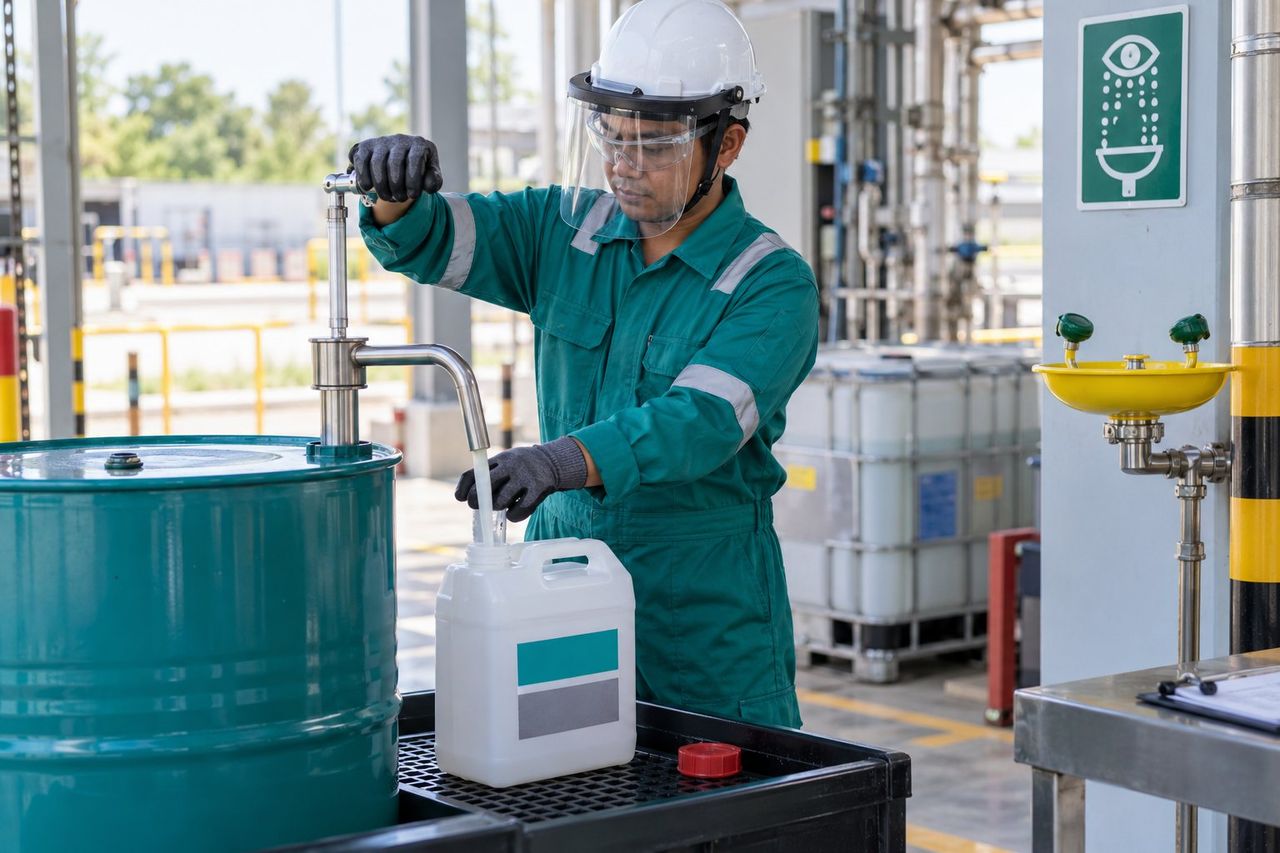 Health, Safety, Security & EnvironmentChemicals & H2SRoutes of exposure, SDS and GHS labels, chemical PPE, storage and decanting, benzene and deadly H2S: a hands-on chemical safety yard.
 Health, Safety, Security & EnvironmentHealth & WellbeingFitness to work, heat stress, fatigue, dengue, haze, hearing and mental health at a Malaysian plant.
 Health, Safety, Security & EnvironmentAgrochemicals & Your HealthHow pesticides get into the body, acute and chronic poisoning, the signs of organophosphate poisoning, cholinesterase tests and medical surveillance, first aid and decontamination, and keeping your family safe.
 Health, Safety, Security & EnvironmentPermit to Work & Risk AssessmentHow high-risk work is authorised: permits, roles, JHA and the risk matrix, toolbox talks, handovers and SIMOPS.
Frequently asked questions
Has USECHH 2000 been replaced?
How often must a CHRA be reviewed?
Can my safety and health officer do the CHRA?
What is the difference between a CHRA and HIRARC?
How long must CHRA records be kept?
What must a chemical register contain?
Sources
- USECHH Regulations 2000 [P.U.(A) 131/2000], full text (copy hosted by Universiti Malaya)
- DOSH: Regulations under the Occupational Safety and Health Act 1994 (current list)
- DOSH: Corrigenda to the CHRA Manual of Recommended Practice, 3rd edition
- CHRA Manual of Recommended Practice, 3rd edition, first reprint 2018 (copy hosted by Universiti Malaya)
- Occupational Safety and Health (Amendment) Act 2022 [Act A1648], section 31B and Fifth Schedule
- CLASS Regulations 2013 [P.U.(A) 310/2013], regulatory database entry (ChemLinked)
- UTM: complying with CLASS 2013 (16-element SDS, labels)
- Enviliance: draft USECHH revision put to public comment, 2020 (regulatory tracker)
This guide is general information for workplaces in Malaysia, checked against the sources above on 30 October 2026. It is not legal advice; laws and guidelines change, so confirm the current text before you act.