AI training for employees Malaysia: what to teach, to whom and how to measure it
Good AI training for employees in Malaysia starts with a short baseline for everyone (what AI is, approved tools, what never to paste, checking output), then adds role-based practice on real tasks, and is measured by behaviour at work rather than course completions.

Why AI training for employees matters now
Most Malaysian workplaces already have staff using ChatGPT, Copilot, Gemini or similar tools, whether or not the company has approved them. The risk is rarely the tool itself. It is an employee pasting a customer list into a free chatbot, sending an AI-drafted email with a made-up figure, or trusting a confident answer on a legal or safety question.
The policy context is also moving. In September 2024 the Ministry of Science, Technology and Innovation (MOSTI) published the National Guidelines on AI Governance and Ethics (AIGE). They are voluntary, but they ask organisations to pass seven AI principles down to end users. In July 2026 the National AI Office issued a public consultation paper on a proposed AI Governance Bill. As of October 2026 that Bill is a proposal, not law, but it signals that accountability for how AI is deployed is heading towards a statutory footing. Personal data in prompts is already covered by the Personal Data Protection Act 2010, as amended in 2024.
Training is the cheapest control you have: it turns a policy on paper into habits on the desk.
The baseline every employee needs
Before anyone learns clever prompts, every employee should be able to answer five questions:
- Which tools am I allowed to use, and with which accounts? Company-licensed tools with data controls are different from personal free accounts.
- What must never go into a prompt? Personal data of customers or colleagues, confidential contracts, source code, passwords, unreleased financials, unless the tool is approved for that class of data.
- How do I check the result? AI can invent facts, citations and numbers. Anything that leaves your hands must be verified against a source.
- Who owns the output? You do. AI-assisted work is still your work, and "the AI said so" is not a defence.
- When do I disclose AI use, and how do I report a problem? Follow the company's labelling rule, and report a suspected data leak as you would any other incident.
Our AI at Work: The Basics and Using Generative AI Safely lessons cover exactly this. Staff practise in a 3D office scene: choosing the approved tool, spotting what must not be pasted and catching a hallucinated answer, then sit a short quiz.
What to teach which roles
| Role | What they need | Suggested lessons |
|---|---|---|
| All staff | Approved tools, data red lines, checking output, disclosure, reporting | AI at Work: The Basics, Using Generative AI Safely |
| Office and admin staff | Clear briefs, emails, summaries, extracting information from documents | Prompting Essentials, Checking & Improving AI Results |
| HR, customer service, sales | Handling personal data safely in prompts, documents and AI tool settings | Data Protection for AI |
| Analysts and data teams | Framing questions, preparing data, checking AI-written code, bias and privacy in models | What Data Science Is and the AI for Data Science topic |
| Managers and risk owners | Risk assessment, bias, human oversight, vendor checks, AI incidents | AI Governance, Bias & Accountability (in the AI at Work certificate) |
| Builders of AI agents and automations | Tool permissions, prompt injection, connectors and stop controls | AI Agentic Security and the Build Agents groups |
Keep the baseline short and compulsory, and make the role modules targeted. A finance clerk does not need a course on neural networks; an analyst does need to know how to check SQL that a chatbot wrote.
ChatGPT training for staff: what good looks like
"ChatGPT training" often means a prompt-tips session. Prompting matters, but the skills that save time and avoid incidents are broader:
- Writing a work brief: task, context, audience, format, an example and the constraints. A clear brief beats any "magic prompt".
- Grounding in documents: giving the tool the source and asking it to quote or cite, so answers can be traced.
- Verifying: checking figures, names, dates and citations; asking the tool to list what it is unsure of; knowing when a specialist must review.
- Revising without losing facts: making a draft shorter or friendlier without the tool quietly changing a number.
- Reusing what works: saving good prompts as team templates instead of every person starting from scratch.
Teach these on the tool your company has approved, using your own (non-sensitive) examples. Generic demos on someone else's use case rarely transfer to Monday morning.
Choosing an AI course for companies
Questions to ask any provider, including us:
- Is it practice or lecture? Staff remember decisions they made, not slides they watched. Look for scenarios where learners choose and get feedback.
- Is it Malaysian? Does it reference the PDPA, the AIGE guidelines and local workplace situations, and is it available in Bahasa Malaysia where your staff need it?
- Does it match your policy? Training should teach your approved tools and your red lines. If you have no policy yet, start with our AI usage policy template.
- Can you see results? Completion, quiz scores and certificates per person and per department, exportable for audit.
- Does it stay current? AI tools change every few months. Ask how often content is reviewed.
- Is it claimable? If you plan to fund training through HRD Corp, check with HRD Corp whether the specific provider and programme are registered and claimable before you commit. Do not rely on a provider's marketing for this.
How to measure AI training
Completion rates tell you who clicked through. They do not tell you whether behaviour changed. Track a small set of measures before and three months after training:
- Policy incidents: reported or detected cases of confidential or personal data pasted into unapproved tools.
- Quality: spot-check a sample of AI-assisted documents for factual errors and missing disclosure.
- Time on named tasks: pick two or three repeatable tasks per team (meeting notes, first-draft replies, monthly report) and measure time taken.
- Adoption of approved tools: licensed-tool usage up, shadow-tool usage down.
- Knowledge: quiz scores on the red lines, repeated yearly.
Report these to the same committee that owns the AI policy, and review the training when the policy, the tools or the law change.
Try it: the AI for Everyone and AI for Data Science topics
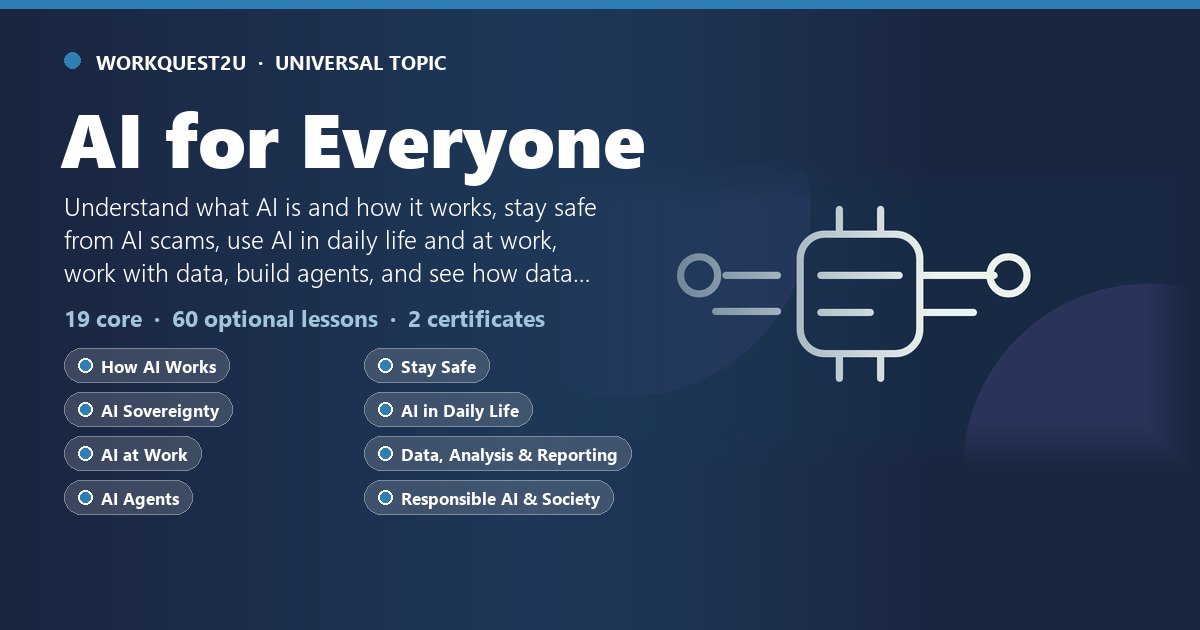
The AI for Everyone topic has two certificates. AI Essentials covers how AI works, staying safe from AI scams and fake content, privacy and AI sovereignty. AI at Work adds approved tools and red lines, prompting, checking results, data work, agents and data protection and governance. The topic is bilingual: the AI Essentials lessons and the workplace basics are available in English and Bahasa Malaysia, and the more advanced workplace lessons are in English for now.
For analysts, AI for Data Science takes learners from framing a question through preparing data, building and evaluating models and checking AI-written code, to fairness, privacy and deployment.
Each lesson is a short 3D scene with a guide, checkpoints and a quiz, so staff practise decisions rather than read about them.
Practise it in WorkQuest2U
Short 3D lessons where staff walk the scene, spot the issues and make the calls. Free to try, with certificates and progress records for companies.
 AI for EveryoneAI at Work: The BasicsAn AI innovation hub: what AI is, its strengths and limits, approved tools, human in the loop, owning the output, labelling AI-assisted work, good uses and red lines.
 AI for EveryoneUsing Generative AI SafelyA KL tower office: approved AI tools, what never to paste, hallucinations, copyright and bias, AI for code, prompt injection, labelling and human accountability.
 AI for EveryonePrompting EssentialsTurn a vague request into a useful work brief: task, context, audience, format, examples and follow-up instructions.AI for EveryoneChecking & Improving AI ResultsDiagnose weak answers, verify claims, preserve facts during revision and decide when a result needs human expertise.AI for EveryoneData Protection for AIProtect personal and confidential information across prompts, documents, retrieval, memory, service settings, logs and outputs.
 AI for Data ScienceWhat Data Science IsStart here: what data science is, the project lifecycle, who does what, describe vs predict vs prescribe, and where AI helps or a person must decide.
Frequently asked questions
What should AI training for employees cover?
Is AI training mandatory in Malaysia?
Should staff be allowed to use ChatGPT at work?
How long should AI training for employees take?
Is AI training claimable under HRD Corp?
Sources
- MOSTI: National Guidelines on AI Governance and Ethics (AIGE)
- MyGOV: National Guidelines on Artificial Intelligence Governance and Ethics
- National AI Office consultation paper on the proposed AI Governance Bill (law-firm summary, July 2026)
- Personal Data Protection Commissioner (JPDP)
This guide is general information for workplaces in Malaysia, checked against the sources above on 30 October 2026. It is not legal advice; laws and guidelines change, so confirm the current text before you act.