How to report a scam in Malaysia: NSRC 997, your bank and Semak Mule
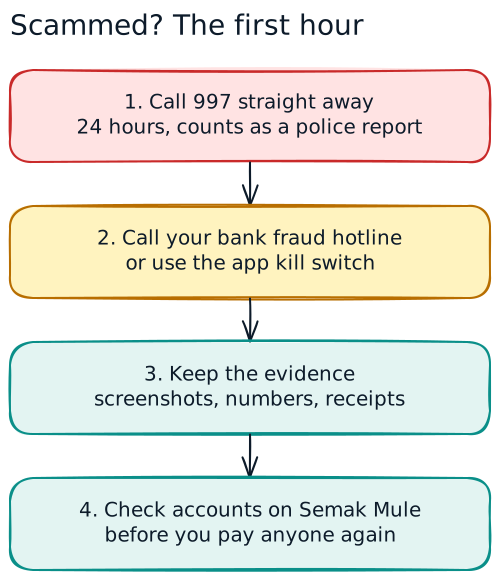
If you have transferred money to a scammer in Malaysia, call the National Scam Response Centre (NSRC) on 997 straight away, then call your bank’s fraud hotline or use its kill switch to freeze your account. The first one to two hours matter most, because scammers move stolen money through mule accounts within minutes.

What to do in the first hour after a scam
Speed decides how much money can be saved. In March 2026 the Home Minister said the first one to two hours are crucial, because syndicates use mule accounts to empty 80 to 90 per cent of a victim’s funds within three to ten minutes. In one case described by the Communications Minister, a victim who reported about eight hours after the transfer recovered only RM170,000 of RM1 million.
| Step | What to do | Why |
|---|---|---|
| 1. Call 997 | Call the National Scam Response Centre. Give the date and time of each transfer, the amount, the account number you paid into and the scammer’s phone number or profile. | The NSRC works with banks to trace and block the money as it moves between mule accounts. |
| 2. Call your bank | Use your bank’s 24-hour fraud hotline or the kill switch in its app to suspend your account and cards. | Stops further debits if the scammer has your login, OTP or a remote-access app on your phone. |
| 3. Stop paying | Do not send any more money, including “fees”, “tax” or “unlock charges” to release your funds. | Recovery fees are a second scam aimed at people who have just lost money. |
| 4. Secure your phone | If you installed an app or shared your screen, disconnect from the internet, remove the app and change your banking and e-mail passwords from a different device. | Malicious apps can read OTPs and approve transactions. |
| 5. Keep evidence | Screenshot chats, call logs, receipts, the scammer’s accounts and any website or app. Do not delete the conversation. | The bank, the police and the NSRC will need it. |
If more than a few hours have passed, still report. Banks and the police can act on later reports, and every report adds the mule account to the records used to warn others.
The NSRC 997 hotline explained
The National Scam Response Centre was set up by the government as a rapid response centre for online financial scams. It is led by the Royal Malaysia Police (PDRM), working with Bank Negara Malaysia, the Malaysian Communications and Multimedia Commission (MCMC) and the National Anti-Financial Crime Centre. It now operates from MCMC’s Menara 2 in Cyberjaya, having moved from the Bank Negara building in Kuala Lumpur.
- Hours: 24 hours a day, seven days a week. The 24-hour service started in September 2025. Some older bank and agency pages still show the earlier 8am to 8pm hours.
- Police report: since the 2025 changes, a call to 997 is treated as a police report. In March 2026 the Communications Minister confirmed that a separate police report is no longer needed for the NSRC to act.
- When to call: as soon as possible, and the official advice is within 24 hours of discovering the scam.
- What it covers: online financial scams where money has been transferred, including Macau scams, investment and cryptocurrency scams, love scams, online shopping scams, impersonation of banks and government agencies, and procurement fraud.
Once a report is lodged, the receiving accounts can be suspended and the transactions investigated, and recovered funds are returned to victims where possible. The amounts returned are rising, from about RM508,000 in 2024 to RM6.7 million in 2025, but most stolen money is still not recovered. Prevention matters more than recovery.
Important: the NSRC only receives calls. It does not phone, WhatsApp or message the public, and the police have said it runs no social media accounts. Fake “NSRC officer” calls have been used to steal millions of ringgit.
Freezing your bank account: kill switch and fraud hotline
Bank Negara Malaysia requires banks to give customers a convenient way to suspend their accounts if they suspect they have been compromised, and to provide dedicated hotlines for reporting scams. Most banks offer this as a kill switch in the mobile app or through the 24-hour fraud line. Once activated, online, card and ATM transactions are typically blocked until you reactivate the account with the bank.
Know where your own bank’s kill switch is before you need it. Practical tips:
- Save your bank’s fraud hotline number from its official website or the back of your card, not from a search result or message.
- If you paid by card, tell the bank so it can block the card and advise on any dispute process.
- Ask the bank for a reference number and write down the time of every call.
- If you are not satisfied with how your bank handled your complaint, Bank Negara’s BNMTELELINK channel takes escalated complaints.
Police reports and Semak Mule
Semak Mule is the Commercial Crime Investigation Department’s (CCID) public portal at semakmule.rmp.gov.my. You can search a bank account number, phone number or company name to see whether it has been linked to police scam reports. It has recorded more than 37 million visits since it launched in 2020.
Use it before you pay a new seller, landlord, “investment manager” or job agent. Two cautions:
- A clean result does not prove an account is safe. New mule accounts appear every day and only reported accounts are listed.
- Semak Mule is a checking tool, not a reporting channel. To report, call 997 and your bank.
Do you still need a police report? For the NSRC to act on a transfer, calling 997 is enough. You may still want a written police report at the nearest station if your bank, insurer or employer asks for one, if the scam involved threats, extortion or identity theft rather than a transfer, or if you could not get through to 997.
Allowing your own account to be used by scammers is itself a crime. Penal Code amendments passed in 2024 (sections 424A to 424D) make it an offence to let others control your bank account or payment instruments for unlawful transactions. Never “rent” or lend your account, and report anyone who asks.
Common scams in Malaysia and their red flags
| Scam | How it usually starts | Red flag |
|---|---|---|
| Macau scam | A call from a “courier”, “bank officer” or “police” saying your name is linked to a crime or unpaid fine, then transfer to a fake officer | Real officers never ask you to move money to a “safe account” or keep the call secret |
| Investment scam | Ads or WhatsApp and Telegram groups promising high, quick returns, often with fake celebrity endorsements or deepfake videos | Guaranteed returns, pressure to top up, withdrawals blocked until you pay a “fee” |
| Love scam | An online partner who cannot meet, then needs money for customs, medical or travel costs | Requests for money from someone you have never met in person |
| Online shopping | Cheap goods on social media, payment by transfer to a personal account | No platform protection, seller avoids the marketplace checkout |
| Job and task scam | Part-time “like and review” tasks that pay small amounts, then require deposits | You must pay to earn |
| Malicious app | A link or APK file for a cleaning service, parcel tracking or government aid | Any request to install an app outside the official store |
Seeing these patterns before they happen helps more than any hotline. The WorkQuest2U Scams 101: The Scam Map and Scam Smart: AI Tricks to Watch For lessons let staff practise spotting red flags in a 3D scene, and If You Have Been Scammed walks through the reporting steps above.
What employers should put in place
Scams hit staff at home and the company at work. A short scam response plan covers both:
- Publish the numbers. Put 997 and the steps above on the intranet, staff app and payslip notes.
- Train regularly. Short scenario lessons on scam types, malicious apps and mule recruitment, with a refresher when new scams appear. Our guide to phishing awareness training covers what to include.
- Protect company payments. Verify any change to supplier bank details by calling a known number, and require a second approver for urgent transfers. See Payment Fraud & Scams.
- Support victims. Give staff who report a scam time off to call the bank and the NSRC, and point them to the employee assistance programme. Shame keeps people silent, and silence costs recovery time.
- Warn about mule recruitment. Young staff and interns are targeted with offers to “rent” their bank accounts. Make clear that this is a crime.
- Customer-facing teams. If your staff handle customer money or accounts, they need extra training on helping a victim and spotting account takeover. The Cybersecurity topic’s Scam Prevention certificate groups those lessons, including Helping a Scam Victim and Mule Accounts.
This guide is general information based on official guidance as of October 2026. Hotline hours and procedures can change, so check the official NSRC and bank pages when in doubt.
Practise it in WorkQuest2U
Short 3D lessons where staff walk the scene, spot the issues and make the calls. Free to try, with certificates and progress records for companies.
 Investor SmartIf You Have Been ScammedA bank fraud call centre, the 997 response wall and a police station counter: what to do, in what order, if you have been scammed, how to dodge the "recovery" scam, and how to help family without shame.
 Cybersecurity & Data ProtectionScams 101: The Scam MapA scam-awareness command centre with a live scam map: how scams use calls, SMS, SIMs and apps in Malaysia, the main scam types, NSRC 997, and the telco's role in protecting public trust.
 AI for EveryoneScam Smart: AI Tricks to Watch ForCloned voices, deepfake investment ads, fake officer calls and parcel messages: spot the tricks, pause, check and report fast.Cybersecurity & Data ProtectionHelping a Scam VictimA store service counter and a quiet room: listen with empathy, act fast (997, bank, police, SIM checks), avoid harmful words, escalate, and look after yourself.Cybersecurity & Data ProtectionMule AccountsA university campus and its branch: how students are recruited as money mules, the red flags at opening and in account activity, the law, and what staff must do.
 Cybersecurity & Data ProtectionPayment Fraud & ScamsA payments hub: email compromise, executive instruction fraud, bank-detail changes, fake invoices, dual release and fast recall.
Frequently asked questions
Is the 997 scam hotline open 24 hours?
Do I need to make a police report after calling 997?
Can I get my money back after a scam?
How do I check if a bank account or phone number belongs to a scammer?
Someone from the NSRC called me. Is it real?
What if more than 24 hours have passed since the scam?
Sources
- MyGOV: NSRC 997 hotline
- Bank Negara Malaysia: What can I do if I have been scammed?
- Malay Mail: Call 997 right away if you suspect a scam (3 Mar 2026)
- The Star: Call 997 if you’ve been scammed, says Fahmi (4 Mar 2026)
- The Star: Calls to 997 to be treated as police reports (26 Jul 2025)
- PDRM CCID: Semak Mule portal
This guide is general information for workplaces in Malaysia, checked against the sources above on 30 October 2026. It is not legal advice; laws and guidelines change, so confirm the current text before you act.