Conflict of interest examples at work, and how to declare and manage them
A conflict of interest exists when a personal interest, such as family, money, a side business or a friendship, could influence, or look like it influences, a decision you make for your employer. Having one is not wrongdoing; hiding it or deciding anyway is. Declare it in writing, step back from the decision and let someone independent decide how to manage it.

What a conflict of interest is
You have a conflict of interest when a personal interest could get in the way of your duty to act in your employer’s best interest. The personal interest can be financial (shares, a loan, a side income), family (a spouse, sibling or cousin on the other side of a deal), or social (a close friend, a former employer, a club or association).
Three kinds matter:
- Actual: you are making a decision now that affects your personal interest, such as evaluating a tender from your brother-in-law’s company.
- Potential: the conflict will arise if things change, such as a friend’s company that is about to bid.
- Perceived: a reasonable person could think your judgement is affected even if it is not, such as approving a promotion for someone you live with.
Having a conflict is normal, especially in Malaysia where families, kampung networks and business circles overlap. The problem is not the relationship. It is keeping quiet about it, or making the decision anyway. The Guidelines on Adequate Procedures under section 17A of the MACC Act list a conflicts of interest policy as one of the control measures every commercial organisation should have, and ISO 37001:2025 now asks organisations to have mechanisms to detect, prevent and control conflicts of interest.
Conflict of interest examples at work
| Situation | Why it is a conflict | What usually happens |
|---|---|---|
| A manager wants to hire her nephew into her own team. | She would select, appraise and promote a relative. | Declare. HR and another manager run the selection; if hired, he reports to someone else. |
| A procurement executive’s spouse is a director of a bidding supplier. | He could shape specifications, leak information or score unfairly. | Declare before the tender opens. He is removed from that tender and its evaluation. |
| An engineer runs a weekend business doing the same work the company sells. | Competing for the same customers, and a risk of using company time, tools or contacts. | Declare and seek approval for outside work; usually refused if it competes. |
| A finance manager holds shares in a key customer. | Credit terms and write-offs could favour that customer. | Declare. Another approver handles that account above a set limit. |
| A sales lead is offered a paid “advisory role” by a distributor he manages. | Divided loyalty, and the payment could be a disguised reward. | Declare and decline while he manages the account. |
| A supervisor is in a relationship with someone who reports to him. | Shifts, overtime, appraisals and discipline could be biased. | Declare. Change the reporting line. |
| A project manager approves variation orders from a contractor who paid for her family holiday. | A gift has created an obligation, and approvals may be influenced. | A breach of the gifts policy as well as a conflict; it can also be a bribery offence. Report it. |
| An HR officer is asked to investigate a grievance against her close friend. | She cannot be seen as impartial. | Declare. Assign another investigator. |
Public officers and section 23 of the MACC Act
Section 23(1) of the MACC Act 2009 makes it an offence for an officer of a public body to use their office or position for any gratification, whether for themselves, a relative or an associate. Section 23(2) adds a presumption: an officer is presumed, until the contrary is proved, to have done so when they make a decision or take action on a matter in which they, a relative or an associate has a direct or indirect interest.
The penalty under section 24 is imprisonment of up to 20 years and a fine of not less than five times the value of the gratification or RM10,000, whichever is higher.
This matters to private companies too, for two reasons:
- “Public body” is wide. Under the Act it includes federal and state governments, local and statutory authorities, and companies or subsidiaries in which such a body has controlling power or interest, as well as registered societies, co-operatives and trade unions.
- The Act defines relatives and associates broadly. Relatives include spouses, siblings and in-laws, parents and children, uncles, aunts and cousins. Associates include nominees, employees and companies in which the person has control or a substantial shareholding.
The Public Officers (Conduct and Discipline) Regulations 1993 also forbid an officer from subordinating public duty to private interests or acting in a way likely to bring private interests into conflict with public duty. If your staff deal with officials who appear to have an interest in your business, record it and escalate it.
Managing versus avoiding a conflict
Not every conflict means someone must leave the deal or the job. The aim is to make sure the decision is not influenced. Options, from lightest to strongest:
- Record only: the interest is small and the person has no role in related decisions.
- Step back: the person leaves the meeting, does not see bid papers and does not vote or approve.
- Extra oversight: a second approver or a higher authority signs off decisions involving the interest.
- Reassign: change the reporting line, account or project.
- Remove the interest: sell the shares, end the outside role or decline the appointment.
- Avoid entirely: the company decides not to deal with the related party at all.
The person with the conflict should never be the one who decides which option applies. That is for the line manager, compliance or, for directors, the Board or audit committee.
The declaration process and what the form should contain
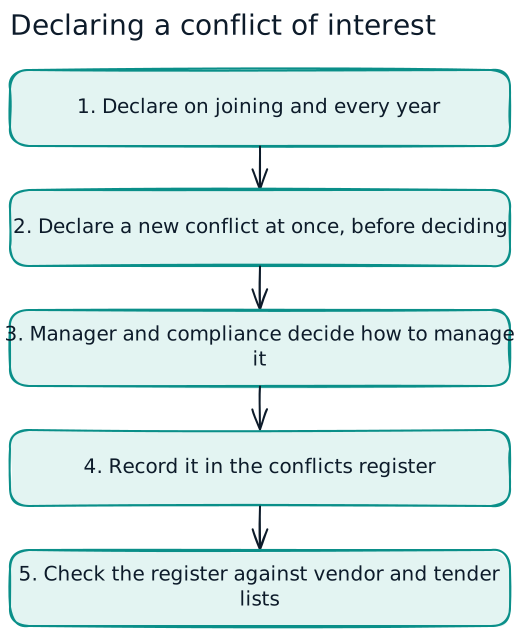
A simple process that works in most organisations:
- Declare on joining and every year, even if the answer is “nothing to declare”.
- Declare again as soon as a new conflict arises, before taking part in any related decision.
- Review: the line manager and compliance decide how to manage it and record the decision.
- Register: keep all declarations and decisions in one conflicts register.
- Check: compare the register with vendor master data, tender committee lists and payroll from time to time.
A conflict of interest declaration form should ask for:
- name, position, department and staff number;
- the type of interest: family, financial, outside employment or directorship, personal relationship, gift or other;
- the person or organisation involved and the relationship to you;
- the decisions, contracts or processes it could affect;
- whether the conflict is actual, potential or perceived;
- a signed statement that the information is complete, and an undertaking to update it;
- the reviewer’s decision, the mitigation agreed, the review date and signatures.
Make declaring easy and non-punitive. People hide conflicts when they fear that declaring will cost them their job. The message should be that a declared conflict is managed, while an undeclared conflict found later is a disciplinary matter.
Practise spotting conflicts
Most people recognise a conflict when it is written down. In real life it arrives as a request from a relative, a friendly supplier or a manager in a hurry. The WorkQuest2U Conflicts of Interest lesson puts staff on a tower office floor in a 3D scene where they face hiring relatives, family in suppliers, side businesses, investments and perceived conflicts, and decide when to declare and step back. Procurement Integrity covers evaluation and bid-rigging, and Gifts, Hospitality & Donations covers gifts that create obligations. For the wider programme, see our anti-bribery training guide.
This guide is general information, not legal advice. For a specific situation, speak to a lawyer or your compliance function.
Practise it in WorkQuest2U
Short 3D lessons where staff walk the scene, spot the issues and make the calls. Free to try, with certificates and progress records for companies.
 Commercial & ContractsConflicts of InterestA tower office floor: hiring relatives, family in suppliers, side businesses, investments, company assets, perceived conflicts and how to declare and step back.
 Ethics & ComplianceProcurement IntegrityA tender office and warehouse: fair specifications, sealed bids, clean evaluations, bid rigging signs, split orders, variations and checking what was delivered.
 Ethics & ComplianceGifts, Hospitality & DonationsFestive hampers, gala dinners, golf days, tenders, officials, sponsorships and donations: when to accept, decline and declare.
 Ethics & ComplianceCode of Conduct & ValuesTour a corporate HQ: integrity, bribery, gifts, conflicts, partners, fair trade, records, respect and speaking up.
 HR Compliance & Respect at WorkSpeak Up & WhistleblowingA quiet room, the speak-up kiosk, a manager's office and the investigation room: when and how to raise concerns, and how reporters are protected.
Frequently asked questions
What are common examples of conflict of interest at work?
Is having a conflict of interest illegal?
What should a conflict of interest declaration form include?
How often should employees declare conflicts of interest?
Do directors have a legal duty to declare conflicts?
Sources
- Malaysian Anti-Corruption Commission Act 2009 (Act 694), ss 3, 23, 24 (reprint as amended to 2018)
- Guidelines on Adequate Procedures, Prime Minister’s Department (4 Dec 2018)
- Public Officers (Conduct and Discipline) Regulations 1993, AGC online version 2025, reg 4
- Skrine: Bursa Malaysia amends Listing Requirements on conflict of interest (May 2023, law-firm summary)
- Thomas Philip: Director’s duty to disclose interest, Companies Act 2016 s221 (law-firm summary)
- Companies Act 2016 s222, annotated text (Foundingbird)
This guide is general information for workplaces in Malaysia, checked against the sources above on 30 October 2026. It is not legal advice; laws and guidelines change, so confirm the current text before you act.