Competition Act 2010 Malaysia: cartels, bid rigging, dominance and penalties
The Competition Act 2010 bans agreements between businesses that significantly prevent, restrict or distort competition in Malaysia, and bans abuse of a dominant position. The Malaysia Competition Commission (MyCC) can fine an enterprise up to 10% of its worldwide turnover for the period of the infringement.

What the Competition Act 2010 covers
The Competition Act 2010 (Act 712) received Royal Assent on 2 June 2010 and came into force on 1 January 2012, after an 18-month grace period. It applies to any commercial activity in Malaysia, and to commercial activity outside Malaysia that has an effect on competition in a Malaysian market (section 3). It is enforced by the Malaysia Competition Commission (MyCC), set up under the Competition Commission Act 2010.
The Act has two main prohibitions:
- Anti-competitive agreements (section 4): horizontal agreements between competitors and vertical agreements along the supply chain.
- Abuse of a dominant position (section 10).
Some sectors regulated under their own laws are excluded by the First Schedule, which in the 2016 reprint lists the Communications and Multimedia Act 1998, the Energy Commission Act 2001, upstream petroleum activities and the Malaysian Aviation Commission Act 2015. Activities in the exercise of government authority are also outside the Act.
“Agreement” is wide. It covers any contract, arrangement or understanding, written or not and whether or not legally enforceable, and includes decisions by an association and concerted practices. An exchange of e-mails or a nod at a lunch can be enough.
Prohibited agreements: price fixing, market sharing and bid rigging
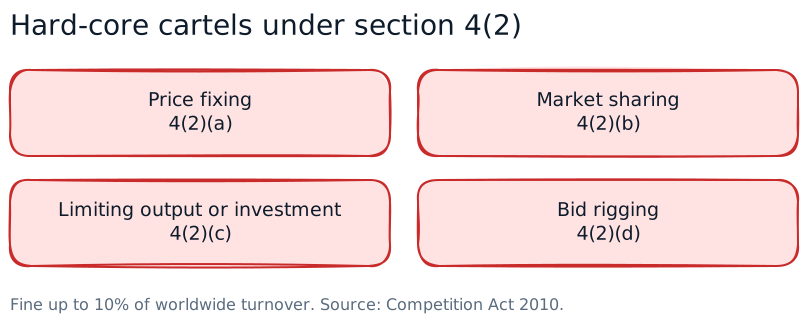
Section 4(1) bans agreements that have the object or effect of significantly preventing, restricting or distorting competition. Section 4(2) goes further: a horizontal agreement between competitors with any of the following objects is deemed to have that anti-competitive object:
| Conduct | Section | What it looks like |
|---|---|---|
| Price fixing | 4(2)(a) | Agreeing selling or purchase prices, discounts, surcharges or other trading conditions, directly or indirectly. |
| Market sharing | 4(2)(b) | Dividing customers, territories or sources of supply between competitors. |
| Limiting output or investment | 4(2)(c) | Agreeing to limit production, market access, technical development or investment. |
| Bid rigging | 4(2)(d) | Agreeing who will win a tender: cover pricing, bid rotation, bid suppression or submitting non-conforming bids. |
For these “hard-core” agreements, MyCC does not need to show actual harm to the market. Other agreements, such as some vertical arrangements, are judged on their effects. Section 5 allows a business to escape liability if it can show significant technological, efficiency or social benefits that could not be achieved otherwise and that are proportionate to the harm, without eliminating competition.
Bid rigging is the risk most staff meet in practice. MyCC’s business guide tells businesses not to share bid prices, not to submit “cover” prices that are not meant to win, not to agree to withdraw or not bid, and not to take turns to win. Each bid decision must be made independently.
Abuse of a dominant position
Being big is not illegal. Section 10 bans abusing a dominant position. A dominant position means significant market power to adjust prices, output or trading terms without effective constraint from competitors. MyCC’s guidelines say a market share above 60% would generally indicate dominance, but market share is not the only factor.
Examples of abuse listed in section 10(2) include:
- imposing unfair purchase or selling prices or trading conditions;
- refusing to supply a particular business or group of businesses;
- applying different conditions to equivalent transactions in a way that harms competitors or competition;
- tying a contract to unrelated supplementary conditions;
- predatory behaviour, such as pricing below cost to drive out a rival; and
- buying up scarce inputs a competitor needs without a commercial reason.
A dominant business may still take steps with a reasonable commercial justification, such as meeting competition.
Penalties, leniency and private claims
| Consequence | Detail |
|---|---|
| Cease and directions (s40(1)) | MyCC must require the infringement to stop immediately and may direct steps to end it. |
| Financial penalty (s40(4)) | Up to 10% of the worldwide turnover of the enterprise over the period of the infringement. |
| Leniency (s41) | Up to 100% reduction for an enterprise that admits involvement in a section 4(2) cartel and gives information or cooperation that significantly helps MyCC. The reduction can depend on whether it was first to come forward and how early it cooperated. |
| Private action (s64) | Anyone who suffers loss directly from an infringement can sue the enterprises involved, whether or not they dealt with them directly. |
| Offences (s61) | Offences under the Act with no specific penalty, such as obstructing an investigation, carry fines of up to RM5 million for a company (RM10 million for a repeat), and for individuals up to RM1 million or five years in prison, or both. |
The leniency regime rewards speed. If your business discovers that staff have been part of a cartel, take legal advice immediately. Being first to approach MyCC can make the difference between a full and a partial reduction.
Trade associations and meetings with competitors
Trade associations are legitimate and useful, but they bring competitors into one room. The definition of agreement includes decisions of an association, so an association’s rules, recommendations, codes of conduct, certification schemes and standard terms can all breach the Act. MyCC’s first decision under the Act found that a floriculturist association had fixed prices after its president announced a 10% increase in flower prices.
MyCC’s guidance warns that just being present at a meeting where an anti-competitive decision is made may be enough to be implicated. Practical rules for staff who attend:
- Insist on a written agenda and minutes.
- Never discuss your prices, price increases, margins, discounts, bids, customers, capacity or future plans.
- If the talk turns that way, object, ask for your objection to be minuted, leave and tell your legal or compliance team.
- Share benchmarking data only through an independent party, aggregated and historical, after legal review.
- Be careful with informal channels such as dinners and messaging groups; they count too.
The 2026 amendments and merger control
The Competition (Amendment) Bill 2026 and the Competition Commission (Amendment) Bill 2026 were tabled in June 2026. The Dewan Rakyat passed them in early July 2026, and Bernama reported that the Dewan Negara passed the competition bill on 27 July 2026. The 35-clause bill addresses gaps in investigation powers, market reviews, settlements and undertakings, MyCC decision-making procedures and the Competition Appeal Tribunal.
The bill does not introduce a general merger control regime. The government has said one will come later within the 13th Malaysia Plan period (2026 to 2030). Sector-specific merger rules still apply in communications, under the Communications and Multimedia Act 1998, and in aviation.
We could not confirm the date the amendments come into force at the time of review. Check the Federal Gazette and MyCC announcements before relying on specific new powers.
Building a competition compliance programme
- Map the risk. Which staff talk to competitors (sales, procurement, business development, association representatives)? Which tenders do you bid for alongside rivals?
- Write the rules down. A short competition policy with clear dos and don’ts, a trade association protocol and a rule that every bid price is set independently.
- Train the people at risk. Sales and tender teams first, then managers. Repeat yearly.
- Give a reporting route. Staff who see collusion should be able to report it through your whistleblowing channel.
- Review contracts. Check distribution, exclusivity and resale price clauses with a lawyer.
In the WorkQuest2U Competition Law lesson, learners move through a 3D industry conference and office and decide how to respond to price talk, information swaps and association proposals. Procurement Integrity covers bid rigging signs from the buyer’s side. These lessons build awareness; they are not legal advice.
This guide is general information, not legal advice. For a specific issue, speak to a competition lawyer.
Practise it in WorkQuest2U
Short 3D lessons where staff walk the scene, spot the issues and make the calls. Free to try, with certificates and progress records for companies.
 Commercial & ContractsCompetition LawAn industry conference and our own offices: cartels, information exchange, trade associations, abuse of dominance and dawn raids.
 Ethics & ComplianceProcurement IntegrityA tender office and warehouse: fair specifications, sealed bids, clean evaluations, bid rigging signs, split orders, variations and checking what was delivered.
 Ethics & ComplianceCode of Conduct & ValuesTour a corporate HQ: integrity, bribery, gifts, conflicts, partners, fair trade, records, respect and speaking up.
 Commercial & ContractsAnti-Bribery & CorruptionA town block at dusk: the MACC Act, s17A corporate liability, officials, facilitation payments, agents, red flags and reporting.
Frequently asked questions
What is the maximum penalty under the Competition Act 2010?
Is bid rigging illegal in Malaysia?
Does Malaysia have merger control?
What is the MyCC leniency regime?
Can a trade association break competition law?
Does the Competition Act apply to foreign companies?
Sources
- Competition Act 2010 (Act 712), reprint as at 15 Aug 2016, MyCC
- MyCC: Competition Act 2010, A Guide for Business
- Bernama: Senate passes Competition (Amendment) Bill 2026 (27 Jul 2026)
This guide is general information for workplaces in Malaysia, checked against the sources above on 30 October 2026. It is not legal advice; laws and guidelines change, so confirm the current text before you act.